
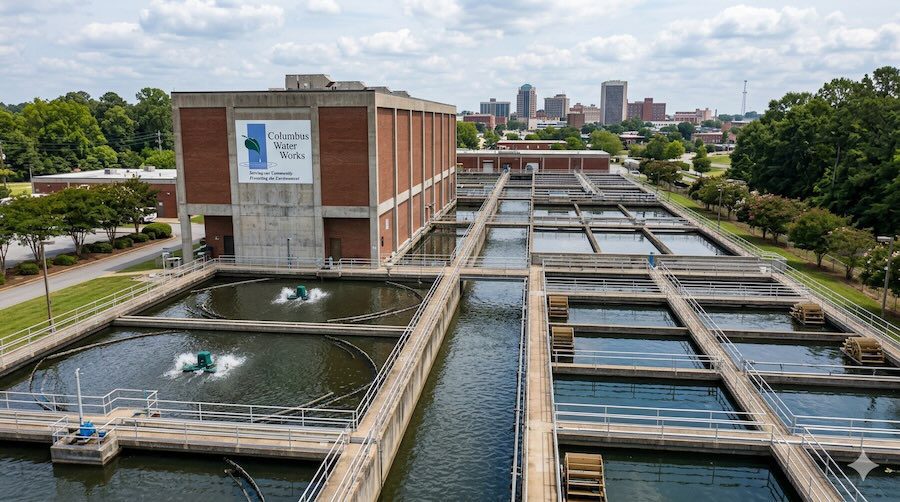

Detected PFAS levels reach 8.5x federal safety limit, triggering $200M in immediate filtration costs.
By MediaShotsUSA Staff
Columbus, GA — May 2026
By The Numbers
33.9 ppt — Highest PFOA level detected in Columbus water samples
4.0 ppt — New federal safety limit set by the EPA
$200 Million — Cost for PFAS-specific filtration at North Columbus and Ft. Benning facilities
$750 Million — Total water and wastewater system investment required by 2031
$7–$9/month — Estimated increase to the average residential water bill
Columbus residents are facing a dual challenge as the city enters a transformative era for its public utilities: a looming public health concern and the staggering financial reality of 21st-century water treatment. As of early 2026, data reveals that the city’s drinking water contains “forever chemicals” at levels significantly higher than new federal safety thresholds.
Per- and polyfluoroalkyl substances, known as PFAS, have become the central focus of Columbus Water Works (CWW). According to the EPA’s Fifth Unregulated Contaminant Monitoring Rule (UCMR 5) data, PFOA concentrations in the Columbus system have been recorded as high as 33.9 parts per trillion (ppt). While the city remains in legal compliance during a federal grace period, this figure is nearly nine times the EPA’s new health-based limit of 4.0 ppt.
The solution comes with a high price tag. CWW has documented a $200 million roadmap to install advanced Granular Activated Carbon (GAC) filtration. This includes a $150 million upgrade to the North Columbus Water Resources Facility and a $50 million project at the Fort Benning plant. These upgrades are essential to capturing the microscopic chemical chains that traditional treatment methods miss.
However, the PFAS crisis is only one component of a larger infrastructure reckoning. By 2031, Columbus is projected to spend a total of $750 million on its water and wastewater systems. This includes a separate $250 million effort to modernize wastewater treatment facilities—some dating back to 1964—to protect the Chattahoochee River from excessive nutrient runoff.
The financial burden is already being felt by local households. A 4.95% rate increase and a new “Regulatory Compliance Fee” took effect on January 1, 2026. Officials estimate the average residential bill will climb by $7 to $9 per month to fund these initiatives.
While the EPA has provided a timeline until 2031 for full compliance, the local urgency is clear. For a city built on the banks of a historic river, the mission has shifted from simply providing water to engineering its way out of a chemical legacy that is proving as durable as it is expensive.
Sources
- Columbus Water Works (2025). 2025 Water Quality Report (Consumer Confidence Report). Confirms PFOA detections ranging from 4.2 to 33.9 ppt.
- Columbus Water Works (2025). Planning Today for a Better Tomorrow: 2025 Annual Report. Documents the $50 million estimate for the Fort Benning facility, the $150 million estimate for the North Columbus facility, and the broader $750 million wastewater solution.
- U.S. Environmental Protection Agency (2024). Final PFAS National Primary Drinking Water Regulation. Established April 10, 2024. Sets the legally enforceable Maximum Contaminant Level (MCL) for PFOA and PFOS at 4.0 parts per trillion (ppt).
- U.S. Environmental Protection Agency (2023–2026). Fifth Unregulated Contaminant Monitoring Rule (UCMR 5) Data Finder. Raw dataset monitoring 29 PFAS compounds across public water systems, including Columbus, GA readings.
- Columbus Water Works (2026). 2026 CWW Rate Increase Bulletin. Details the 4.95% rate increase and the monthly Regulatory Compliance Fee ($5.00 for residential homes) effective January 1, 2026.
