
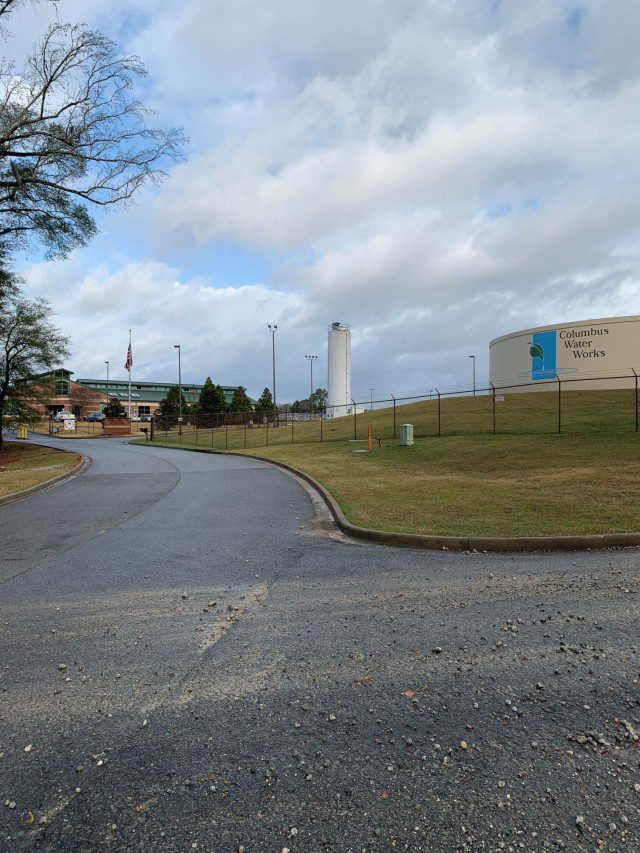

Annual Consumer Confidence Report covering 2024 reveals PFOA detections as high as 33.9 parts per trillion and PFOS exceedances on both regulated and unregulated testing tables — even as the utility highlights “zero drinking water violations” in its 120-year history
COLUMBUS, Ga. — Columbus Water Works’ newly released 2025 Water Quality Report describes a utility that has never had a drinking water violation in more than 120 years of service. On the same pages, it documents PFOA concentrations in finished tap water as high as 33.9 parts per trillion — more than eight times the federal Maximum Contaminant Level of 4 parts per trillion that the Environmental Protection Agency finalized in April 2024.
Both statements are technically accurate. The new federal PFAS limits are not yet enforceable, and water utilities have until 2029 — recently extended by the EPA to 2031 — to meet them. But for households served by CWW’s two treatment plants on the Chattahoochee River, the 23-page Consumer Confidence Report makes plain that the gap between today’s tap water and tomorrow’s legal standard is wider than previous public statements have indicated.
What the report actually shows
The 2025 CCR, which covers calendar-year 2024 testing data, contains two separate PFAS datasets on consecutive pages.
The first table, on page 14, summarizes regulated monthly testing for the six PFAS compounds covered by the new federal rule. PFOA averaged 8.7 ppt across 2024 monthly samples, with a detection range of 1.7 to 20.0 ppt. PFOS averaged 4.7 ppt, with a range of 1.7 to 7.4 ppt. Both compounds carry a federal MCL of 4 ppt and a Maximum Contaminant Level Goal of zero. In the column labeled “Does it meet Standards?” the report enters “No” for both, footnoted to the 2029 compliance deadline.
The second table, on page 15, summarizes Unregulated Contaminant Monitoring Rule data — quarterly samples analyzed by certified independent laboratories under a separate EPA program. The UCMR results are higher across the board. PFOA there averages 11.8 ppt with a detection range of 4.2 to 33.9 ppt. PFOS averages 6.3 ppt with a range of 5.0 to 8.4 ppt. Both again register “No” against the 4-ppt standard. Four additional PFAS compounds — PFBS, PFBA, PFPeA, and PFHxA — were also detected at levels for which the federal government has not yet set enforceable limits.
A third regulated PFAS, PFHxS, averaged 2.0 ppt and the federally defined hazard index for mixtures averaged 0.18, both within their respective standards.
“Zero drinking water violations” — and “No” in the standards column
The document’s cover page features a prominent blue checkmark and the assertion that Columbus Water Works has “had zero drinking water violations in our entire 120+ years of providing water to the community.” The utility’s president, Jeremy Cummings, opens his introductory letter to customers by writing that CWW “continues to meet or exceed all current regulatory requirements and is prepared to meet the upcoming PFAS standards in 2029.”
Both claims are accurate under the existing federal enforcement framework. The PFOA and PFOS limits, while finalized in April 2024, do not become enforceable until 2029 under the original rule, or 2031 under the EPA’s May 2025 extension. Until then, exceedances are reportable but not violations.
That timing nuance, however, sits in tension with what the same report shows on its testing tables — and with the EPA’s own framing of why the new limits exist. When then-EPA Administrator Michael Regan announced the rule in April 2024, he called it “life-changing” and said it had the potential to “prevent tens of thousands of PFAS-related illnesses.” The agency set the MCL at 4 ppt because the underlying Maximum Contaminant Level Goal — the level below which “there is no known or expected risk to health” — is zero.
Why these numbers matter for health
PFAS molecules — per- and polyfluoroalkyl substances — are built around carbon-fluorine bonds, among the strongest in chemistry. They do not break down in the environment. Once ingested, they accumulate in human blood, liver, and kidneys, with elimination half-lives of roughly 3.5 years for PFOA and 5 years for PFOS.
Long-running studies of populations with high occupational or community exposure have linked PFAS to kidney and testicular cancer, thyroid disease, elevated cholesterol, ulcerative colitis, pregnancy-induced hypertension, and reduced birth weight. Some of the most reproducible findings involve children: those with higher PFAS blood levels mount weaker immune responses to routine childhood vaccines, including tetanus and diphtheria.
The U.S. Agency for Toxic Substances and Disease Registry warns that even low-level chronic exposure adds to a body burden that does not clear quickly. The National Academies of Sciences, Engineering, and Medicine recommended in 2022 that physicians offer PFAS blood testing to patients with likely elevated exposure.
How PFAS reached the Chattahoochee
The watershed has multiple plausible PFAS sources. The most prominent locally is Fort Moore — the U.S. Army installation formerly known as Fort Benning — where decades of firefighter training relied on PFAS-laden aqueous film-forming foam. The Department of Defense has acknowledged that runoff and groundwater plumes from such training sites have reached drinking water systems in dozens of communities nationwide. Engineering firm Freese and Nichols completed an extensive PFAS pilot study at the Fort Benning Water Treatment Plant in partnership with CWW, and that study’s findings have informed the utility’s broader treatment decisions.
The 2025 CCR notes that the source water assessment for the system rates overall contaminant susceptibility as “low” and identifies routine sources of concern — a marina with fuel stations, sewer infrastructure, commercial and industrial areas, lawns, and golf courses — but does not specifically discuss the Fort Benning contribution.
The pilot program is now complete
Earlier statements from CWW described an ongoing pilot evaluating six advanced treatment technologies, with completion targeted for December 2025. The 2025 CCR moves that timeline to past tense. On page 14, the utility states that “in anticipation of the final regulations, CWW completed a pilot project to evaluate and determine which advanced treatment technology is the most effective for removing PFAS. Results are being compiled and will be evaluated to ensure we meet the 2029 deadline.”
The pilot tested reverse osmosis, ion exchange, and multiple configurations of granular activated carbon — the four “Best Available Technologies” identified by the EPA for PFAS removal. According to project documentation from the related Fort Benning study, the team also discovered that some filter media, when placed downstream of the plant’s existing chlorine pretreatment, increased disinfection byproduct concentrations — a finding that has shaped the technology selection.
Vic Burchfield, the senior vice president who has served as CWW’s primary public spokesperson on PFAS, told the Columbus Ledger-Enquirer in earlier reporting that the utility plans to fund full-scale construction through Georgia Environmental Finance Authority loans and municipal bonds, with costs reflected in incremental rate increases averaging under 4% per year rather than a single sharp increase.
The utility has not publicly announced which of the six tested technologies it will install, or provided a public cost estimate. Two to three years of design and construction following pilot completion would put a full PFAS treatment system online around 2028 — three years before the federal compliance deadline as currently extended.
Other findings worth noting
The 2025 CCR documents elevated levels of two other regulated contaminant classes that, while compliant with current standards, sit close to legal limits. Total Trihalomethanes — a class of disinfection byproducts associated with cancer risk — averaged 65 parts per billion against an MCL of 80 ppb, with a detection range of 23 to 83 ppb. Haloacetic Acids, another disinfection byproduct class, averaged 49 ppb against an MCL of 60 ppb, with a range of 27 to 59 ppb. Both are common in chlorinated surface-water systems but are at the upper end of typical municipal averages.
The utility completed its lead service line inventory in 2024, identifying no lead service lines or laterals in either the Columbus or Fort Benning systems. Of 50 home tap samples drawn during the most recent triennial lead-and-copper testing in 2022, however, one returned a result of 350 ppb — more than 23 times the 15 ppb action level. That site was treated as an outlier reflecting the home’s internal plumbing rather than CWW infrastructure, and the utility met the regulatory requirement that 90% of samples fall below the action level.
A federal regulatory floor that recently moved
While CWW has been preparing to comply, the federal PFAS regulatory landscape has shifted. In May 2025, the EPA announced it would keep the 4 ppt limits for PFOA and PFOS but extend the compliance deadline from 2029 to 2031. In September 2025, the agency moved to rescind the limits previously set for four other PFAS compounds — PFNA, PFHxS, GenX, and a hazard index for mixtures. A formal rule revision is expected to be finalized in spring 2026.
For Columbus, the practical effect is mixed. The utility now has additional time before federal enforcement attaches, but the underlying readings — and the public health concerns motivating the rule — have not changed.
What the report tells residents
The 2025 CCR closes with a note that PFAS compounds “are collected and tested monthly as part of our regular water quality testing” and directs readers to www.cwwga.org for additional information. Amy Gamble-Coker, CWW’s Manager of Environmental Services, is listed as the technical contact for questions about the report or about source water assessment.
For households not willing to wait the three-plus years until plant-level treatment comes online, the path to lower exposure runs through the kitchen tap. (See sidebar.)
SIDEBAR: What Columbus residents can do at the tap right now
The gap between today’s PFAS exposure and a future plant-level fix is at least three years. Households that want to close that gap have several options, listed here from most to least protective. Look for products independently certified by NSF International, the Water Quality Association, or IAPMO — and specifically certified to NSF/ANSI Standard 53 and 401 with PFAS named, or to NSF/ANSI 58 for reverse osmosis. Many widely sold carbon filters do not carry PFAS-specific certification.
Reverse osmosis (RO) under-sink systems — most protective
These push water through a membrane fine enough to block more than 95% of PFAS, including the short-chain variants other technologies miss. Typical installed cost: $200–$700, plus periodic filter and membrane replacement.
- Aquasana SmartFlow RO — among the most fully certified residential systems on the market; tested by WQA to NSF/ANSI 42, 53 (including P473 for PFAS), 58, and 401.
- Waterdrop G3P800 Tankless RO — high-flow tankless system tested to NSF/ANSI 58, 53, and 42; well-reviewed for PFAS reduction in independent lab testing.
Certified carbon-block under-sink and pitcher filters — middle ground
These do not match RO for short-chain PFAS but substantially reduce PFOA and PFOS. They cost less, install easier, and don’t produce a wastewater stream.
- Aquasana Claryum 3-Stage Max Flow (AQ-6300M) — under-sink unit certified to NSF/ANSI 42, 53, and 401.
- Clearly Filtered 3-Stage Under-Sink System — independently tested for 200+ contaminants including PFAS.
- Clearly Filtered Pitcher — for renters or households not ready for an installed system. Note that Brita Elite and standard ZeroWater pitchers are not currently NSF-certified for PFAS specifically; verify the model’s certification page before buying.
What does not work
Boiling concentrates PFAS rather than removing it. Most refrigerator filters are certified for taste and chlorine reduction (NSF/ANSI 42), not for PFAS — check your specific model. And bottled water is not a guaranteed solution; multiple studies have detected PFAS in bottled brands.
Practical advice
If your household includes pregnant women, infants, young children, or anyone undergoing cancer treatment or with a compromised immune system, point-of-use filtration is worth prioritizing now rather than in 2028. The kitchen tap is what matters most — PFAS exposure through bathing and dishwashing is far lower than through ingestion. A single certified under-sink unit at the kitchen sink covers the highest-exposure pathway at the lowest cost.
For independent confirmation of your home’s water quality, services like SimpleLab’s Tap Score or your local cooperative extension office can provide a state-certified-lab analysis for $150–$300.
Reporting drew on Columbus Water Works’ 2025 Water Quality Report (Consumer Confidence Report) covering 2024 testing data, including the introductory letter from CWW President Jeremy Cummings (page 2), the regulated PFAS testing table (page 14), the Unregulated Contaminant Monitoring Rule table (page 15), and the lead and copper supplemental information (page 16). Additional reporting drew on EPA drinking water rule announcements and the April 2024 statement from then-Administrator Michael Regan; previous remarks by CWW Senior Vice President Vic Burchfield reported by the Columbus Ledger-Enquirer and Georgia Public Broadcasting; the Freese and Nichols Fort Benning PFAS pilot study; the U.S. Agency for Toxic Substances and Disease Registry health summaries; peer-reviewed PFAS health research; and NSF International and Water Quality Association product certification listings.
