

URBAN POLICY & DEVELOPMENT
How Columbus could lose its public square without anyone voting on it
By Robert Haven | 706Reports.com
May 27, 2026
Something is changing about the way American cities are built — and most residents don’t notice it happening until it’s already done.
Across the country, as traditional downtowns struggle with safety concerns, neglected infrastructure, and the chaos that comes with genuinely open public space, a new kind of urban development is quietly filling the vacuum. It looks like a city. It feels like a city. But it isn’t one — not in any legal or democratic sense. It’s a private enclave designed to deliver all the charm of a walkable neighborhood with none of the friction that comes from actually sharing space with the public.
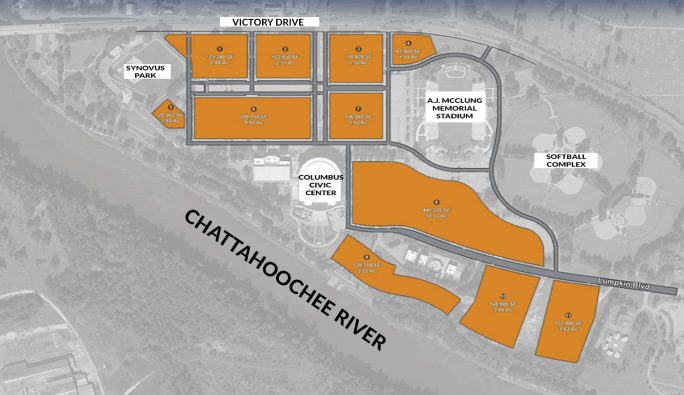
Columbus, Georgia is not immune to this trend. In fact, with South Commons emerging as the city’s most ambitious redevelopment project in a generation — explicitly modeled on The Battery Atlanta — the question is worth asking right now, before the concrete is poured: what kind of city are we building, and for whom?
What a “Vetted City” Actually Looks Like
The modern private enclave doesn’t look like a gated community. It looks like Avalon in Alpharetta — luxury apartments above ground-floor restaurants, manicured green space, corporate offices, and a calendar full of family-friendly events. Or it looks like Hudson Yards in Manhattan, a $25 billion privately developed neighborhood built on a platform over a rail yard, complete with its own parks, its own retail, and its own security apparatus.
What makes these places different from a traditional downtown is not their aesthetics. It’s their legal status. Because the entire district sits on private property, the developers and management companies can enforce rules that no municipal government could ever impose on a real public street.
The tools are already here. License plate readers and facial recognition cameras can flag individuals with prior trespass histories before they reach the sidewalk. App-based entry systems are being piloted in some developments, requiring a digital pass — tied to a hotel booking, a residential lease, or a verified credit card — to enter certain zones during peak hours. And perhaps most powerfully, there’s what urban theorists call the “Code of Conduct loophole”: on a public street, you have a constitutional right to loiter, to protest, to gather. On private property dressed up as a public square, the moment you violate a Code of Conduct — playing music too loudly, gathering in a group larger than four — private security can remove you for trespassing. Legally. No appeal.
The Seduction of the Frictionless Plaza
It would be easy to dismiss these places if they weren’t so genuinely appealing. The honest truth is that for millions of American families — including plenty in Columbus — these private enclaves feel like a relief.
There are no panhandlers. No potholes. No teen takeovers. Security is present but invisible, dressed in polo shirts rather than riot gear, using behavioral analytics software to identify disruptions before they escalate. For people exhausted by the genuine instability of neglected public spaces, walking into a place like this feels like exhaling.
Urban planners call this the “architecture of reassurance” — spaces engineered not just to be safe, but to feel safe. The European-style plaza, the string lights, the dog-friendly patios, the weekend farmers market: every element is curated to produce a specific emotional response. It works. That’s the problem.
The Crisis Outside the Gates
What happens to everyone who doesn’t make the cut?
Historically, the public square has been the place where a city’s social classes are forced into contact with one another. The rich and the poor, the young and the old, the housed and the unhoused — a real city puts them in the same space and asks them to coexist. That friction is uncomfortable. It’s also democracy in its most literal form.
When we privatize that space, we don’t eliminate the friction. We just relocate it. The teenagers excluded from a pristine, vetted entertainment district don’t disappear. They move to the remaining public spaces — the ones already underfunded, already struggling, already politically easier to ignore. Those spaces become more volatile. The case for further private enclosure becomes stronger. The cycle accelerates.
There’s a fiscal dimension to this too. When wealth and commerce concentrate inside a private district, the public infrastructure outside it starves faster. Tax revenue that might have flowed into genuinely public amenities gets captured by a TAD or a private development agreement. The parks, the recreation centers, the community programs that might have given young people somewhere to be — those budgets tighten while the private plaza gets a new fountain.
What This Means for Columbus Right Now
None of this is an argument against developing South Commons. A world-class mixed-use entertainment district anchored by a Double-A baseball stadium could be genuinely transformative for this city — if it’s done right.
But “done right” requires asking uncomfortable questions before the master plan is finalized, not after. Who will have access to the public spaces within the development? What conduct codes will govern behavior in those spaces, and who enforces them? Will the TAD dollars that subsidize the project be matched by equivalent investment in the genuinely public spaces — the parks, the corridors, the neighborhoods — that surround it?
Columbus has a choice that most cities only get once. South Commons is still on paper. The Battery Atlanta model is a blueprint, not a mandate.
The velvet rope city is seductive precisely because it solves a real problem. The chaos of neglected public space is real. The exhaustion of residents is real. The demand for somewhere safe and walkable and alive is real.
But a city that solves those problems by pulling up the drawbridge isn’t really solving them. It’s just deciding who has to live with them.
This is the final installment of a three-part series on Uptown Columbus and the future of public space in Columbus, Georgia. | 706Reports.com
