
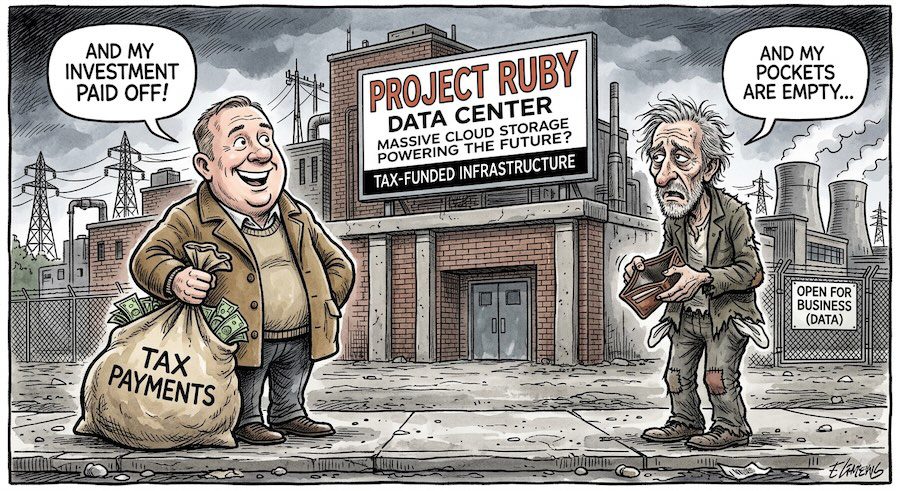

What Columbus Residents Need to Know About the Hidden Financial Risks
A Plain-Language Financial Analysis for the Columbus, Georgia City Council
The Big Picture: Why This Matters to You
When a major tech company proposes building a massive data center in your community, the first headlines are almost always the same: jobs created, tax dollars promised, economic growth guaranteed. Project Ruby is no different.
But buried beneath those promises is a financial story that rarely makes the front page — one that directly affects your property taxes, your utility bills, and the city services your family depends on. This article explains that story in plain language.
The core risk can be summed up in one sentence: Columbus may be locking itself into permanent, rising costs based on tax revenues that could shrink dramatically — and without proper contract protections, ordinary residents will be left paying the difference.
This analysis does not address questions about water use, electricity supply, or environmental impact — those issues are already receiving appropriate attention. What has been largely overlooked is the financial risk to the city’s budget, which is what this article focuses on.
Section 1: How Data Centers Actually Generate Tax Revenue
To understand the risk, you first need to understand how a data center creates money for a city.
Unlike a factory or a retail store — where the building and land hold steady value for decades — a data center’s value is largely tied to the computer hardware packed inside it: thousands of specialized computer chips (called GPUs), server racks, memory modules, and cooling equipment.
This hardware needs to be completely replaced every three to five years just to keep up with modern computing demands. And here’s the critical part: the price of that hardware changes dramatically based on global supply and demand.
A Simple Example
Imagine a data center spends million replacing its hardware during a period of global chip shortages — when chips are scarce and expensive. If Columbus charges a 9% sales tax on that purchase, the city collects $9 million in a single year. Now imagine that global chip manufacturers catch up with demand. Suddenly the same hardware upgrade costs only $50 million. The city now collects just $4.5 million — a 50% drop in revenue — while every city expense stays the same.
This is not a hypothetical scenario. The semiconductor (computer chip) industry is well-documented as running in cycles of boom and bust. History shows it reliably: shortage periods drive prices to extreme highs, then expanded manufacturing floods the market and prices crash. Budget analysts who treat peak-shortage prices as a long-term baseline are building on sand.
Section 2: The Tax Exemption Trap
In many parts of the country — including Georgia — cities offer data center companies a special deal to get them to choose their location: they exempt the company from paying sales tax on all that expensive hardware.
Instead of collecting sales tax at purchase, the city relies on property taxes — annual taxes based on the assessed value of the equipment sitting inside the building.
On the surface, this sounds reasonable. But it contains three serious traps:
| The Problem | What It Means | The Impact |
|---|---|---|
| Fast Depreciation | Computer hardware loses 80–90% of its value within three years. | Property tax revenue drops sharply within a few years, even if nothing else changes. |
| Cheaper Chips = Lower Valuation | Property is assessed based on replacement cost. When chip prices fall, new equipment is assessed at a lower value. | The city collects less property tax even as the building stays busy and profitable. |
| The Investment Cap Delay | Some deals exempt a company until it has spent a set amount (e.g., $500M). When prices are low, companies buy more hardware before reaching that threshold. | The city waits years longer than expected before collecting a single dollar of taxable revenue. |
Section 3: The City’s Costs Only Go Up
Here is the heart of the problem: while tax revenue from a data center can shrink dramatically, the costs a city incurs to support one move in only one direction — upward.
Modern data centers the size of what Project Ruby proposes are extraordinary consumers of public infrastructure. They require:
- Dedicated electrical substations and upgraded power grid connections
- Expanded water lines and wastewater treatment capacity
- Reinforced roads to handle heavy equipment and construction traffic
- Ongoing emergency services coverage (fire, hazmat)
To pay for this infrastructure, cities typically borrow money by issuing municipal bonds — essentially long-term loans that must be repaid on a fixed schedule over 20 or 30 years, regardless of what happens to the economy.
Think of it like taking out a 20-year mortgage on a house because your employer promised you a big raise. If the raise doesn’t come through — or disappears entirely — you still owe the same mortgage payment every month. The bank doesn’t care about your employer’s chip pricing cycle.
If Columbus issues bonds to build infrastructure for Project Ruby based on projected data center tax revenues, and those revenues fall due to a global chip price correction, the city remains legally obligated to make those bond payments. The money to cover the gap has to come from somewhere.
Section 4: The Scissors Effect — When Both Blades Close
Economists describe the combined effect of falling revenue and rising fixed costs as the “Scissors Effect” — like two blades of a scissor closing at once, with the city’s budget caught in between.
| ▼ Blade 1: Falling Revenue | ▲ Blade 2: Rising Costs |
|---|---|
|
|
| Result: Budget shortfall — covered by residents through higher taxes and fees | |
When caught in this squeeze, city governments historically have only a few options — none of them good for residents:
- Raise residential property tax rates to cover the gap
- Increase water and electricity rates for households and small businesses
- Cut funding to public schools, road maintenance, or emergency services
- Take on additional debt, compounding future problems
Section 5: What Smart Cities Do to Protect Themselves
This is not a problem without solutions. Cities that negotiate carefully can capture the genuine economic benefits of a data center while protecting residents from the downside. There are two key protections to insist on:
Protection 1: Guaranteed Minimum Payments
The most effective safeguard is called a Minimum Payment in Lieu of Taxes — or PILOT — clause. This is a contractual guarantee that regardless of what happens to global chip prices or hardware depreciation, the data center operator must pay Columbus a fixed minimum dollar amount every single year.
Think of it as a floor on the city’s income from the deal. Even if the tech industry has a terrible year globally, Columbus is still guaranteed its baseline revenue.
Protection 2: Utility-Based Fees Instead of Hardware-Based Taxes
Data centers consume enormous amounts of electricity and water 24 hours a day, 365 days a year — that never changes, regardless of chip prices. Smart cities recognize this and charge dedicated franchise fees or consumption taxes directly on that electricity and water usage.
Because server power consumption is constant and predictable, these fees provide steady, reliable income that doesn’t fluctuate with global markets. The tech company can’t cut its power consumption when chips get cheap.
These protections don’t reduce Columbus’s ability to attract Project Ruby. They simply ensure that if the deal works for the company, it also reliably works for the city. A well-run company should be comfortable committing to these terms — and if they aren’t, that itself is important information.
Section 6: Questions Columbus Residents Should Be Asking
Before the City Council votes on Project Ruby, Columbus residents deserve clear answers to the following questions:
- Does the proposed agreement include a Minimum Payment in Lieu of Taxes (PILOT) clause? If so, what is the guaranteed annual floor payment?
- Are the city’s financial projections based on current (peak shortage) chip prices, or on normalized, long-term average prices?
- What happens to the city’s bond obligations if hardware tax revenues drop by 50% within three years of the facility opening?
- Are there dedicated utility consumption fees — separate from hardware taxes — that provide stable annual revenue regardless of chip prices?
- What is the total cost of the public infrastructure (roads, water, electrical grid) required to support this facility, and how is that debt structured?
- Is there a clawback provision — requiring the company to repay incentives if it fails to deliver promised jobs or tax revenue?
The Bottom Line
Data centers can be good deals for cities. The technology sector is real, growing, and capable of generating meaningful local revenue. Project Ruby may well be a genuine opportunity for Columbus.
But the history of municipal finance is full of cautionary tales — cities that won the race to attract a company, only to find years later that the costs exceeded the benefits, and that ordinary residents were left holding the bill.
The goal is not to say no to Project Ruby. The goal is to make sure that if Columbus says yes, it does so with its eyes open and its residents protected — with contract terms that guarantee stable revenue regardless of how global semiconductor markets behave.
The environmental and infrastructure questions are important and are already being debated. But this financial question — whether Columbus can afford the deal it is being offered, not just in boom years but in lean ones too — deserves equal space at the table.
Residents interested in the full financial analysis are encouraged to request a copy of the proposed agreement language from the Columbus City Clerk’s office, and to ask their council members specifically about the PILOT clause and infrastructure bond structure before any vote is taken.
This article draws on independent economic research including published analyses of data center municipal finance, semiconductor supply cycle documentation, and public finance literature. It is intended for general public information purposes.
