
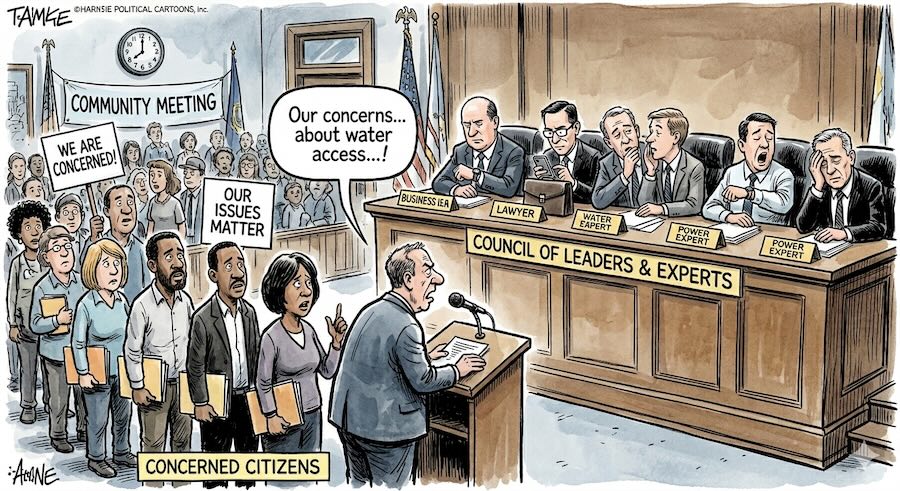

A Plain-Language Analysis of the Unofficial Data Center Overlay Ordinance Review
Prepared for Columbus, Georgia Residents and City Council
The Columbus Chamber of Commerce recently released an 18-page review of the proposed Technology Overlay Ordinance that would enable Project Ruby and future data centers in Columbus. The committee that produced it included engineers, architects, utility representatives, and business leaders. They met five times, consulted subject-matter experts, and produced a document that is detailed and professionally written.
An independent analysis of that document — drawing on published research, PSC filings, utility company testimony, and documented data center impacts in comparable communities — found the Chamber report to be thorough on procedure and selective on substance. Its water figures are misleading at hyperscale scale. Its energy framing presents best-case projections as settled facts. Its PFAS conclusion is contradicted by the ordinance’s own list of permitted cooling technologies. Its enforcement tools are weaker than they appear. And it does not address the two largest structural risks at all: the likelihood that one data center attracts many more, and the scale of new fossil fuel generation being built across Georgia to serve this load.
The questions below are organized by topic. They are based on that independent analysis and on publicly available sources including Google, Meta, and Georgia Power filings, PSC docket records, and research from the Southern Environmental Law Center, the Energy and Environment Study Institute, and Grid Strategies. They are not rhetorical. They are the specific questions Columbus residents deserve to have answered — on the record, in public, before the City Council votes.
How to use this document: Each numbered question can be submitted in writing to the Chamber committee, read aloud at a public hearing, or posed directly to your City Council representative. A request for written responses before the second council reading creates a public record regardless of whether the questions are answered.
1. Water — The Numbers Don’t Add Up
The Chamber committee told Columbus residents that Project Ruby would use 88,000 to 330,000 gallons of water per day, calling that figure “less than a thousandth” of the city’s surplus. Independent research tells a very different story. Google’s own public filings show comparable hyperscale sites using 2 to 3.9 million gallons per day. Large hyperscale facilities can consume up to 5 million gallons daily — roughly equivalent to the water needs of a town of 10,000 to 50,000 people. Meta’s Newton County, Georgia campus accounts for approximately 10% of that county’s entire daily water use. After Meta arrived, nine more data center applicants filed in Newton County, some requesting up to 6 million gallons per day each.
The 88,000 to 330,000 gallon figure appears to reflect a single building at early startup — not the full four-building, 600-megawatt campus at full operation. Any councilmember who repeats that number publicly will be in a very difficult position when Phase 2 and Phase 3 water demand becomes public.
1a. The 88,000 to 330,000 gallon figure — does it apply to a single building at startup, or to the full four-building 600 MW campus at full operation? If it is a single building, what is the projected water demand for the complete campus?
1b. Did the committee consult Google’s, Meta’s, or any other hyperscale operator’s published water use disclosures when arriving at this figure? If so, why do those disclosures show numbers one to two orders of magnitude higher than what the committee presented to the public?
1c. Newton County now has nine additional data center applicants requesting up to 6 million gallons per day each, following Meta’s arrival. What framework does Columbus have to prevent the same outcome on the Chattahoochee?
1d. A councilmember who repeats the 330,000 gallon figure publicly will face a difficult position when Phase 2 and Phase 3 water demand becomes public. Does the committee stand behind that number for the full buildout?
2. PFAS — A Contradiction in the Committee’s Own Document
The Chamber committee’s FAQ states: “PFAS is not a known component of data center cooling chemistry.” The proposed ordinance simultaneously lists immersion cooling as an explicitly permitted technology. Those two statements cannot both be true.
Two-phase immersion cooling systems — including products from Chemours (Opteon) and, until recently, 3M (Novec, now discontinued due to PFAS concerns) — are well-documented PFAS-based cooling solutions. They use fluorinated dielectric fluids to transfer heat. They are closed-loop. They are not evaporative. And under the ordinance as written, they are permitted.
The industry is actively moving away from PFAS-based cooling fluids. Vendors like Submer and Perstorp now market “PFAS-free” immersion fluids specifically as a competitive selling point — which makes sense only if the alternative they’re competing against contains PFAS. The correct answer is that PFAS risk depends entirely on which fluid an operator selects. The ordinance should require fluid identification at permitting — before the facility is built — not at the point of sewer discharge after the facility is already operating.
2a. The ordinance permits immersion cooling. Two-phase immersion cooling historically uses PFAS-based dielectric fluids including Chemours Opteon and the now-discontinued 3M Novec line. How can the committee simultaneously permit immersion cooling and assert that PFAS is not a component of data center cooling chemistry?
2b. Did the committee consult any cooling systems engineer or chemical engineer when making the PFAS determination? If not, on what basis was that claim made?
2c. Why does the ordinance require disclosure of cooling chemistry only at the point of sewer discharge — after the facility is built and operating — rather than at the permitting stage, before construction begins?
2d. Would the committee support adding language to the ordinance requiring fluid identification at permitting, specifically prohibiting fluorinated fluids and PFAS compounds regardless of cooling system architecture?
3. Energy Costs — Best Case Presented as Base Case
The committee presented Georgia Power’s projected $102 per year residential savings as if it were a delivered, guaranteed benefit. It is not. That figure comes from a December 2025 stipulated agreement and depends on actual large load contracts materializing through 2031. After 2031, the backstop expires.
Consumer advocates in the same PSC docket placed a very different number on the record: if data center demand doesn’t materialize at the levels Georgia Power has forecast, overbuilding could raise rates by approximately $3.4 billion — roughly $20 per month per household — once the 2031 protection expires. The committee presented neither this number nor the conditions that determine which scenario plays out.
Additionally, Georgia Power testified under cross-examination in 2025 that it had not yet signed any new large load data center customers that year — even as it sought certification for nearly 10 gigawatts of new generation. And Grid Strategies’ November 2025 national analysis estimated that utility load forecasts may overstate 2030 data center demand by roughly 25 gigawatts, or about 40 percent. None of this appeared in the committee’s document.
3a. The $102 per year savings figure is projected, not delivered, and depends on the 2031 backstop remaining in effect. What happens to residential rates after 2031 if data center contracts don’t materialize at the levels Georgia Power has forecast?
3b. Consumer advocates placed a $3.4 billion ratepayer exposure on the record in the December 2025 PSC docket if the generation buildout exceeds actual demand. Did the committee review that filing? If so, why was it not disclosed to the public?
3c. Georgia Power testified under cross-examination in 2025 that it had not signed any new large load data center customers that year, even as it sought certification for nearly 10 gigawatts of new generation. How does the committee reconcile that testimony with its presentation of the PSC rate structure as a reliable protection for ratepayers?
3d. Grid Strategies’ November 2025 national analysis estimated that utility load forecasts may overstate 2030 data center demand by roughly 40 percent. Did the committee consider that estimate when evaluating the stability of Georgia Power’s rate projections?
4. The Generation Buildout — What the Committee Didn’t Mention
This is perhaps the most significant omission in the entire Chamber document. The committee spent considerable space arguing that data center customers pay for their own infrastructure and that residential ratepayers are protected. What it did not mention is what is actually being built across Georgia to serve that load.
In December 2025, the Georgia PSC certified 9,985 megawatts of new energy generation — approximately 80% expected to power data centers — at a construction cost of $16.5 billion. Customers could pay $50 to $60 billion over the cost recovery period. The generation mix includes: five new natural gas combined cycle units at Plants Bowen, McIntosh, and Wansley; coal plants at Scherer and Bowen that were scheduled to retire in 2028 and 2035 being kept online through 2038; Plant Wansley, which was retired as a coal plant in 2022, being rebuilt as a gas facility; and more than 1,500 megawatts of new battery storage. The Southern Environmental Law Center has filed for air permits for six new methane gas burning units connected to this buildout.
On-site diesel backup generators at data center scale have become a regional air quality issue in Northern Virginia, where state regulators are now tightening rules in response to community complaints. The committee’s ordinance addresses generator testing schedules but not cumulative emissions or air permit pathways.
4a. The PSC certified nearly 10 gigawatts of new generation to serve data center load, with $50 to $60 billion in projected customer cost recovery. A Columbus councilmember approving a 600 MW campus is contributing to that buildout. Why does the committee’s document not mention this?
4b. Plant Wansley was retired as a coal plant in 2022 and is being rebuilt as a natural gas facility to serve data center load. Plants Scherer and Bowen, scheduled to retire in 2028 and 2035, are now being kept online through 2038. How does the committee square this with its framing of data centers as a net positive for the energy grid?
4c. On-site diesel backup generators at data center scale have become a regional air quality issue in Northern Virginia, with state regulators tightening rules in response to community complaints. The committee’s ordinance addresses generator testing schedules but not cumulative emissions or air permit pathways. Why was this omitted?
4d. The committee’s document does not describe the scale or fuel mix of the generation being built to serve data center load in Georgia. Was this a deliberate editorial decision, and if so, on what basis?
5. Reclamation Bonding — A Punt, Not a Finding
The committee declined to recommend a reclamation bond — money posted upfront that the city could use to remediate the site if the project is abandoned — because, it said, “no other jurisdiction currently requires a reclamation bond for projects of this size.”
That reasoning does not hold up. Reclamation bonding is routine and legally required practice for quarries, landfills, and power plants at comparable industrial scale. The committee’s alternative assurance — that “utility commitments create layers of protection” — does not withstand scrutiny. Utility commitments run between the developer and Georgia Power. They do not flow to the City of Columbus for site remediation if the operator goes bankrupt or walks away from the project. The city would own the infrastructure and the problem.
5a. Reclamation bonds are standard practice for quarries, landfills, and power plants at industrial scale. On what basis does a $5 billion data center campus warrant less financial assurance for site remediation than those industries?
5b. The committee’s alternative — that utility commitments protect residents — was characterized by independent analysts as hand waving, because those commitments run between the developer and Georgia Power, not to Columbus. Can the committee explain specifically how utility commitments protect Columbus in a project abandonment scenario?
5c. If no other jurisdiction requires a reclamation bond for projects of this size, isn’t that an argument for Columbus to lead rather than follow — particularly given the absence of any PILOT minimum payment agreement or other financial floor?
6. The Megawatt Cap — A Loophole, Not a Safeguard
The ordinance says the Development Agreement “shall address any conditions limiting expansion or megawatt capacity beyond the initial approved scope.” The committee presented this as a meaningful protection.
It is not. “Shall address” is not the same as “shall include a binding cap.” The ordinance leaves the cap entirely to project-specific negotiation — which means the city’s leverage is highest at first approval and drops significantly with every subsequent phase. Project Ruby is already filed in phases: 200 MW, then 600 MW, potentially up to 900 MW. Each phase approval will face a council whose general fund increasingly depends on the tax revenue from earlier phases. That political dynamic — a council voting against its own budget — is the most predictable and least discussed risk in this entire debate.
6a. “Shall address” a megawatt cap is not the same as “shall include” one. Will the committee support changing the ordinance language to require a binding numerical cap as a non-negotiable term of the Development Agreement — not a subject of negotiation?
6b. Project Ruby is filed in phases. Each phase approval will face a council whose general fund increasingly depends on the tax revenue from earlier phases. What structural mechanism in the current ordinance prevents that political lock-in from making Phase 3 and Phase 4 approvals effectively automatic?
6c. Once the city is collecting $70 to $80 million per year in property taxes from Phase 1 and Phase 2, can the committee identify a realistic political scenario in which the council denies Phase 3?
7. Clustering — The Problem the Document Doesn’t Address
The committee acknowledges that it tried not to write an ordinance aimed at one project, and that the rules need to work for any future application. That framing is responsible in principle. In practice, it means the committee wrote a framework optimized for repeated use on this site — without building in any limit on how many times it can be used.
The infrastructure that makes Project Ruby viable — the on-site substation, the high-voltage transmission tie-in, the sewer extension paid for by the developer, the regional fiber that will follow — is precisely what lowers the marginal cost for every subsequent applicant. A site selector evaluating the next Georgia campus in 2027 or 2028 will look at Columbus and see: power available, water available, sewer extended, fiber in place, ordinance already drafted, 60-to-90-day rezoning process. That is a green light.
Newton County, Georgia went from one Meta campus to nine pending applicants in a few years. Some of those applicants are requesting up to 6 million gallons of water per day each. The committee cites the Meta Newton County campus favorably in its document. It never mentions what happened next.
7a. The ordinance acknowledges cumulative impact exactly once — in the section titled “Things We Couldn’t Fully Answer.” Why was a cumulative impact framework not developed as a recommendation?
7b. When the next data center applicant arrives in Columbus citing the existing infrastructure as evidence of feasibility, what mechanism in the current ordinance gives the council a principled basis to say no?
7c. Newton County went from one hyperscale campus to nine pending applicants requesting up to 6 million gallons per day each. The committee cites the Meta Newton County campus favorably. Why was Newton County’s trajectory not used as a planning baseline for what Columbus might face?
7d. The 865-acre Layfield Road site is 85% undeveloped, with infrastructure now running to it. What binding development limits apply to that remaining 85%, and when will those limits be established?
8. Enforcement — Weaker Than It Looks
The committee presented the ordinance’s enforcement tools as meaningful protections. Independent analysis suggests they are largely theoretical against an operator of this scale.
A $1,000 per day fine is rounding error for a $5 billion facility. Certificate of occupancy revocation is a nuclear option that city governments almost never use against a major taxpayer once property tax revenue is flowing — because doing so means voting against the city’s own budget. Civil action requires Columbus to file suit against the outside counsel of Microsoft, Meta, Google, Amazon, or Apple — a legal fight the city has never faced at this scale. Monthly self-sampling review and quarterly inspections require adequate staffing — and the committee never asked where that capacity comes from or how it scales if a second or third campus arrives.
Every concrete provision in the ordinance ultimately routes to the Development Agreement — a document that doesn’t exist yet, that will be negotiated between city staff and hyperscale corporate counsel, with no specification of what resources the city will commit to that negotiation.
8a. A $1,000 per day noise fine is less than two seconds of revenue for a $5 billion facility operating at commercial scale. Did the committee model what fine level would actually create a compliance incentive for an operator of this size?
8b. Certificate of occupancy revocation has been recommended as the ultimate enforcement escalation. Can the committee identify a single case in Georgia in which a municipality revoked the certificate of occupancy of a major industrial taxpayer for noise or environmental violations?
8c. The Development Agreement will be negotiated between Columbus city staff and the outside counsel of a hyperscale operator — likely Microsoft, Meta, Google, Amazon, or Apple. What resources is the city committing to ensure that negotiation is conducted on equal terms?
8d. The enforcement architecture assumes adequate inspection staffing for monthly self-sampling review, quarterly third-party sample analysis, and unannounced inspections. How does that staffing scale if a second or third campus arrives on the same site?
9. Committee Composition — Who Was in the Room
The committee’s membership list is public. It includes representatives from architecture firms, a major construction company that builds data centers professionally, a civil engineering firm, a real estate developer, a credit union, a telecommunications company, and two Georgia Power representatives. Georgia Power profits directly from data center load growth. Brasfield & Gorrie builds data centers.
What the committee did not include: a land use economist, a representative from Harris or Talbot counties whose residents border the site, anyone from a community that has lived through the clustering pattern, an environmental economist, a public health professional, a representative of neighborhoods near the Upatoi site, an independent financial analyst, or a Flint Energies ratepayer. These are not the people most likely to benefit from the project being built.
The committee also declined to answer the urban heat island question — saying no engineer on the panel could verify the figure — rather than conducting a literature review that a group including architects and environmental engineers could have produced in under an hour. And the noise anecdote cited in the document — a committee member who could whisper inside a Meta facility — addresses interior noise. The community complaint has always been about chiller yards, transformer hum, and substation noise at the property line. Those are not the same thing.
9a. Brasfield & Gorrie, which builds data centers professionally, participated as a subject matter expert. Two Georgia Power representatives contributed, and Georgia Power profits directly from data center load growth. How does the committee respond to the characterization that its composition was uniformly supply-side?
9b. No residents from RE-10 tracts adjacent to the proposed site participated. No representatives from Harris or Talbot counties, which border the site, participated. How were the interests of those directly affected parties represented in the committee’s deliberations?
9c. The committee declared the urban heat island question unanswerable. Urban heat island effects from large impervious industrial sites are a published research literature. A committee including architects and environmental engineers could have conducted a literature review in under an hour. Why wasn’t that done?
9d. The Meta facility noise anecdote — a committee member who could whisper inside the building — addresses interior noise. The community complaint has always been about chiller yards, transformer hum, and substation noise at the property line. Why was that distinction not acknowledged?
10. The Question That Matters Most
An independent analysis of the Chamber’s document concluded that it is “a defensible on paper, supply-side product written by the people most likely to benefit from the project being built.” That is a direct and serious characterization of the committee’s work. The committee deserves the opportunity to respond to it on the record — before the council votes, not after.
The specific things the independent analysis said the ordinance still needs, beyond the committee’s recommendations: a hard megawatt cap with no negotiated escape hatch; a reclamation bond comparable to peer industrial uses; a cumulative impact framework that triggers automatically when a second hyperscale applicant arrives; and a fluid identification disclosure requirement at permitting rather than at discharge.
The Overarching Question
Given everything the independent analysis has identified — the water figures, the PFAS gap, the PSC contingencies, the generation buildout, the clustering trajectory, the enforcement weaknesses, and the composition of the committee itself — does the committee believe its recommendations are sufficient to protect Columbus residents if this project underperforms, expands beyond its initial footprint, or attracts additional applicants to the same site?
If the answer is yes, the council deserves to hear the specific mechanism for each risk.
If the answer is no, the council deserves to hear that too.
Columbus residents who want to raise these questions should contact their City Council representative, submit written questions to the Chamber committee through the Columbus City Clerk’s office, and attend public hearings on the Technology Overlay ordinance before any vote is taken.
Sources underlying these questions include: Most Policy Initiative (Data Center Water Use, April 2026); EESI (Data Centers and Water Consumption, June 2025; PFAS Forever Chemical Pollution, April 2026); New York Times (Newton County water reporting, July 2025); Submer and Perstorp PFAS-free cooling fluid documentation; Georgia PSC Data Center Fact Sheet (March 2026); Perkins Coie Georgia PSC analysis (January 2026); Southern Environmental Law Center (July 2026); Grid Strategies National Load Growth Report (November 2025); Utility Dive (Georgia Power IRP, July 2025); Goldwater Institute Data Centers Policy Report (January 2026); Piedmont Environmental Council; Encino Environmental Services (February 2026); Georgia Power PSC filings (July and December 2025). This article is intended for civic information and public engagement purposes.
