

Columbus Water Works is spending about $1.05 billion. Paying that back will cost close to $1.8 billion. A new jail could add $500 million more — and nobody has said what it costs to tear the old one down.
Part two of two: what Columbus owes
Part one looked at what Columbus families earn. This part looks at what they owe.
Columbus is about to spend a great deal of money on things people rarely think about. Water pipes. A sewage plant. A courthouse. A jail.
Someone has to pay for all of it. That someone is you.
Most of these decisions have already been made. Some were voted on months ago.
Your water bill, year by year
Columbus Water Works is running the biggest building program in its history. It plans to spend about $1.05 billion between 2026 and 2032.
Most of that is a rebuild of the sewage treatment plant, which costs $650 million. Another $270 million goes to other planned projects. And $100 million goes to removing PFAS — a group of long-lasting chemicals — from water at Fort Benning.
The utility pays for this with your bill.
In October 2025, it took a plan to City Council. The board approved it in December. The plan does two things.
First, water, sewer and storm charges go up 4.95% every year from 2026 through 2031.
Second, a new charge appeared on every bill in January. It is called the Regulatory Compliance Fee. It starts at $5 a month and rises to $20 a month by 2029.
You already saw the first step. A typical bill went from $55.48 to $63.24 in January.
Follow the utility’s own plan forward, and here is where it lands.
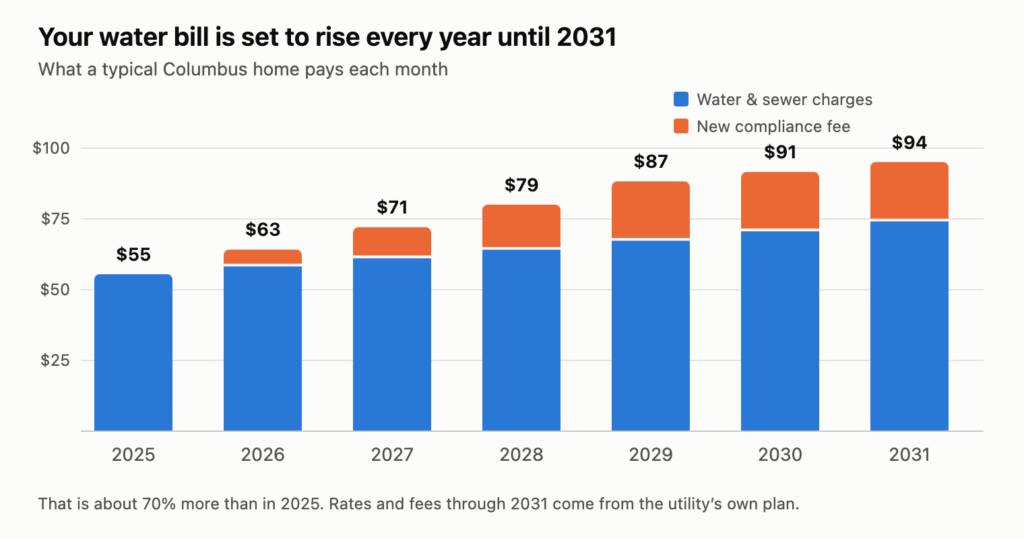
By 2031, a typical bill reaches about $94 a month. That is about $1,130 a year, up from $666 in 2025.
That is a rise of about 70% in six years. Over the same stretch, the typical family income here has not moved at all.
The rate increases and the fee steps come from the utility’s own plan. Adding them up year by year is our arithmetic.
What the borrowing really costs
Here is something the plan does not tell you.
When a city spends $1.05 billion, it does not have $1.05 billion sitting in a drawer. It borrows the money. And borrowed money costs more than it was worth when you got it, because you pay interest on top.
The utility’s plan shows what it will pay on its loans each year. That number climbs sharply.
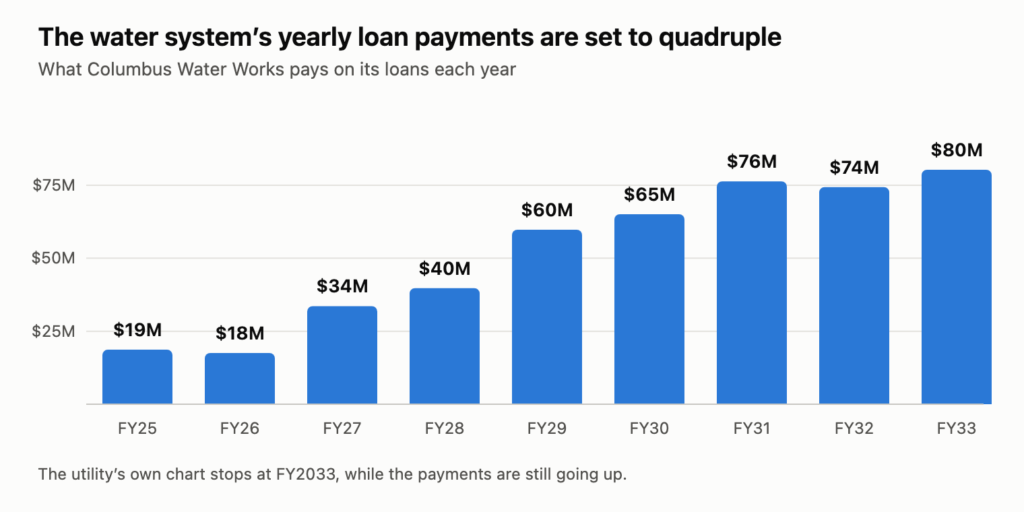
In 2025, loan payments were $18.68 million. By 2033, they reach $80.33 million. That is more than four times as much.
But the plan runs 21 pages, and none of them say how much interest the utility will pay in total. There is no interest rate. There is no loan term. There is no total.
The chart also stops in 2033 — while the payments are still going up. Money borrowed in 2032 will be paid back long after that.
We can work backward from the utility’s own numbers. By 2033, about $65 million a year goes to the new loans. Payments that size on $1.05 billion point to a loan of 25 to 30 years at about 4% to 4.5% interest.
If that is right, the real cost is closer to $1.8 billion.
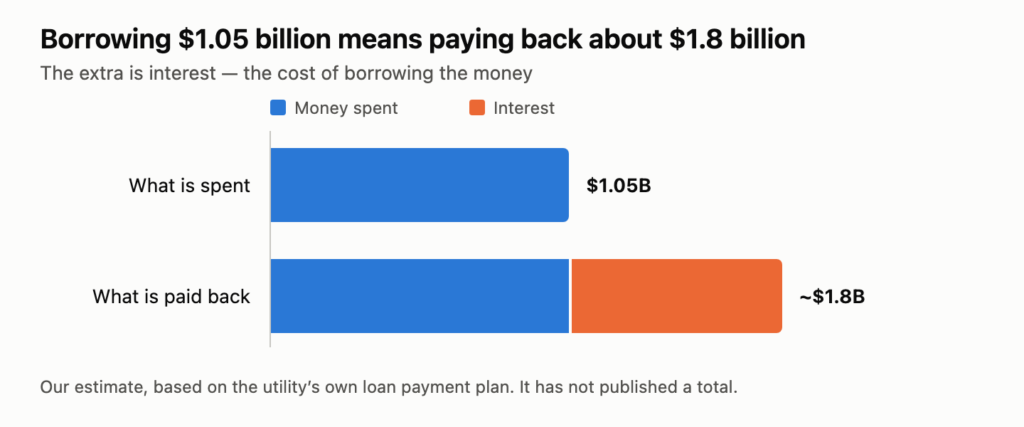
The extra — somewhere between $650 million and $900 million — is interest.
That figure is ours, not the utility’s, and it could be lower. Some of the money comes from a state loan program that charges below-market rates. Some of the work is paid in cash instead of borrowed. Both would bring the number down.
The exact figure is not really the point. The point is that a program described everywhere as $1.05 billion will cost ratepayers a good deal more, and no page in the document shown to Council says so.
The jail, and the number nobody has given
The city is planning a new jail with 1,600 beds. The estimate is $500 million. A new courthouse, already going up, costs $207.5 million.
Nobody has said how the jail will be paid for. Until that is decided, there is no way to know what the interest on it will be either.
And there is a second gap.
No public figure has been offered for tearing down the existing jail. It has not even been said whether that work is inside the $500 million or on top of it.
That is unlikely to be a small amount. Jails are built to be hard to break — thick concrete, heavy steel, secure fittings. The same things that make them hard to break out of make them expensive to take down. Old buildings usually need to be checked and cleared of hazardous material first. And the work has to be done while the site stays secure, right up until the new jail opens.
So of the roughly $1.76 billion Columbus has committed, the jail is the one line where the public has been given a price without being told what the price covers.
Is any of this unfair?
It is worth saying plainly: Columbus water is cheap.
A typical bill here was $55.48. The Georgia benchmark is $62.49. The regional average is $68.08. The national average is $74.19.
In a comparison of 22 Georgia utilities, Columbus came 14th at about $60. Atlanta was $95. Gwinnett County was $73.
The utility also points out that water rates across the industry have gone up more than 5% a year since 2010. Its own increases have usually been under 4%.
So a fair reading is that Columbus has been paying less than most places, and is now catching up. The sewage plant is old. The PFAS rules come from the federal government. This is not spending the utility chose for fun.
That does not make the bills easier to pay. It just explains them.
The help available is small
Columbus Water Works runs a program for households with low incomes. It takes $10.50 a month off the bill and waives the new compliance fee. Together that is worth $15.50 a month.
288 customers are enrolled.
There are roughly 81,400 households in Columbus.
What is not in the report
The Columbus State University report in part one measured what families earn. It measured pay, jobs, rent and home prices.
It did not look at any of this.
Its housing gap compares income to a home loan payment. It does not include the water bill, the courthouse, the jail, or the interest on any of them.
Add those, and the squeeze on Columbus families is tighter than that report shows. And unlike home prices, most of this has already been voted on.
Three questions worth asking
One. Does the $500 million jail estimate include tearing down the old jail? If not, what does that cost?
Two. How will the jail be paid for, and what will the interest add?
Three. What is the total cost of the water program, including all interest, over the full life of the loans?
None of these are hard questions. They just have not been answered.
Sources: Columbus Water Works 2026 Rate Update, presented to Columbus Council October 28, 2025, prepared with Raftelis; board approval December 8, 2025. 2026 Columbus Economy Report, Butler Center for Research and Economic Development, Columbus State University, January 2026. Repayment and interest estimates are 706report calculations based on the utility’s published debt service forecast.
