

Fort Benning · Part two of two
Part one asked who says yes to the reactors coming to Fort Benning. The answer was the Army, which is also the customer. This part asks a simpler question: why spend this much on this little?
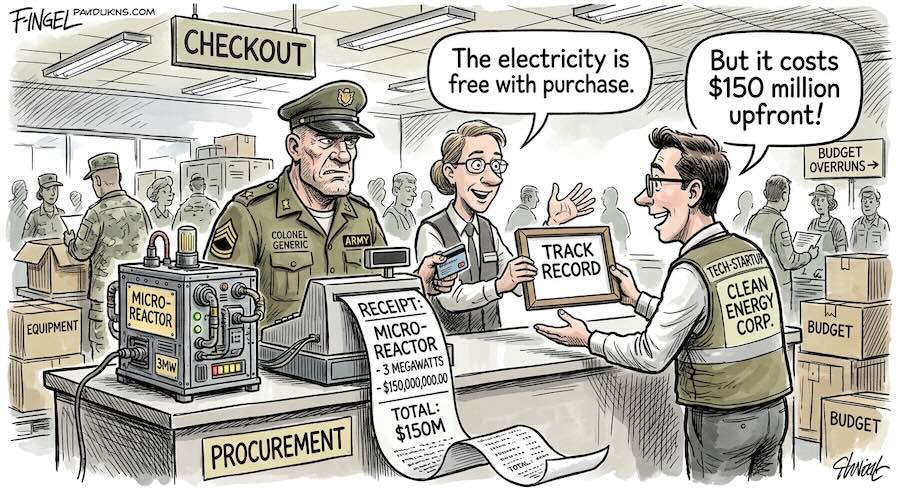
The short answer. The Army is not really buying electricity. It is buying an operating record for a new industry. The company says so out loud.
The price
Radiant Industries has an award worth up to $750 million. For that it will build 15 reactors by 2030. Each one makes one megawatt.
That works out to about $50 million for each megawatt. A megawatt runs about 1,000 homes.
Three of those reactors are coming to Fort Benning. The Army has already said they will not power the post. They are backup for a few important buildings.
As a way to buy electricity, that is very hard to defend. Diesel generators already work, and Columbus is not hard to deliver fuel to. Hold that thought. There is an answer, and it comes at the end.
How the money moves
The Army is not buying reactors. It will not own them. The company will build them, own them, and run them.
The Army pays as the company hits milestones. The contract type is called Other Transaction Authority, or OTA. It sits outside the normal government purchasing rules. It is legal, it is common for new technology, and its whole point is speed. The Army says it copied the idea from NASA, which paid SpaceX by milestone to build rockets NASA did not own.
Three details are worth writing down.
- The Army will not say how the $2.2 billion splits among the five companies.
- It says it may move money between companies. That can happen without a new competition.
- The contract itself is not public.
A pattern, not a scandal. None of this is improper. But it is the third time in this story that the faster of two legal routes was chosen. A nuclear license became an Army permit. An environmental study may become a shortcut. Normal purchasing became OTA. Each one has less outside review than the road not taken.
The company
Radiant was started in 2020 by Doug Bernauer, an engineer who worked at SpaceX on power for a future Mars base. That is not a knock. It explains the design.
The reactor is called Kaleidos. It makes one megawatt of electricity and 3.5 megawatts of heat. It is cooled by helium, not water. It fits in a shipping container. It needs no digging and no cooling water. The company says it can be dropped off and plugged in within a day.
Money has come fast. Radiant raised $100 million in late 2024. It raised another $350 million by early 2026, which valued the company at more than $1.8 billion. It is building a factory in Oak Ridge, Tennessee.
So the Army’s award, up to $750 million, is bigger than everything Radiant has raised from investors. This is not one customer among many. For this company, it is the business.
The diesel math does not add up
The best argument for paying more is fuel. Diesel has to be trucked in and stored. A sealed reactor does not.
Radiant puts a number on it. Each reactor, it says, replaces about 1.8 million gallons of diesel a year.
That number does not match the size of the reactor, and it is worth showing the work. One megawatt running all year makes 8,760 megawatt-hours of electricity. A normal generator makes about 13.5 kilowatt-hours from a gallon of diesel. That comes to roughly 650,000 gallons. Not 1.8 million.
There are fair explanations. The reactor also makes 3.5 megawatts of heat, and a number based on heat instead of electricity would land much closer. The comparison might also be against a bigger set of generators, or against what it costs to haul fuel to a war zone, which is a far larger number than the fuel itself.
Radiant has not published how it got there. Until it does, treat 1.8 million as a claim, not a measurement. It is a fair question to ask, and it has an easy answer if the math is good.

The reactor has not run yet
This is the plainest fact in the story, and almost nobody locally has mentioned it.
No Kaleidos has ever run at full power. The first one is being tested now. Radiant got its first load of nuclear fuel in July 2026, delivered to a test building at Idaho National Laboratory. Full-power testing follows.
Radiant says it will deliver to customers in 2028. The President’s order says an Army reactor has to be running somewhere by September 30, 2028.
From first fuel to a working reactor in Columbus
About two years from the first full-power test of a brand new design to a working installation.
A short runway. It is not a criticism to say a first-of-its-kind machine is a first-of-its-kind machine. It is a reason the review process matters more here than it would for the hundredth one. Part one explained why that review is happening out of public view.
There is not enough fuel
These reactors run on a fuel called HALEU. It is uranium enriched to between 5 and 20 percent. Normal reactor fuel is under 5 percent. Weapons-grade is above 90 percent. So HALEU is stronger than normal fuel and nowhere near a weapon.
The problem is not what it is. The problem is that America barely makes any.
Congress ordered the Energy Department to have 21 metric tons of it ready by June 30, 2026. The only plant making it in this country is in Piketon, Ohio. Its contract rate is about 900 kilograms a year.
What Congress ordered, and what one plant makes
The rest has to come from uranium the government already has in storage. The Energy Department has pointed to federal sites in Tennessee, South Carolina and Idaho. It expects commercial plants to catch up around 2027.
Nine hundred against twenty-one thousand. A contract for 15 reactors is not a promise of fuel for 15 reactors. Radiant has been given two allocations from the government’s limited supply. The second, in July 2026, was tied to putting a reactor on a military base. Where Fort Benning’s fuel actually comes from has not been said.
Where the used fuel goes
Jeff Waksman, the Army official in charge, was asked about waste. He gave a clean answer.
These reactors cannot leave radioactive soil behind. That is all part of the agreement that we have with these companies.
Radiant is responsible for loading the fuel, changing it, and storing what comes out.
Both things can be true and still miss the question. The reactor leaves. The used fuel still exists. America has no permanent place to put it. Every bit of used reactor fuel in this country is sitting in a pool or a steel cask, waiting on a decision nobody has made.
The Army’s own draft rulebook is more honest about this than the press conference was. It creates something called a Storage Permit. The permit covers fresh fuel, fuel still inside a shut-down reactor, and used fuel taken out of one. It says the permit is meant for short-term storage. Then it gives an example: storage at the site “prior to transfer to an off-site location.”
The path the paperwork describes
The rule assumes a destination the country has never built.
Not here is not the same as handled. This is a national failure going back forty years, not an Army one. But “no long-term waste on these installations” is a statement about Fort Benning, not about the fuel. The difference belongs on the record.
Security, and a rule nobody finished
Stronger fuel is more worth stealing. That is not alarmism. It is the basis of the government’s own security rules.
Nuclear material is sorted into three security categories. HALEU at the stronger end, in amounts of 10 kilograms or more, falls into the middle category. That is a higher tier than normal power plant fuel.
In 2008 the Nuclear Regulatory Commission started writing a rule about exactly this. It was meant to set protection levels based on how attractive the material would be to steal. The work was stopped in 2018 to save money. It was never finished.
So the rule written to answer this question does not exist, and these reactors arrive sealed and already fueled.
Two things cut the other way. The fuel is TRISO, meaning every grain of uranium is sealed inside ceramic shells that make it hard to use. And an Army post already has security a commercial site does not. Waksman said the requirements there “go beyond what you will often see in the private sector,” and there is no reason to doubt him. The gap is not that Fort Benning is unguarded. It is that the national rule was abandoned eight years ago and nobody restarted it.
The computer question
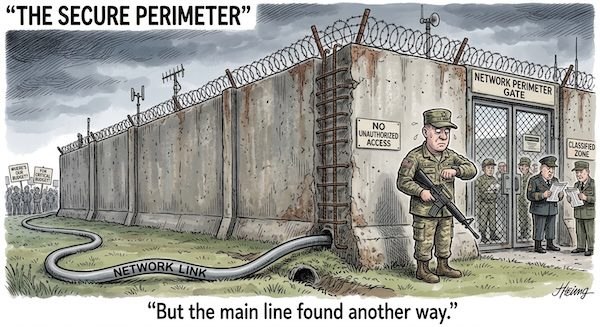
A sealed reactor that arrives ready to plug in is a computer as much as a machine. All the concrete in the world does not help with that.
The Army rulebook you can actually read, from 2016, does not mention cybersecurity once. Not a single time. It was written for research reactors in a different era.
The rewrite fixes it, and thoroughly. The 2025 draft sets out a full cybersecurity program. It was written to match Defense Department rules and, in its own words, to measure up against what the Nuclear Regulatory Commission requires of advanced reactors. It pulls in national standards for computer security, for the control systems that run machinery, for supply chain risk, and for what contractors must report when they are attacked.
That is a serious answer, and anyone worried nobody thought about this should know the work exists.
The catch is the same one as everywhere else in this story. That rulebook is a draft, and the draft is not public. What is actually in force is the 2016 version that says nothing.

What if the company fails?
The Army raised this risk itself. Five companies were picked on purpose, Waksman said, because “there’s a very real chance that one or more of these companies will fail.”
So what happens if the company that owns a fueled reactor at Fort Benning goes under?
For a normal commercial reactor there is a clear answer. Federal rules require the owner to prove, at all times, that the money to clean up and dismantle the reactor will be there. It can be a trust fund, an insurance policy, a bond, or a guarantee from a parent company. The rule exists because owners do fail.
Nothing like that appears in the Army rulebook the public can read.
Two honest caveats. The rulebook is a draft, so the final version may add one. And contracts often carry cleanup and liability terms. That contract is not public, so nobody outside can say.
One detail suggests the question is live. The draft rules require paperwork when there is a “change in permit holder.” The rulebook expects a reactor permit may change hands. Nothing published says who pays if the old owner is gone.
So why buy it?
Go back to the start. Three megawatts, at a price per megawatt that would be steep for a big power plant, at a post where diesel already works.
As a way to buy electricity, it makes no sense. It is not a way to buy electricity.
Mike Starrett is Radiant’s chief commercial officer. Here is what he said when the award was announced:
Operating on military installations first gives us the reliability track record to unlock commercial deployments, and the resulting, much larger commercial volume drives down costs, letting the government buy at scale for less. It’s a powerful accelerant for Radiant, made possible only through Janus.
Waksman called the program the “spear tip” not just for small reactors but for all advanced reactors in the country.
Put those together and the deal makes sense. The Army is buying a track record for a new industry. The reactors at Fort Benning are the proof that lets these machines be sold to data centers, factories and towns later. That is why three megawatts costs what it costs. It is a coherent thing for a government to buy. Industrial policy usually is.
It also answers a question part one had to leave open. The law that excuses military reactors from a nuclear license covers a reactor used by a contractor “for the account of the Department of Defense.” Contractors are named in the rule, so private ownership does not break the chain. But whose account this is really for is a fair question, when the company says the point of being on a base is to open a commercial market.
That is the kind of question a public license hearing exists to test. There is no hearing.
Five more things to ask for
Part one listed seven documents worth requesting. Add these.
- The contract with Radiant, including who pays for cleanup, who keeps the used fuel, and what happens if the company fails.
- The basis for the claim that each reactor replaces 1.8 million gallons of diesel a year.
- The July 2026 fuel allocation: how much, from where, and for which base.
- Any requirement that the company set aside money for cleanup, in the draft rulebook or the contract.
- The results of the full-power test in Idaho, and the standard the Army will use to call the design ready.
The point
Nothing here says these reactors are unsafe. A sealed, air-cooled, ceramic-fueled reactor really is more forgiving than what came before. Waksman said he would rather live near one of these than near a fuel farm, and he may well be right.
The point is narrower, and it is the same as part one’s.
This is a first-of-its-kind machine. It runs on fuel the country cannot yet make in quantity. It leaves waste with nowhere to go. It is bought on a contract nobody can read, under a rulebook still in draft, from a company whose peers the Army expects some of to fail, on a deadline set by an executive order.
Any one of those is manageable. All of them together is the sort of thing a public hearing is built to examine.
There isn’t one.
Sources: Columbus Ledger-Enquirer, Aug. 27, 2026 · Executive Order 14299, May 2025 · Army Regulation 50-7, Nov. 17, 2016 · PNNL-37613, “Army Reactor Program Regulatory Bases,” April 2025, prepared for the U.S. Department of Energy · 10 CFR 50.11 · 10 CFR 50.75 · NRC Enhanced Security of Special Nuclear Material rulemaking, 2008 to 2018 · FY2024 National Defense Authorization Act · U.S. Department of Energy HALEU Allocation Process · Centrus Energy production reporting · Radiant Industries announcements, April 2025, December 2025, July 2026 and Aug. 2026 · Defense One, POWER Magazine, TechCrunch and Axios, Dec. 2025 to Aug. 2026.
