
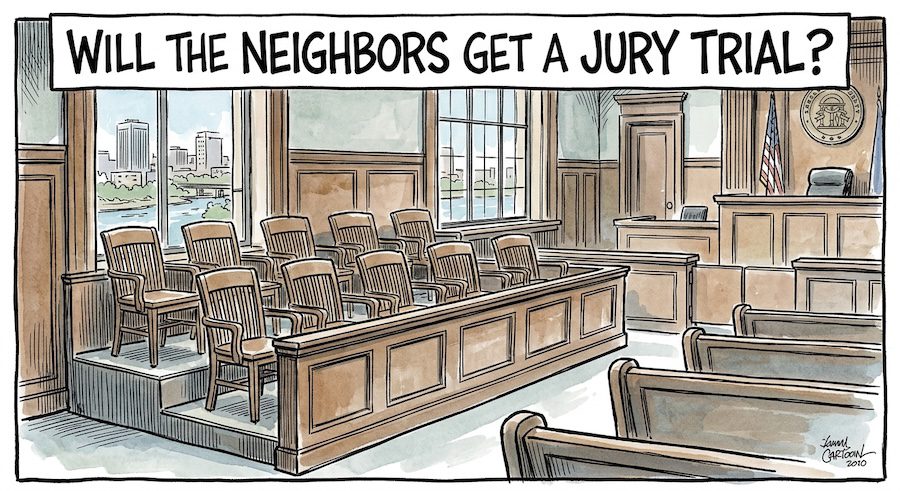

Jonathan Waters filed on deadline Monday and conceeded the legal point the city would have likely argued. Then he asked Judge Martin to seat a jury as a matter of discretion — one whose verdict, in Georgia, binds.
The short version
- Plaintiffs filed their jury argument Monday, Sept. 14, at 10:05 a.m., meeting the deadline Judge Martin set from the bench.
- The brief concedes outright that no count in the case is triable of right by a jury.
- It asks him to seat one anyway, under a Georgia statute that lets a judge order a jury where nobody could demand one — and, unlike the federal equivalent, makes that verdict binding.
- The request is narrow by design. A jury would answer questions of fact. The judge would keep every question of law and write the judgment.
- The brief names five factual disputes it says a jury should settle.
- Still no ruling on the city’s motion to end the case.
- One new detail: a confidential contact in July 2025 between the developer group and the water utility.
COLUMBUS, Ga. — When Judge John T. Martin Sr. ended last Wednesday’s hearing, he gave the neighbors suing Columbus until the close of business Monday to explain why a jury should hear any part of their case.
The filing arrived Monday morning at 10:05.
It opens by conceding the thing the city would have spent its response arguing.
“We acknowledge that no count in this action is triable of right by a jury and that the Court maintains ultimate authority over the result.”
That is the plaintiffs’ own lawyer, in his own brief, agreeing that nobody in this case has a right to a jury.
Then comes the sentence the rest of the document is built on.
“Our concession does not end the matter; it frames it.”
What they conceeded
The brief lists the reasons a jury right does not attach here, and does not dispute any of them.
Georgia’s Zoning Procedures Law confers no jury right. The Seventh Amendment, which guarantees civil juries in federal court, does not apply in state court — the brief cites a United States Supreme Court decision from 1916. And Georgia’s own constitutional guarantee does not reach suits in equity or for injunction, under a Georgia Supreme Court decision from 1973.
This case is a suit in equity. Both sides have asked the court to declare what the law is. Nobody is asking for money. On the court’s own docket, the case type is listed as “Injunction.”
The brief also heads off a characterization before anyone can make it. The plaintiffs, it says, never demanded a jury on the legal questions or as a matter of absolute right. The original complaint asked for a jury only on “all issues so triable” — language that tracks the statute rather than claiming anything beyond it.
What they are asking for instead
Georgia has a provision most people have never heard of, and it is doing all the work here.
Under O.C.G.A. § 9-11-39(b), in cases that are not triable of right by a jury, a judge “may nevertheless order a trial with a jury whose verdict will have the same effect as if trial by jury had been a matter of right.”
Read that twice. The judge does not have to seat a jury. But if he chooses to, the verdict is not a suggestion.
That is the distinction the brief drives at. In federal court, a judge in an equity case can empanel an advisory jury and then disregard what it says. Georgia does not work that way.
“Unlike the federal advisory-jury rule,” the brief argues, “Georgia’s statute gives the court-ordered verdict full binding effect, reflecting this State’s distinctive and long-settled practice of trying issues of fact to juries in equity.” It traces that practice back to Georgia’s Judiciary Act of 1799.
It leans on a second statute as well. Because this is a declaratory judgment action, O.C.G.A. § 9-4-6 provides that where a declaration involves fact issues “triable by a jury” and a jury has not been waived, those issues “shall be submitted to a jury of 12 in the form of interrogatories.” The brief argues this is not discretionary at all, and that at a minimum it confirms a declaratory action is not automatically a bench matter.
The argument is built around the judge’s own objection
At the hearing, Martin said plainly what was bothering him.
“From where I sit, I’m not really sure what the jury can tell me that I didn’t resolve myself as the finder of fact.”
Much of the brief is an answer to that sentence.
Its central move is to make the request small. The plaintiffs, it says, “do not ask a jury to set zoning policy, to decide questions of law, or to displace the Court’s equitable judgment.”
The mechanism it proposes: the court decides which factual questions go to the jury, the court writes the questions, the jury answers them, and then the court applies the Zoning Procedures Law, the city’s ordinances, the Open Meetings Act and the constitutional standards to those answers, and enters the judgment itself.
The brief lists what stays with Martin either way. Whether the published notice satisfied state law. Whether the post-hearing amendment was “material” as a matter of law. Whether the Open Meetings Act reaches the committee as an “agency.” Whether the ordinance bears the required substantial relation to public welfare.
A jury, in other words, would not decide whether Columbus broke the law. It would decide what happened.
The five questions
The brief identifies the factual disputes it says are genuinely contested, each tied to numbered paragraphs of the original complaint.
Was the ordinance built for one project? Whether the overlay, though written in general terms, was “reverse-engineered” so that in practice a single assemblage qualifies — the brief describes it as approximately 900 acres; 706report has reported the site as 865 acres — and is “in substance a vehicle to authorize a particular industrial development.”
Was the information the council relied on sound? Whether the “Unofficial Review” presented to councilors was structurally biased and rested on premises that were false or materially incomplete on energy, water, emissions, fiscal return and reclamation.
Did the late amendment change the substance? Whether the council’s post-hearing amendment materially changed the text, the scope and the impact — including by reshaping the project’s energy-generation architecture rather than merely refining it.
What was the committee? Whether the Chamber-hosted committee was created by or for the council to perform the governmental work of vetting the ordinance, and whether the council relied on work it did behind closed doors.
Was the hearing one-sided? Whether the council heard only presentations aligned with the project while excluding opposing evidence and speakers — and the circumstances under which people were removed at the first reading.
The brief’s framing of why these belong to a jury: “These are not abstractions of law. They are questions about intent, reliance, credibility, and community impact.”
And its argument for why a Muscogee County jury in particular: the contested questions are “whether neighbors were silenced at their own hearing; whether a rural, agricultural community will keep its quiet, its night sky, its water, and its way of life; and whether local government dealt straight with its citizens about a project it had known of for months.”
A detail that was not in the record before
In arguing that live testimony will be needed, the brief refers to a confidential contact in July 2025 between the developer group and the water utility — and says it should be tested through the testimony of the committee chair, the planning director and the utility’s representatives.
July 2025 is roughly seven months before Project Ruby was announced publicly, in February 2026.
The brief offers no detail beyond that, and the underlying allegation sits in a paragraph of a complaint the city has denied. What it establishes is narrower: the plaintiffs intend to put utility representatives under oath about a contact they say happened well before the public knew there was a project.
What still has not happened
The city asked Martin on Aug. 7 to end this case on the paperwork, without a trial, on all seven counts. As of this filing, no ruling on that motion has appeared.
Monday’s brief does not mention one. It describes itself as submitted “pursuant to this Court’s request,” which confirms only that Martin asked for it.
As we wrote last week, a judge scheduling discovery and arguing about trial format is behaving like a judge with a case in front of him. That remains an inference, and we continue to mark it as one. Martin can still rule on the motion at any time.
Martin also asked for a proposed discovery schedule on Monday. It is not part of this brief. Whether it was filed separately or is still outstanding is not clear from what is public.
For the record
Coverage of last Wednesday’s hearing, including our own, has been working from an incomplete picture of who represents the city. The certificate of service on Monday’s filing names all three: James C. Clark, Jr., Thomas F. Gristina and Jack P. Schley, of Page, Scrantom, Sprouse, Tucker & Ford, P.C., in Columbus. The Ledger-Enquirer’s photo caption from the hearing identified Clark as “John Clark.” The court’s own calendar had listed only Schley.
What happens next
Martin gave discovery a 60-day window for responses. On his own arithmetic at the hearing, that puts the next court date somewhere between Thanksgiving and Christmas.
He said he expects the case to be settled on its course before the year is out. “This ball has advanced downfield significantly,” he said. “We haven’t just had the kickoff. I mean, we’re already in the third or fourth quarter.”
The ordinance remains in force. It has been the law in Columbus since June 18. No order has ever frozen it.
Case: Keep It Rural LLC et al. v. City of Columbus, Georgia et al., SU2026CV001406, Muscogee County Superior Court. This story is based on Plaintiffs’ Bench Brief on the Court’s Discretion to Impanel a Jury to Resolve Disputed Issues of Fact, filed Sept. 14, 2026, which 706report has read in full. Quotations from the Sept. 9 hearing, including those from Judge Martin, are as reported by Kala Hunter of the Columbus Ledger-Enquirer, which had a reporter in the courtroom; 706report did not. See “Lawsuit about Columbus data center ordinance gets first hearing. What happened,” published Sept. 9, 2026. Docket details are from the court’s own case record.
