

Whether a data center helps a town or hurts it comes down to the deal. This guide walks Columbus Council through the choices that come before anyone signs, with real examples of what can go right and what can go wrong. Part 1 of 2.
The short version
- A data center can help a city’s budget or hurt it. It depends on the deal.
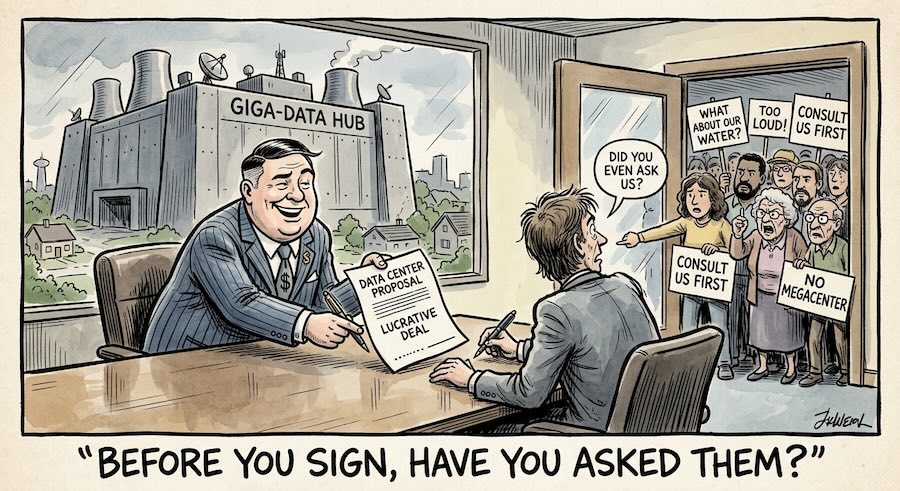
- Listen to the public first. They gave you their trust.
- Decide where before you decide how much.
- Know who you are dealing with, and how big the project could grow.
- Georgia already gave away the sales tax. Property tax is the one money lever council controls.
- Any tax break hits our schools the hardest.
COLUMBUS, Ga. — In July, Effingham County, near Savannah, made a deal with OpenAI. The company plans a data center there worth about $20 billion.
The deal is spelled out in a memorandum of understanding dated July 21. The county announced the project the next day. Under the deal, OpenAI’s payments are based on half the property’s value for 15 years.
Homeowners got good news fast. The county says the average homeowner’s 2026 bill will drop about 30%. But that cut is paid for by a one-time land sale, not by the data center’s yearly taxes.
The county and its development authority also promote an $80 million community pledge from OpenAI. That pledge is not in the signed agreement.
Is that a good deal? Money magazine looked at towns across the country and found no simple answer. Whether a data center helps or hurts “hinges upon what’s negotiated,” Pete Grieve wrote. It depends on the deal.
That is why this guide exists. Columbus now has a Technology Overlay, a zoning law that sets rules for data centers. The city claims no data center application is pending. But if one comes, Columbus Council will face the same choices Effingham did. This guide walks through those choices in the order they come up, with real examples of what went right and what went wrong.
Disclosure: 706report wrote the People’s Overlay, a set of proposed protections sent to council in June. Some of the ideas below appear in it.
Who Council works for
Every step in this guide comes back to one idea. The public gave council its trust. Listening to the people is the first duty of council, not a box to check.
Most Americans do not want these projects nearby. In a Gallup poll published in May, 7 in 10 opposed an AI data center in their area. Nearly half were strongly opposed. In a Pew survey taken this summer, half of adults said data centers are mostly bad for home energy costs. That was up from 38% in January.
People are already feeling the pinch. In a Pew survey this spring, 3 in 4 adults said their home energy costs have gone up in recent years. Most said data centers’ growing energy use is at least a small part of the reason.
Listening does not mean doing whatever the loudest voice says. More than 200 years ago, the British statesman Edmund Burke said a representative owes the public his judgment. But Burke also said the public’s wishes deserve “great weight.” Good judgment starts with hearing people out.
Listening means three things:
- Hear people before you decide. Not after the deal is done.
- Give them the facts. People can’t weigh in on a deal they can’t see.
- Answer them on the record. Say what you heard and what you did about it.
Columbus has its own lesson here. Several hundred residents came to the overlay’s first reading in June. Council later added three protections: a 500-foot buffer next to homes, a ban on PFAS “forever chemicals” in cooling fluid, and a ban on diesel backup generators. Two of them match protections 706report proposed. But all three first appeared in the text council adopted, after the public hearings had closed. Residents never got to comment on them. Even good changes deserve a public hearing.
The legal minimum is not sufficient. Georgia law requires only a short notice in the newspaper, a sign on the site, and as little as 10 minutes per side at a zoning hearing. Georgia’s Open Meetings Act does not even guarantee the public a chance to speak. Meeting the minimum is not the same as listening.
Falling below the minimum can also sink a project. In Prince William County, Virginia, a court threw out the approval of a 2,100-acre data center park because the county’s hearing notices were faulty. The project is now dead.
Plain words for deal words
- Hyperscale data center: a giant building, or group of buildings, full of computers. These run AI and online services for big tech companies.
- Megawatt (MW): a measure of electric power. One megawatt is very roughly enough for a few hundred homes.
- Abatement: a tax break. The company pays less than the normal tax.
- PILOT: “payment in lieu of taxes.” A set payment the company makes instead of regular property taxes.
- Millage, or mills: the property tax rate. One mill is $1 of tax for every $1,000 of assessed value.
- Assessed value: the value the tax is based on. In Georgia it is 40% of what the property is worth.
- Tax digest: the total assessed value of all taxable property in the county.
- NDA: “non-disclosure agreement.” A promise to keep something secret.
- Development authority: a public board that makes deals to bring businesses to town, often with tax breaks.
- Bond-for-title: a common Georgia deal. The development authority holds title to the property for a time, and the company pays a PILOT instead of full taxes.
- Clawback: a rule that makes a company pay money back if it breaks its promises.
Stage 1: Where
For Council, the first question is not “how much will they pay?” It is “does this belong here?” Once the money talk starts, the site is hard to change.
Do
- Hold a community meeting before any site decision. In St. Charles, Missouri, residents spoke out against a proposed data center called “Project Cumulus.” A company spokesperson admitted “the team’s process was poor.” The developer withdrew in August 2025. Four days later, all 10 council members voted to pause new data centers for a year.
- Set siting rules before the first application. Dodge County, Georgia, has a draft ordinance that sets clear rules in advance. It calls for buildings set back 1,000 feet, limits on noise, and outside experts to study noise and the environment. Clear rules tell a developer what to expect before anyone gets attached to a site.
- Be willing to say no to the wrong land. In Monroe County, Georgia, nearly 900 residents came to a hearing on a data center planned for more than 900 acres. They told commissioners about flooding along their creeks. A regional study said the same thing: the land sits in a 100-year floodplain. Commissioners voted no, unanimously. What residents knew and what the experts found pointed the same way.
- Plan for the second and third applicant. Fayetteville, Georgia, approved one big data center campus in 2023. When more came knocking, the city banned new data centers in March 2026. Newton County, home to a Meta campus, had rules that covered only one business park. When interest grew elsewhere, it needed an emergency moratorium to catch up.
- Get every notice right. Prince William’s lesson is simple. A careless notice can undo years of work.
Don’t
- Don’t write the rules after a project shows up. Coweta County, Georgia, paused new data centers after a huge project called “Project Sail” was proposed. Then it wrote its rules. According to DeSmog, a lobbyist for the project team sent in edits, and most of the public feedback came from developers or their representatives. The project was approved 3-2.
- Don’t treat a site as settled just because the land is under contract. A land deal is the developer’s business. Whether the land is right for the city is council’s business.
Questions to ask at this stage
- Have the neighbors been told, and have they had a real chance to speak?
- Is this land right for it? Think about floods, wells, roads, noise and nearby homes.
- Can the water and power systems serve this site without new costs to everyone else?
- Is there a better site, such as an industrial park?
- If we say yes here, what happens when the next one asks?
What this could look like in Columbus (a made-up example)
A developer asks to build on farmland near homes. Before any talks about money, council holds a community meeting near the site. Residents raise worries about wells and noise. Staff check the site against the water and power systems. Council tells the developer the site does not fit, and points it to land already zoned for industry.
Stage 2: Who and how big
Before council can judge a deal, council members need to know who they are dealing with and how big the project could become. Developers often hide both behind code names and NDAs.
Do
- Learn who the real company is, early enough for the public to weigh in. Pima County, Arizona, now requires details of a project to be public at least 90 days before any vote. Ninety days gives residents time to read, ask questions and speak.
- Put the maximum power and water use in writing. Then any increase needs a new vote. In Loudoun County, Virginia, a county supervisor has proposed this idea. It is only a proposal, but the logic is sound. A project should not quietly double in size after approval.
- Have the developer pay for the city’s own expert. The developer brings lawyers and consultants. Council should have its own. Rosemount, Minnesota, reportedly had a developer put $100,000 up front to pay for the city’s review. Columbus would need to check with the city attorney about how to do this in Georgia.
Don’t
- Don’t negotiate under an NDA right up to the vote. In Effingham, the development authority’s chief was bound by an NDA with OpenAI until a week before the vote, The Current reported. The authority emailed notice of its vote to seven people, three business days ahead. Three OpenAI representatives came. Nobody from the public did. Whether or not that broke the law, the public was not part of it.
Other places have learned this lesson. In St. Charles, a city staff member had signed an NDA early on. The mayor later said there will “never be another NDA.” In August, Delaware passed a law that voids local NDAs that hide information about large data centers.
Questions to ask at this stage
- Who is the company that will actually use this building?
- What is the most power and water this site could ever use, at full size?
- Has anyone at the city or the development authority signed an NDA? Who, and when does it end?
- Who is advising council, and who pays them?
What this could look like in Columbus (a made-up example)
A developer arrives with “Project X,” a code name, and no named tech company. On day one, council asks for three things. First, the name of the end user, made public 90 days before any vote. Second, the most megawatts and gallons the site could ever use, in writing. Third, a deposit to pay for council’s own expert. If the developer says no, that tells council something too.
Stage 3: The money
Here is the most important fact about the money: Georgia already gave away the sales tax.
State law exempts data center equipment from sales tax. That includes local sales taxes that would normally help Columbus. The state hired experts to study this break. They found it cost Georgia $474 million in state revenue in one year, 2025. They found that about 70% of the data centers would have come to Georgia anyway. And the state got back about 4 cents for every dollar it gave up.
Council cannot change that law. What council can affect, through the development authority, is property tax. It is the one big money lever left. Don’t give it away cheaply.
In plain words: who gets the property tax?
In most of Columbus, property tax is 39 mills. About 16 go to the city government and about 23 go to the Muscogee County School District.
Say a data center is worth $1 billion, and it pays full taxes.
- Its assessed value is $400 million (40% of $1 billion).
- It would pay about $15.7 million a year.
- About $9.2 million (59%) would go to schools.
- About $6.4 million (41%) would go to the city.
Now say it gets a deal like Effingham’s, with taxes based on half its value. It would pay about $7.8 million a year less. Most of that loss, about $4.6 million, would come out of the schools.
(706report’s math, using the 2026 tax rates published by the city and the school district.)
The city has little room to raise taxes on its own. Columbus’s main tax district is at 8.97 mills, just under its 9-mill charter limit. So the terms of any deal matter even more.
In plain words: why the big number shrinks
Developers often quote a big tax number. But most of a data center’s value is in computers, and computers lose value fast.
Georgia’s tax rules count servers at 76% of their cost in year one, 51% in year two and 30% in year three. After that, they count at just 10%.
Say a data center holds $500 million in servers. In year one, the tax on those servers would be about $6 million. By year four, it would be under $1 million.
Companies do replace servers, which can bring the value back up. But no one can promise when.
This has happened before. In 2021, Loudoun County, Virginia, the world’s biggest data center market, collected about $60 million less from data centers than it expected. The equipment was worth less than forecast.
Columbus has heard big numbers already. In February, Choose Columbus, the Development Authority of Columbus, announced that a proposed $5.18 billion campus would pay $68.7 million a year in property tax by 2030. Its own project page now projects about $605 million over 10 years, and that math assumes the computers are replaced every five years. If they are not, the number falls. At today’s rates in the city’s main tax district, $68.7 million a year would take property worth about $4.4 billion, about 27% of the county’s entire tax base today. (706report’s math.) A number that large, built mostly on computers, should be checked, not counted on.
Do
- Publish the draft deal and an independent money study before the vote. In Rockland County, New York, a board approved about $77 million in tax breaks for a data center that would bring one permanent job. The public hearing lasted 20 minutes. Nobody came. People can’t speak up about a deal they never see.
- Set a fixed minimum payment that goes up every year. Hermiston, Oregon, did this with Amazon. Amazon must pay at least $2 million a year, rising as it adds buildings. It also pays fees for schools and public safety that rise 3% a year, plus $5 million up front for each campus. A floor protects the city when the computers lose value. Amazon made its first payment, $2.65 million, in November 2025.
- Think about offering no tax break at all. If the site is what the company wants, it may come anyway. Bartow County, Georgia, gave no tax breaks to its data centers. In Quincy, Washington, data centers paid full property taxes, and the city’s tax rate fell about 70% over two decades.
- Run the numbers for the school board, not just the city. Any tax break takes more from the schools than from the city. The school board should see the math before anyone signs.
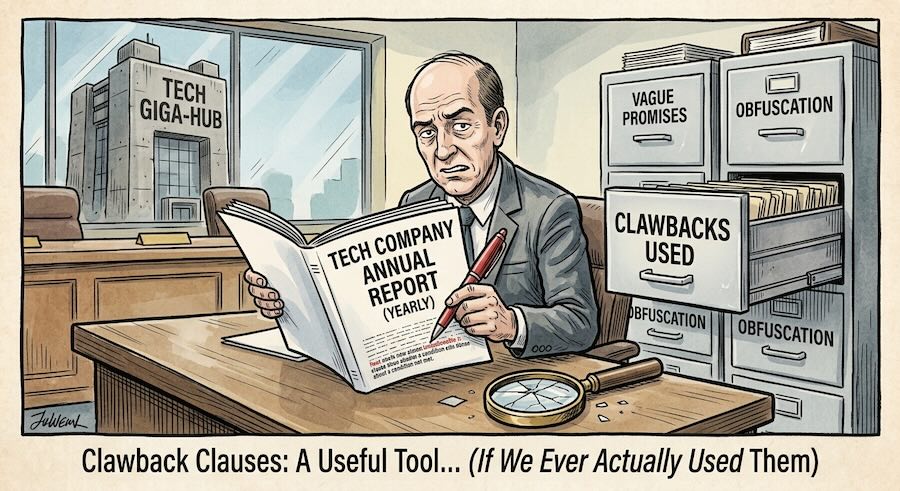
- Build in clawbacks. In Marysville, Ohio, if a data center stops running for more than a year, the city can recover up to all the taxes it gave up for that year and the two before. A lien on the property backs that up.
Don’t
- Don’t pay for ongoing tax cuts with one-time money. Effingham’s 30% homeowner cut comes from land-sale money, not the data center’s yearly taxes. The county’s development authority calls the sale “a direct, one-time infusion.” When the one-time money runs out, the cut needs another source.
- Don’t build a budget on the developer’s number. Use your own expert’s estimate, and plan for the computers losing value.
Questions to ask at this stage
- How much will this project pay each year, for each of the first 15 years? Who made that estimate?
- How much of the value is computers, and how fast will it drop?
- Is there a guaranteed minimum payment? Does it rise each year?
- How much of any tax break comes out of the school budget?
- If the company leaves or breaks its promises, what do we get back?
What this could look like in Columbus (a made-up example)
A $1 billion proposal is $600 million in computers and $400 million in buildings and land.
- Version A: no floor. In year one it pays about $13 million. By year four, if the computers aren’t replaced, it pays about $7 million. The schools and the city lose the difference.
- Version B: a floor. The deal says the company pays at least $12 million a year, rising 3% each year. In year five it pays at least $13.5 million, no matter what the computers are worth.
Same project. Very different result for the schools.
(706report’s math, using 2026 rates and Georgia’s tax rules for computers.)
Checklist: Before anyone signs
Checklist
Who you work for
☐ Residents heard from before any decision, not after
☐ All key facts made public with time to read them
☐ Public concerns answered on the record
Where
☐ Community meeting held near the site
☐ Siting rules in place before the application
☐ Site checked for floods, water, power, roads, noise and homes
☐ Plan in place for the next applicant
☐ Every legal notice checked by the city attorney
Who and how big
☐ End user named at least 90 days before the vote
☐ Maximum power and water use in writing
☐ No NDA blocking council or the public
☐ Council’s own expert, paid for by the developer
The money
☐ Draft deal and independent money study published before the vote
☐ Guaranteed minimum payment, rising each year
☐ “No tax break” option considered
☐ School board shown the math
☐ Clawbacks written in
☐ No ongoing tax cuts funded by one-time money
Next: Part 2, Making It Stick. Part 2 covers jobs and community benefits, power and water, and what happens after the vote. It ends with the full Recommended Council Negotiating Playbook.
Notes on sourcing. Every figure in this piece is either quoted from a public document, attributed to the party that published it, or labeled as 706report’s own arithmetic. The Columbus examples marked “a made-up example” are illustrations, not predictions about any project or official.
Effingham County terms are from the memorandum of understanding between the Effingham County Industrial Development Authority and Octans GA LLC, dated for reference July 21, 2026, and from Effingham County releases of July 22 and Sept. 2, 2026. The account of the authority’s notice and meeting is from The Current, Aug. 8, 2026. The Money piece is Pete Grieve, Money Research Collective, published Sept. 1, 2026, as syndicated by the Columbus Ledger-Enquirer. Polling is from Gallup (May 13, 2026) and Pew Research Center (May 8 and Sept. 22, 2026).
Georgia’s sales tax figures are from the state’s December 2025 tax incentive evaluation of the data center exemption, prepared by the University of Georgia Carl Vinson Institute of Government for the Department of Audits and Accounts. Columbus tax rates, the tax base and the 9-mill cap are from the Columbus Consolidated Government FY2027 budget book and the 2026 digest notices of the city and the Muscogee County School District. The school district’s 23.075-mill rate was advertised for adoption June 29, 2026. Equipment depreciation factors are from Georgia Department of Revenue Rule 560-11-10. Tax splits, the $1 billion examples, the server example and the 27% comparison are 706report’s arithmetic from those sources, using the main urban service district’s 2026 rates.
Tax projections for the proposed campus are from Choose Columbus’s Feb. 12, 2026 announcement and its Project Ruby Updates page.
The overlay’s protections are as worded in the adopted text of the Technology Overlay. Their timing is as reported by 706report on Aug. 27, 2026.
