
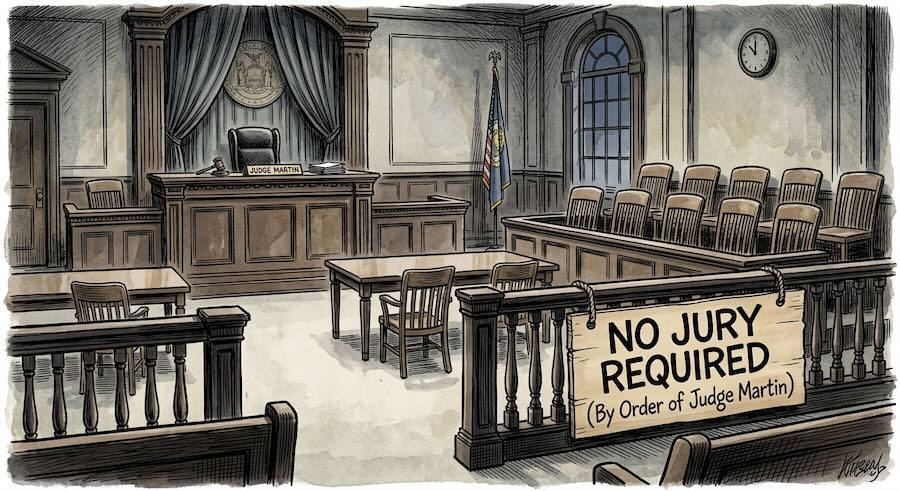

The neighbors asked Judge Martin to let a jury settle five factual disputes. He said no: whether a zoning law is valid is a question for the judge. A bench trial is set for Dec. 14.
The short version
- Judge John T. Martin Sr. signed an order Oct. 8 denying the neighbors’ request for a jury.
- The case goes to a bench trial beginning Monday, Dec. 14. The judge alone will decide it.
- His reasoning: whether a zoning ordinance is valid “is a question of law for the court and not a question of fact for the jury.”
- The five factual disputes the neighbors raised are, in the order’s words, “either immaterial, questions of law, or issues which this Court may itself resolve.”
- Still no ruling on the city’s August motion to end the case. The order does not mention it.
- The order was drafted by the city’s lawyers and signed by the judge. That is common practice in Georgia.
COLUMBUS, Ga. — The neighbors suing Columbus over its data center zoning law will not get a jury.
Judge John T. Martin Sr. of Muscogee County Superior Court signed the order on Oct. 8. It was filed with the clerk that afternoon at 4:25. The case will go to trial before the judge alone, beginning Dec. 14.
The neighbors are Keep It Rural LLC and eight landowners in Upatoi. They are asking the court to throw out the Technology Overlay, the zoning ordinance Columbus Council adopted on June 16. The city says the data center the overlay was written around is “perceived and hypothetical.”
The ruling settles a question that has been open since the Sept. 9 hearing, when Martin said he doubted a jury was needed and asked both sides to brief it.
What the neighbors asked for
Last month the neighbors’ lawyer, Jonathan Waters, conceded that nothing in the case gives anyone a right to a jury. Instead, he asked Martin to use his discretion and seat one anyway. A Georgia statute allows that. In Georgia, a jury seated that way gives a binding verdict.
Waters asked for a jury on five factual disputes:
- whether the ordinance was written for one project;
- whether an “Unofficial Review” of the ordinance was biased;
- whether a late amendment was material;
- what a Chamber-hosted committee actually did;
- whether the public hearing was one-sided.
What the judge decided
Martin said no, for two reasons.
First, the law. “This is an equitable action for a declaration voiding a legislative zoning enactment,” the order says. Under Georgia Supreme Court decisions going back to 1978, the validity of that kind of law “is a question of law for the court and not a question of fact for the jury.” The order says neither statute the neighbors cited changes that. One only says a judge “may” seat a jury, and refusing to is not an error. The other “creates no jury right where none otherwise exists.”
Second, the five disputes. The order says they “do not set forth issues of fact requiring submission to a jury.” It also describes how limited a judge’s review of a zoning law is. The court “does not re-weigh the evidentiary premises the legislative body relied upon.” It decides, as a matter of law, “whether the enactment bears a substantial relation to the public welfare.”
In plain words: at trial, Martin will not ask whether Council’s reasons were good ones. He will ask whether the law is connected closely enough to public health, safety and welfare to stand. The test comes from a 2017 Georgia Supreme Court case that both sides cited.
The order also quotes the neighbors’ own complaint, which says they “do not ask this Court to decide whether data centers are good or bad policy.” They are challenging the ordinance and how it was adopted.
Who wrote the order
The last page reads “Prepared by” Thomas F. Gristina of Page, Scrantom, Sprouse, Tucker & Ford, “Counsel for Defendant.” Georgia judges often ask the winning side to draft the order, then review and sign it. Martin signed this one.
What the lawyers say
706report asked both sides’ lawyers for comment on Oct. 9: Jonathan Waters, for the neighbors, and Thomas F. Gristina, for the city. Neither responded by the Oct. 13 deadline.
What a jury might have heard, and what the city would have said
This is an illustration, not a prediction. It imagines the kind of evidence each side might have used if there had been a jury. It does not say this evidence exists. It does not say what either side will show Judge Martin on Dec. 14. When a point comes from the city’s own court papers, we say so.
A judge decides what the law means. A jury decides what happened: who knew what, who wrote what, and what went on in the room. The neighbors wanted a jury to answer five questions. Here is how that might have gone.
1. Was the law written for one project?
- The neighbors might offer:
- a map expert to show that only one site in the county fits the law’s rules;
- a timeline. On Feb. 12, Choose Columbus named a developer, a $5.18 billion price and a jobs number. That was before the law was written;
- the people who wrote the law, under oath.
- The city would likely say: the law covers the whole county, and any land that fits can use it. In its August court papers, the city calls the data center “perceived and hypothetical.” In other words, the city says there is no actual project yet. No one has applied. Any project would still need its own zoning vote and public hearing.
2. Was the “Unofficial Review” slanted?
- The neighbors might offer: outside experts on water, power, air and taxes. Each would point to a claim in the review that was wrong or left something out.
- The city would likely say: the review was one piece of what Council heard. Guesses about the future are never certain, and that is not the same as bias. The judge’s order makes a similar point. Courts do not “re-weigh the evidentiary premises” Council relied on. That means a judge does not redo Council’s homework.
3. Did a late change matter?
- The neighbors might offer:
- the version of the law the public saw at the June hearings, next to the final version;
- an engineer to explain how the changes affected the way the site would make and back up its power;
- residents who say they never got to speak on the final version.
- The city would likely say: the changes made the law tougher, not weaker. They added a 500-foot buffer and banned PFAS cooling fluids and diesel backup generators. And whether a new hearing was needed is a question about the law. That is for the judge, not a jury.
4. What did the Chamber committee do?
- The neighbors might offer: members, agendas, sign-in sheets and emails, to show the committee did the city’s work in private.
- The city would likely say: it was a private group that gave advice. It could not decide anything. Council voted in public, after notice and hearings.
5. Was the public hearing one-sided?
- The neighbors might offer: people who were there on June 2, the list of speakers, and video of the meeting. That includes the moment three people were removed.
- The city would likely say: it followed Georgia’s rules for notice and hearings. The video and minutes would show how many opponents spoke. And the person running a meeting has to keep order.
Why it mattered. The neighbors’ best evidence is the kind a jury can see: a map with one site on it, a timeline, a video. The city’s best case is about the law. Courts assume zoning laws are valid. They also do not usually ask why lawmakers voted the way they did. The order’s own heading calls the neighbors’ questions “immaterial legislative motive,” among other things. In plain words: why Council acted does not decide the case. That is why the jury mattered so much to both sides. The neighbors can still show their evidence to Judge Martin. But he will judge it by a legal test, not by a jury’s sense of what is fair.
What has not happened yet
The city’s motion to end the case is still undecided. On Aug. 7 the city asked Martin to rule for it on the pleadings alone, calling the data center “perceived and hypothetical.” The Oct. 8 order does not mention that motion, and the court docket showed no ruling on it as of Oct. 13. Setting a trial date suggests the case is moving forward. But the motion could still be decided before Dec. 14. 706report asked both lawyers whether the motion is still pending. Neither responded.
Discovery is under way. At the Sept. 9 hearing, Martin gave the parties 60 days to answer discovery requests, according to the Columbus Ledger-Enquirer, which had a reporter in the courtroom. He predicted the next court date would fall between Thanksgiving and Christmas. Dec. 14 fits that.
What happens next
The bench trial begins Monday, Dec. 14. Martin will hear the case and write the judgment. Either side could appeal a final ruling.
For the record
The order’s first paragraph describes the neighbors’ request as made under O.C.G.A. §§ 9-11-39(c) and 9-11-49. The neighbors’ brief relied on § 9-11-39(b) and § 9-4-6. The order’s own analysis addresses those two. 706report asked both lawyers about the difference. Neither responded.
Notes on sourcing.
The case: Keep It Rural LLC et al. v. City of Columbus, Georgia et al., SU2026CV001406, Muscogee County Superior Court.
The order: Order Denying Plaintiffs’ Request to Impanel a Jury, signed Oct. 8, 2026 and e-filed that day at 4:25 p.m., which 706report has read in full. It was provided to 706report by the plaintiffs’ counsel. It is a public court record.
The plaintiffs’ brief: Plaintiffs’ Bench Brief on the Court’s Discretion to Impanel a Jury, filed Sept. 14, 2026.
The Sept. 9 hearing: Martin’s comments are as reported by Kala Hunter of the Columbus Ledger-Enquirer, Sept. 9, 2026. 706report did not have a reporter in the courtroom.
The city’s motion: its Aug. 7 motion for judgment on the pleadings is as reported by the Ledger-Enquirer.
Disclosure: 706report wrote the People’s Overlay, a set of proposed protections submitted to Council during the overlay debate.
