
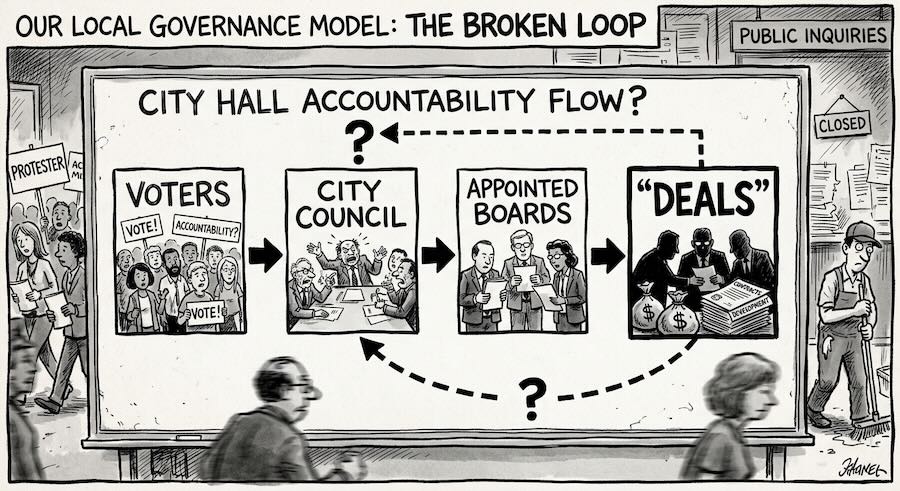

$25 million in bonds. A tax break for the Ralston. A vote taken right after a closed-door session, with minutes that didn’t surface for seven weeks. Who answers for decisions like that? In Columbus, the honest answer is complicated.
The short version
- Two public boards make many of Columbus’s biggest development decisions: the Development Authority of Columbus (DAC) and the Downtown Development Authority (DDA).
- Council appoints their members. It also gives the DAC about $1.45 million a year in city property tax. But Council does not vote on their deals.
- The day-to-day work is done by Choose Columbus, whose staff also serve as the DAC’s staff. What Choose Columbus is, legally, is not clear from public records.
- On Aug. 26, the DDA voted to give the Ralston a “tax incentive.” The public could not see the minutes until seven weeks later.
- The rules provide checks. In practice, many of them are late, hard to find or rarely used.
- 706report has asked both boards for records. We’ll report what they show.
COLUMBUS, Ga. — On a Wednesday morning in late August, six members of a little-known city board met in an office on 11th Street. They went behind closed doors to talk about real estate. When they came back out, they voted to approve $25 million in tax-exempt bonds for the Ralston, the downtown tower being renovated by a North Carolina developer. They also voted to take title to the building “in order to provide a tax incentive,” according to the board’s minutes.
The board was the Downtown Development Authority. Its minutes of that Aug. 26 meeting were not posted where the public could easily find them. They became public about seven weeks later, when they were attached to a Columbus Council agenda packet on Oct. 13.
It may have been legal. But it is also a good example of a larger issue: who answers for the development decisions made in Columbus’s name?
This story lays out what the public record shows, and the questions it raises. Our purpose here is not to provide easy canned answers. Rather, we are more interested in asking questions. These are questions residents, Council and the boards themselves should be able to answer.
How it works
Columbus Council is elected by citizens. Under the City Charter, Council appoints the members of city boards and authorities. Its votes on appointments must be taken out loud and recorded. Does that mean that they are responsible to Council for their actions? Good question. Six Council votes can remove a board member “for cause” but does that mean for decisions that are obviously in opposition to the will of Council or Voters?
The Development Authority of Columbus (DAC) is a public body created under state law. It is not a city department. Its seven members are appointed by Council. It can:
- issue bonds;
- own and lease land;
- give grants;
- grant property-tax breaks through a “bond-for-title” deal, where the authority holds title to a company’s property so normal property tax isn’t owed.
The city gives the DAC a share of property tax: 0.25 mill, or $1,445,963 in the current budget. Council holds a second 0.25 mill in reserve for economic development.
The Downtown Development Authority (DDA) works the same way, but only downtown. State law sets its size at eight members. Its own bylaws say seven. It has six today.
Choose Columbus is the name residents see. Missy Kendrick is president and CEO of both Choose Columbus and the DAC. She is also the President/CEO of the DDA.
- Signs it is the DAC’s staff: the DAC’s minutes list Choose Columbus staff as DAC staff, and the DAC’s meeting page is on the Choose Columbus website.
- Signs it is separate: Choose Columbus has its own chairman, Pace Halter of W.C. Bradley Real Estate. When it launched in 2025, the Ledger-Enquirer called it a “standalone organization.”
- What we couldn’t find: 706report found no nonprofit tax filing for it.
The key point: Council picks the boards and funds the DAC. Council does not vote on the boards’ bonds, land deals or tax breaks. Those are approved by the boards themselves. Bonds are then confirmed by a Superior Court judge.
Questions worth asking
- Is Choose Columbus the DAC under another name, or a separate organization? Who employs its staff, and who pays them?
- Should Council see, or vote on, a tax break before it is final?
The checks, on paper and in practice
Georgia law and the City Charter give residents real checks on these boards. Here is how each one works, and what the record shows.
Check 1: Council appoints, and can remove, members
On paper: Council chooses every DAC and DDA member and can remove one “for cause” with six votes.
In practice:
- Expired terms: every DDA member’s term expired on Aug. 15, 2023, according to a Clerk of Council memo, and members kept their seats under a state rule that lets them serve until replaced.
- The board stopped meeting: its own minutes from June 2025 say the board “has not met in several years.” It was revived that year after the Clerk’s office was “informed of a need arising” for it to reconvene. The memo did not say who raised that need.
- The cost of inactivity: at the Aug. 26 meeting, Kendrick told the DDA that $36,943.84 of its money “had previously been seized by the state due to inactivity.” She said she had reclaimed it.
- Removals: 706report found no record of Council ever removing an authority member for cause.
Questions worth asking
- How did the DDA go two years with expired terms, and who asked for it to reconvene?
- Has Council ever removed a development authority member for cause?
Check 2: Open meetings and public minutes
On paper: Georgia’s Open Meetings Act covers both boards. Meetings must be announced in advance. A summary of actions taken must be available within two business days, and minutes must be kept and released on request.
In practice:
- Where minutes appear: the city’s online boards portal posts DAC minutes weeks or months after meetings, and Council agenda packets often carry them first.
- DAC agendas: 706report found no 2026 DAC agendas posted there.
- DDA minutes: before October, the only DDA minutes posted were from June 2025. The Ralston minutes appeared only in a Council packet on Oct. 13, 2026, seven weeks later.
Questions worth asking
- Why aren’t agendas posted before DAC and DDA meetings?
- Should these boards post their minutes online within days, not weeks?
Check 3: Members must disclose conflicts
On paper:
- Business with the board: under Georgia law, a DAC or DDA member who does business with the board must say so in advance, have it recorded in the minutes, and stay out of the vote. Larger deals also require a newspaper notice.
- Other interests: the City Charter’s ethics code also asks appointed officers to disclose financial interests to Council.
In practice: unlike elected officials, appointed authority members file no yearly financial disclosure with the state. The minutes are the only paper trail, so when minutes are late or missing, so is the record of any conflict. (Two examples are below.)
Check 4: Residents can object to bonds
On paper: before bonds are final, a Superior Court judge holds a “validation” hearing. Any resident may appear and object.
In practice: the hearing is announced by a legal notice in the newspaper. Under Georgia law, people who had notice and didn’t object usually can’t challenge the bonds later.
Question worth asking
- Has anyone ever objected at a DAC or DDA bond hearing in Muscogee County?
Check 5: Records are open
On paper: Georgia’s Open Records Act covers both boards. Records kept by a private group doing a board’s work are public too.
In practice:
- Where to ask: since a 2025 change in state law, requests for Choose Columbus records about DAC work go to the DAC, not to Choose Columbus.
- Its own meetings: whether Choose Columbus’s own meetings must be open depends on how much of its money comes from taxes. That figure isn’t public.
Question worth asking
- Does Choose Columbus get more than a third of its money from taxes?
Two votes, and what the minutes don’t say
The DAC’s own minutes show two recent votes in which members had connections to the people receiving the money. Neither vote appears to break Georgia’s conflict law, which covers a member’s financial stake. The question is whether residents should be told about such connections when the vote happens.
Jan. 8, 2026. DAC member Will White proposed, and moved, a $20,000 DAC donation to Columbus State University for its Korea-Georgia Dialogue, an event meant to attract Korean business to the area.
- His CSU role: CSU had announced in November 2025 that White chairs its Foundation’s board of trustees.
- A second trustee: the same announcement named DAC member Laura Gower as a new trustee.
- The vote: it passed 7-0, with Gower voting yes.
- The minutes: they do not mention either member’s Foundation role.
Aug. 13, 2026. Gower moved to add an “Airport Intergovernmental Agreement” to the DAC’s agenda, then moved to approve it.
- The agreement: under it, the DAC passes $260,000 in city money to the Columbus Airport Commission.
- The connection: Gower’s husband, Austin Gower, is the commission’s secretary.
- The vote: it passed 5-0.
- The minutes: they do not mention the relationship.
- The Airport Commission’s side: its minutes for June, July and August show no vote on the agreement.
Questions worth asking
- Should DAC and DDA members say on the record when they, or a close family member, also sit on a board that an item would benefit, even when the law doesn’t require it?
- Does the DAC give its members any written guidance on these situations?
- Should Council ask the people it appoints to file a simple yearly list of their other board seats?
What could change
Council could require these boards to:
- post agendas before meetings, and minutes within a set number of days;
- publish a running list of every bond-for-title tax break, with the tax abated and when it ends;
- give Council a short public report before voting on any tax incentive over a set size.
Council could also:
- require the people it appoints to file a yearly disclosure of their other board seats and close family members’ public roles;
- ask the DAC to publish a written agreement with Choose Columbus, saying who employs the staff and how it is paid for.
Questions worth asking
- Which of these would each Council member support?
- Will Mayor-elect Isaiah Hugley, who takes office Jan. 4, 2027 with economic development on his transition team’s list, review how Choose Columbus, the DAC and the DDA fit together?
What 706report has asked for
On Oct. 18, 2026, 706report filed Open Records Act requests with both boards.
From the DAC:
- the $260,000 airport agreement;
- any conflict-of-interest policy, and any disclosures members have filed;
- 2026 agendas and closed-session records;
- the records of its grants;
- any agreement with Choose Columbus, and who employs its staff;
- the city funding agreement and the DAC’s budgets;
- a list of its tax-break deals.
From the DDA: the notices, records and closed-session affidavits for its Ralston meetings, the bond documents, and the tax-break schedule, including how much school tax is affected.
Georgia law gives agencies three business days to respond or to say when records will be ready. We’ll report what the records reveal.
What you can do
- See board meetings and minutes: the city’s boards portal (columbusga.gov/Boards), and Council agenda packets at columbus-ga.municodemeetings.com, where the newest board minutes often show up first.
- Ask for records: send a written request to the DAC or DDA under the Georgia Open Records Act (O.C.G.A. 50-18-70). They must answer within three business days.
- Watch for bond notices: look for “bond validation” legal ads in the Ledger-Enquirer. You can attend the hearing in Muscogee Superior Court and object.
- Ask your Council member: Council appoints these boards. Ask who they’ve appointed, and why.
- Serve: anyone can apply for a city board through the city’s boards portal.
706report will publish responses from any of the people or boards named in this story. Send yours through our contact form.
Notes on sourcing.
DAC minutes: Jan. 8, 2026 (p. 4), posted on the city’s boards portal; Aug. 13, 2026 (pp. 754 and 757 of the Council agenda packet of Sept. 22, 2026).
DDA minutes: June 11, 2025; Aug. 26, 2026 (pp. 315-316 of the Council agenda packet of Oct. 13, 2026).
Council: Columbus Council minutes of July 28, 2026 (Res. 192-26) and Aug. 25, 2026 (Res. 224-26); Clerk of Council memo on the DDA, April 22, 2025.
Columbus Airport Commission minutes: June 24, July 23 and Aug. 27, 2026.
Columbus State University: news release, Nov. 21, 2025.
City budget: City of Columbus FY2027 budget, pp. 426-427.
Laws and the Charter: Columbus City Charter, Secs. 3-103 and 4-103, and Appendix Two; O.C.G.A. 36-62-5(e) and 36-62A-1 (conflicts); O.C.G.A. 50-14-1 (open meetings) and 50-18-70 (open records); O.C.G.A. 36-82-75 to -77 (bond validation).
Ledger-Enquirer: May 15, 2025 and Sept. 28, 2026.
Family connection: the Gowers’ marriage is shown in a 2009 family obituary.
Disclosure: 706report wrote the People’s Overlay, a set of proposed protections submitted to Council during the Project Ruby overlay debate.
