
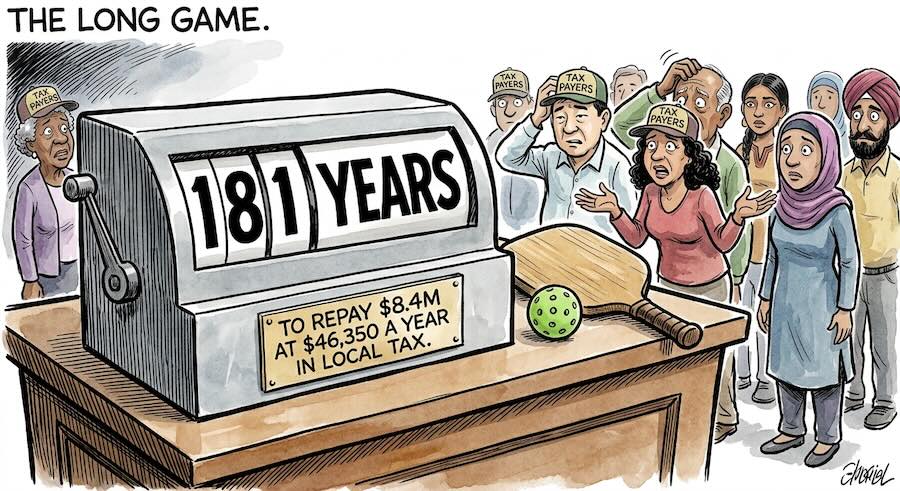

Two tournaments a year. About $46,000 in local taxes. More than $8 million in public money. Supporters say Uptown’s new courts will earn their keep. Before the first serve, here is what the numbers, our neighbors in Rome, Opelika and Dothan, and 30 years of research say about that promise.
The short version
- On Oct. 13, Columbus Council voted 7-2 to add $1.7 million to the Uptown pickleball complex on Third Avenue. News reports put the public total at $8.4 million. The city’s own budget figures add up to more.
- The case for spending more rests partly on tourism: tournaments that bring visitors, hotel stays and tax revenue.
- No feasibility study, business plan or attendance forecast appears in the council records 706report reviewed.
- The only economic study is a Columbus State University report. It projects about $46,000 a year in local taxes. At that rate, paying back $8.4 million would take more than 180 years, before operating costs.
- Other cities’ experience, and decades of research, point the same way: sports complexes can be good for a community, but they rarely pay for themselves.
- That doesn’t make the courts a bad idea. It means the question Council should be answering is a different one.
COLUMBUS, Ga. — When the vote came in on Oct. 13, supporters in the council chamber cheered. Seven councilors had agreed to put another $1.7 million into the city’s first dedicated public pickleball complex, enough to build all 25 planned courts instead of a scaled-back version.
“This begins to pay for itself and cover this initial investment fairly soon,” Councilor Joanne Cogle said, according to WTVM.
It is a claim that can be tested. Columbus is not the first city to build courts to attract tournaments, and economists have been studying whether sports facilities pay off for more than 30 years.
So 706report looked at three things:
- what the city’s own records show;
- what happened in cities that built similar complexes;
- what the research says.
This story lays out what we found, and the questions it raises. As before, our purpose is not to supply canned answers. These are questions residents, Council and the project’s supporters should be able to answer.
How $1.6 million became $8 million-plus
The Columbus Pickleball Association (CPA), a nonprofit group of players, has pushed for public courts since before 2020. Its members raised money, bought land and paid for demolition. The city’s role grew from there.
- June 2023. Council set aside $1,801,527 from reserves “for pickleball courts and EA Sports.” City staff now describe CPA’s original request as $1.6 million.
- November 2024. CPA bought a warehouse site at 1641 Third Ave. for $625,000. The plan grew to 28 courts.
- November 2025. The advisory committee for the 2nd Avenue/City Village tax allocation district (TAD) voted 3-2 to put $2.6 million of TAD money into the project.
- December 2025. Council hired Brasfield & Gorrie to design and build the complex. The contract price was not included in the public agenda packet.
- June 2026. Staff reported a budget of $7.48 million:
- $4.05 million from the city’s general fund reserves;
- $2.6 million from the TAD;
- $450,000 from OLOST, the “other local option sales tax,” for parking;
- about $382,000 in cash from CPA.
- September 2026. Staff said the project would run $1.7 million over budget. Soil conditions, stormwater design and construction prices were blamed.
- Oct. 13, 2026. Council approved the extra $1.7 million, 7-2. Councilors Cathy Cook and Simi Barnes voted no. Councilor Toyia Tucker was absent.
CPA says it has raised about $1.35 million in all. About $950,000 of that went to buying and clearing the land.
Cook, who joined Council in July, put it this way at a September work session: “It seems a little outrageous to me that we went from a commitment that was around 1.6, and now we end at 7.1, and we want another 1.7,” she said, according to WRBL.
What’s the real total? News reports, citing the city, say the public investment is now $8.4 million. But the city’s own pieces add up differently:
| Source | Amount |
|---|---|
| General fund reserves | $4,051,527 |
| Tax allocation district | $2,600,000 |
| OLOST | $450,000 |
| Added Oct. 13 | $1,700,000 |
| Total public money | $8,801,527 |
That is a $400,000 difference. A September staff slide put “total taxpayer funding” at $8,401,527, a figure that doesn’t match the slide’s own numbers. We need clarification from the city’s Finance Department. Staff estimated the full 25-court project at about $9.1 million.
It is also not clear where the rest of the general fund money was approved. The 2023 set-aside was $1.8 million. The general fund share is now $4.05 million. 706report did not find the council action that added the other $2.25 million.
Questions worth asking
- Is the public share $8.4 million or $8.8 million? Which pieces are counted, and which aren’t?
- When, and by what vote, did the general fund share grow from $1.8 million to $4.05 million?
- What is the Brasfield & Gorrie contract price?
- Where exactly is the extra $1.7 million coming from? The official meeting summary says “Staff to determine funding source.”
What would “pays for itself” take?
“Pays for itself” is a specific claim. It means the city gets back, in tax and fee revenue, at least what it spends: the cost of building the courts, plus the cost of running them.
That is different from “economic impact,” the number most often quoted for projects like this. Economic impact counts all the spending connected to a project, at businesses throughout the area. Only a small slice of that spending comes back to local government as taxes.
The study behind the numbers
The only economic analysis of the project is a report by the Butler Center for Research and Economic Development at Columbus State University (CSU), signed by its director, Dr. Fady Mansour. It is posted on the Pickleball Association’s website.
The study is often cited for one figure: $11.3 million in economic impact. That number is real, but it is mostly a one-time figure, the ripple effect of spending about $8 million on construction. Most of that money is the public’s own.
For the years after the complex opens, the study projects:
| Each year | Economic activity | Local taxes |
|---|---|---|
| Running the facility | $775,001 | $28,189 |
| Two tournaments, about 400 visitors each | $401,936 | $18,161 |
| Total | $1,176,937 | $46,350 |
At the Oct. 13 meeting, CPA president Lance Tankersley told Council the facility is projected to generate “about $165,000 a year in local, state and federal tax revenue.” That is consistent with the study. But most of that $165,000 goes to Atlanta and Washington. The local share is $46,350.
The arithmetic
These are 706report’s calculations, using the study’s own numbers:
- At $46,350 a year in local taxes, it would take about 181 years to collect $8.4 million.
- Counting only the tournament visitors, at $18,161 a year, it would take about 460 years.
- The study estimates the facility’s own running costs at $185,000 to $282,000 a year. (It gives both figures.) That is four to six times the local tax the study projects.
- The study’s “local” taxes include those collected by the county, the school district and other local bodies. The city’s own share is smaller.
To be fair to the study, it never claims the complex pays for itself. It assumes just two tournaments a year, a modest estimate, and it measures economic activity, not payback. The “pays for itself” claim came from elsewhere.
Where would tournament money go?
Even if tournaments fill local hotels, the extra hotel tax would not go to the courts. Columbus’s 8% hotel-motel tax is already divided up by Council:
- 4% to the Columbus Convention and Visitors Bureau;
- 2% to the Civic Center;
- 1% to the Trade Center;
- 1% to the performing arts.
Sales tax is similar. Muscogee County’s rate is 9%. Four cents of each dollar go to the state. Much of the rest is set aside by law for schools, transportation and voter-approved projects.
Questions worth asking
- Has anyone estimated what the city will actually collect, in taxes and fees, each year?
- Who will pay to run, light, staff and resurface the courts? From what budget?
- How many tournaments a year does the city expect, and how many visitors will stay overnight in Columbus hotels?
- Does Council intend to direct any hotel-motel tax to the complex? Would that take money from the bureau, the Civic Center or the arts?
What other cities found
Rome, Georgia: a busy center that still needs a subsidy
The closest Georgia example is the Rome Tennis Center at Berry College, a 60-court city complex built with about $12 million in sales-tax money and opened in 2016. Like Columbus’s courts, it was pitched as a tournament magnet.
What was promised. A 2009 study by the University of Georgia’s Selig Center, paid for by Berry College, projected $16 million to $28 million a year in economic impact from 20 to 35 tournaments.
What happened. The center is a success by many measures. It hosted 53 tournaments in 2024, more than the study’s best case. But Rome’s tourism office reported $7.7 million in economic impact that year, well under the low end of the forecast.
The operating gap. It does not pay for itself:
- In 2014, Rome raised its hotel-motel tax by two percentage points specifically to run the center.
- In 2018, the city’s audited financial report showed the center spending about $629,000 more than it earned, before that hotel tax was counted.
- Rome’s 2025 budget expects about $773,000 in earned revenue against about $1.37 million in operating costs. Hotel tax fills the gap.
- Debt payments come from yet another city fund.
Opelika, Alabama: the neighbor that got there first
Thirty miles away, Opelika built covered courts at its Sportsplex for a fraction of Columbus’s cost. The first 12 courts and their pavilion cost the city about $511,000 in 2018, about $43,000 a court, according to news reports at the time. Opelika later added 12 more, helped by a $100,000 sponsorship. The courts are free and open to the public.
Opelika now hosts four to six tournaments a year. Local tourism officials have estimated a few hundred thousand dollars in visitor spending per event. Those are estimates of spending, not tax revenue, and 706report found no city figures on what Opelika actually collects or spends on the courts. Some Columbus players already drive the 45 minutes to Opelika to play.
Columbus’s courts will cost about $336,000 each, nearly eight times Opelika’s first phase. Columbus’s courts include more, such as post-tension concrete, lighting and buildings. But they will compete for many of the same tournaments.
Dothan, Alabama: the twin down the road
About 90 miles south, Dothan opened a 25-court covered pickleball complex in July 2026. It cost $6.4 million: about $4.7 million from the city’s general fund, $1.5 million from Visit Dothan and $200,000 from Houston County.
According to WTVY, the courts drew more than 12,000 visits in their first month, about 370 a day. Admission is free. Dothan’s leisure services director said tournament visitors are “central to the city’s long-term plan.” He predicted, “It’ll help pay for itself in due time.”
It is too soon to know. But Dothan is now competing for the same regional tournaments Columbus hopes to attract.
A crowded field
Besides Opelika and Dothan, within a few hours’ drive:
- Macon has 32 indoor courts at Rhythm and Rally, part of a much larger mall redevelopment.
- Peachtree City opened 18 courts in May 2026.
Questions worth asking
- Which tournaments does the Columbus Sports Council expect to land, and which cities are bidding against it?
- Has anyone asked Rome, Opelika or Dothan what their courts cost to run?
- If Columbus needs extra hotel tax to cover operations, as Rome did, will Council say so now?
What the research says
Economists have studied public spending on sports facilities for decades. Their findings are unusually consistent.
Big stadiums don’t pay off. A 2023 review in the Journal of Economic Surveys by J.C. Bradbury, Dennis Coates and Brad Humphreys covered more than 130 studies. It found that recent research continues to confirm “the decades-old consensus of very limited economic impacts.”
Forecasts often look better than results. In a 2024 study in Public Finance Review, Robert Baumann and J.C. Bradbury re-ran a consultant’s model that had predicted a surplus for Cobb County’s Truist Park development. Using research-based assumptions, they estimated a net loss of $100 million to $200 million.
Small events are different, but only under conditions. Researchers including Nola Agha and Marijke Taks have found that smaller events can do better than big ones. They point to two conditions: visitors must be genuinely from out of town, and they must use hotel rooms and restaurant seats that would otherwise sit empty. John Crompton of Texas A&M, who studied 30 tournaments and events, put it simply: “without an overnight stay, the economic impact on a community is likely small.”
“Impact” is not the same as benefit. A study of a youth track championship in Windsor, Ontario, found $5.6 million in economic impact. A cost-benefit analysis of the same event found a net loss of $2.4 million.
Hotel tax rarely covers the bill. A study of Charlotte, N.C., found the extra hotel tax from sporting events fell short of what the city owed on its sports venues.
Questions worth asking
- Will the city measure results after the courts open: tournament registrations by ZIP code, hotel bookings, tax collections?
- If the numbers fall short, what happens next?
The case for building it
None of this means the courts are a mistake. Supporters make arguments that don’t depend on tourism:
- Recreation. Pickleball is one of the country’s fastest-growing sports, especially among older adults. Columbus has had few public courts. Some local players drive 45 minutes to Opelika for covered courts.
- Private money. CPA members raised about $1.35 million, bought the land and cleared it. Tankersley told Council that after “minimum administrative costs, we will give 100% of our profits back into this facility.”
- No new debt. Councilor Glenn Davis noted the money is a one-time investment that would not create debt. He also argued that waiting would only raise the price.
- Revitalization. Supporters say the four courts under the Second Avenue bridge would put a blighted space to use.
- Recruiting. “From a recruiting ability, will we be at the bare minimum to get into the game? Yes,” said Craig Howard, executive director of the Columbus Sports Council, according to WRBL.
These are real reasons. Cities build parks, pools and golf courses because residents use them, not because they turn a profit. Davis made that comparison himself, according to the Ledger-Enquirer: “It would be like golf.”
But that is a different argument from “it pays for itself.” If the courts are a public amenity, the honest question is whether $8 million-plus is the right price, and what else that money could have done. Residents raised that question at the meeting. “We always find money to appease uptown,” resident Corie Wilson said, according to WTVM.
Questions worth asking
- Is this a recreation project or a tourism project? The answer changes how it should be judged.
- The deal has the city owning the land and Parks and Recreation maintaining the courts. Has Council approved that? 706report found no approved agreement with CPA, and no deed transferring the land, in the council record.
- How much of any tournament revenue will come back to the city? Councilor Charmaine Crabb asked that revenue sharing be included in the agreement.
- Will the agreement come to Council, in public, before construction starts, as staff said it would in June?
What you can do
- Watch for the agreement. Staff told Council in June that the land donation and the city’s agreement with CPA would come back for approval before construction starts. That vote is the best remaining chance to set terms on operating costs and revenue sharing.
- Ask your councilor:
- What will the complex cost to run each year, and who pays?
- What will the city actually collect?
- Read the study yourself. The CSU report is posted at columbuspba.org/economic-impact.
- Speak at Council. Residents can sign up for the public agenda.
706report will follow the agreement, the contract and the first year of operating numbers. We’ll report what they show.
706report will publish responses from any of the people or organizations named in this story. Send yours through our contact form.
Notes on sourcing.
City of Columbus records (columbus-ga.municodemeetings.com):
Council minutes, June 13, 2023
Agenda packet, Dec. 9, 2025 (Res. 400-25, TAD Advisory Committee vote)
Agenda packet and minutes, June 16, 2026
Agenda packet and minutes, Sept. 29, 2026
Agenda packet and summary, Oct. 13, 2026
Hotel-motel tax allocation: CCVB contract agenda item, 2025
Studies:
Butler Center for Research and Economic Development, Columbus State University, Economic Impact Study of a New Pickleball Facility in Columbus, Georgia (2025)
Bradbury, Coates & Humphreys, Journal of Economic Surveys (2023)
Baumann & Bradbury, Public Finance Review (2024)
Taks et al., International Journal of Sport Finance (2011)
Crompton & Lee, Journal of Park and Recreation Administration (2000)
Agha & Taks, International Journal of Sport Finance (2015)
Depken & Stephenson, Economic Inquiry (2018)
Other cities:
City of Rome audited financial report, 2018, and monthly financial statements, 2024-25
Rome News-Tribune, Sept. 28, 2025
Georgia Trend, May 2010
WTVY, July 11 and Aug. 14, 2026
Opelika Observer, March 2022; WTVM, Jan. 2022 and Sept. 2023
News:
WTVM, Oct. 13, 2026
WRBL, Sept. 29 and Oct. 13, 2026
Columbus Ledger-Enquirer, Oct. 19, 2026
