
Term-limited Mayor Skip Henderson will present his nominee on May 12. The same council that voted 7-3 to terminate Isaiah Hugley over a year ago will decide whether to confirm the replacement on May 26 — a week after Hugley himself appears on the ballot to succeed Henderson. The council says it removed Hugley over operational scandals across finance, animal control, and a disputed pandemic-era grant. Hugley says he was fired for racial reasons and is suing. Both narratives now sit in the room where the next city manager will be chosen.
COLUMBUS, Ga. — The path to filling Columbus’s vacant city manager office runs through one of the more politically loaded handoffs a Georgia consolidated government has produced in recent memory.
Mayor Skip Henderson, term-limited and ineligible for a third consecutive four-year term, will present his nominee at the council’s regular meeting on Tuesday, May 12, 2026. The earliest the council can vote on confirmation, under its procedural rules, is Tuesday, May 26, 2026 — one week after the May 19 election that will choose Henderson’s successor and reshape several council seats. Newly elected mayors and regularly elected council members do not take office until January 2027. The May 26 vote will be cast by the same ten-member council that voted 7-3 to terminate City Manager Isaiah Hugley a year ago — over Henderson’s stated objection.
Hugley himself is on the May 19 ballot to replace Henderson.
The result is an institutional fork: a lame-duck mayor will name a successor for an office held until last year by a man currently running to become his boss, and a council that fired the previous occupant 7-3 will spend the following Tuesday voting on the replacement. Whatever the council decides will be inherited in January 2027 by a new mayor — possibly Hugley — who had no role in the choice and would face the same charter supermajority threshold to reverse it.
The role itself
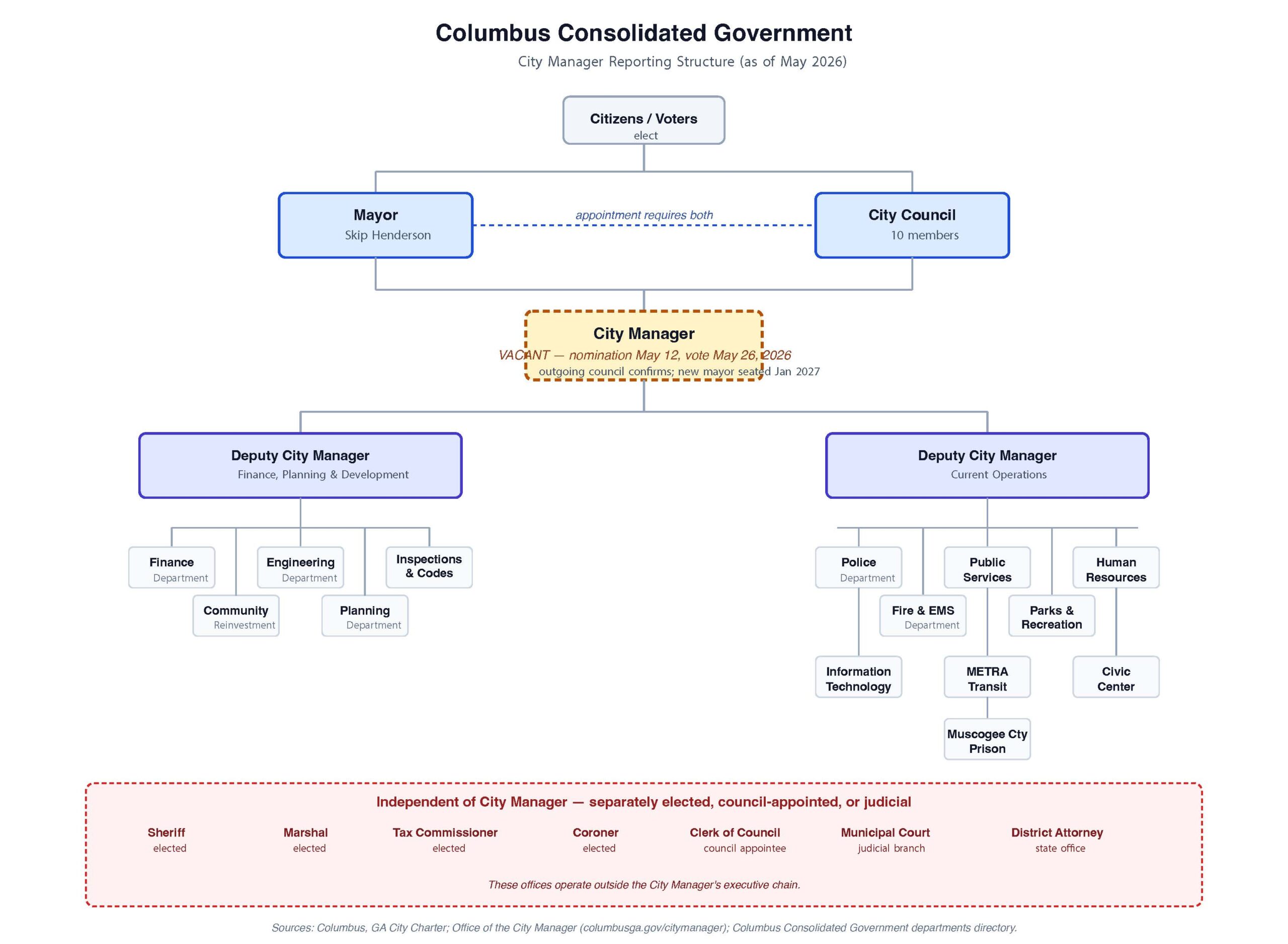
The Columbus city manager is the chief professional administrator of the consolidated city-county government formed by the 1971 merger of Columbus and Muscogee County. Under the city charter, the mayor and the council are elected; the city manager is appointed.
The mayor selects the nominee; the council confirms by majority vote. Once seated, the city manager is “responsible to the mayor” — but is removable by the council on the affirmative vote of seven of the ten members, even without the mayor’s recommendation. That asymmetric removal authority is precisely what ended Hugley’s tenure: Henderson did not recommend termination, but seven council members voted to remove him anyway, clearing the charter’s supermajority threshold by exactly one vote. Henderson said publicly afterward that he wished the outcome had been different.
The same supermajority threshold will protect whoever the council confirms on May 26 — any future mayor who inherits Henderson’s pick and wants to remove that person will need to assemble seven council votes to do so.
Day to day, the city manager runs the operational government — overseeing two deputy city managers, supervising department heads across police, fire and EMS, finance, engineering, planning, public services, parks and recreation, human resources, information technology, METRA Transit, the Civic Center, the Muscogee County Prison, and the inspections and codes office; developing the annual budget; and translating council policy into operational reality. The Sheriff, Marshal, Tax Commissioner, Coroner, Clerk of Council, Municipal Court, and District Attorney sit outside the city manager’s chain — separately elected, appointed by the council, or part of the judicial branch.
In a city of roughly 200,000 residents, the city manager is the official whose decisions, more than any other, determine whether services actually arrive at the curb.
Why the council says it fired Hugley
The formal termination notice was relatively general. It cited a “pattern of sustained dysfunction and operational breakdown” within the departments Hugley oversaw, named only two departments specifically — animal control and finance — and asserted that those breakdowns had resulted in law enforcement scrutiny and, in some cases, criminal investigation, at “great expense to the city and its taxpayers.” It did not itemize specific incidents within those departments. The full text of the notice is publicly available; what follows is the underlying record those general phrases reference.
The Finance Department audit and criminal investigation. A 2023 internal review by Columbus’s then-internal auditor, Donna McGinnis, reported that as much as $45.1 million in city funds was unaccounted for across multiple departments. An independent external audit, conducted by the Atlanta law firm Troutman Pepper, narrowed and refined the picture: it identified roughly $2.5 million in collectable but uncollected revenue — primarily from a multi-year backlog of unsent business license delinquency notices to companies that had failed to pay renewal fees between 2020 and 2022 — and estimated total potential revenue loss between $20.1 million and $26.9 million for the period from January 2016 through September 2023. City officials disputed how to characterize the gap; Finance Director Angelica Alexander argued the unaccounted figure reflected “unrealized opportunity” and was driven by pandemic-era staffing shortages rather than missing cash. The Muscogee County Sheriff’s Office opened a criminal investigation into the finance department that produced two arrests, though the charges were not formally connected to financial wrongdoing. The audit and investigation costs to the city totaled roughly $1 million.
The Columbus Animal Care and Control scandal. In summer 2024, leaked videos depicting alleged mistreatment of animals — and unprofessional conduct by staff, including statements by then-CACC Manager Canita Hardnett-Johnson — sparked public outcry and a Columbus Police Department investigation. By October 2024, eight current and former city employees had been arrested, with 34 felony and misdemeanor charges filed in total, including animal cruelty charges against Hardnett-Johnson. Hugley publicly acknowledged that the department was under-resourced — 25 positions funded with 12 unfilled — and announced that the city would move to privatize animal control, with the Paws Humane Society in negotiations to take over operations. Litigation related to the scandal remained ongoing as of Hugley’s termination.
Beyond the formal notice. A separate set of concerns was raised by individual council members in the public discussion surrounding the firing but was not formally itemized in the termination notice. Most prominent among these was a 2022 American Rescue Plan grant of $29,000 awarded to a State Farm Insurance agency operated by Carolyn Hugley — Isaiah Hugley’s wife and the Georgia House Minority Leader. Several council members argued the grant should have been disclosed to the full council and treated the matter as a conflict-of-interest concern. Hugley and Mayor Henderson have responded that the grant was disclosed to the mayor and the city attorney, that the council itself had delegated administration of the city’s roughly $78 million in ARP funds to the Greater Columbus Chamber of Commerce, and that the award went through multiple layers of independent review. Other concerns surfaced in the same window — about specific personnel decisions, contracting practices, and inter-departmental oversight — but, like the ARP grant matter, were not part of the formal grounds cited in the termination letter.
The narrowness of the formal notice has itself been a point of contention. Some observers have argued that confining the cited grounds to general language about animal control and finance makes the firing easier to defend in court if Hugley’s discrimination claim advances; others have argued the same narrowness reveals that the council’s strongest specific case was thinner than the sum of grievances aired in the run-up.
Why Hugley says he was fired
Hugley and his attorneys have offered a fundamentally different account of his termination. They argue that the operational issues cited by the council were either pretextual, exaggerated, or attributable to factors beyond Hugley’s direct control, and that the actual driving force behind the 7-3 vote was racial animus by at least one of the council members who voted to remove him.
On August 19, 2025, Hugley filed a charge of discrimination with the Equal Employment Opportunity Commission. The complaint alleges that Councilor Charmaine Crabb — who made the motion to terminate Hugley and was the first signature on the termination notice — made racially charged statements during a Muscogee County Sheriff’s Office investigation of the city’s Finance Department. Among the statements his complaint attributes to Crabb are references to Hugley and Black community members as “little mafiosos” exhibiting “mafia type behavior,” and remarks about “skin color”-based hiring she alleged favored members of Historically Black fraternities and sororities. Hugley’s complaint argues those statements were part of a pattern of conduct that culminated in his retaliatory firing in violation of Title VII of the Civil Rights Act of 1964.
Hugley’s attorney also sent a May 30, 2025 letter to the city attorney demanding immediate reinstatement, a written apology, and $213,278.52 in compensation. He has separately accused Councilor Byron Hickey of unethical actions in a related dispute. Crabb and the other six councilors who voted to terminate retained their own counsel. Their attorney has rejected Hugley’s characterization of the firing as racially motivated and has defended the council’s decision as grounded in the documented operational record.
The underlying factual disputes — what Crabb did or didn’t say, whether her alleged statements influenced the votes of other council members, whether the operational issues attributed to Hugley were of the magnitude the council alleged or were the foreseeable result of pandemic-era staffing constraints across his departments — will be litigated in the EEOC process and, potentially, in federal court if the EEOC issues a Notice of Right to Sue.
For the purposes of the May 26 confirmation vote, the dispute matters because it is being asserted in real time by the most visible Columbus political figure outside Henderson himself. Hugley is not commenting on the matter as a removed administrator looking backward; he is commenting on it as a candidate for the mayoralty asking voters to choose him on May 19, framing his platform of “restoring civility to city government” as an explicit response to the council majority that fired him.
The Hugley campaign
Hugley served as Columbus’s city manager for nearly 20 years before his May 27, 2025 termination — the first African American to hold the position. He officially announced his mayoral candidacy in March 2026, drawing nearly 400 attendees to a launch event at Warehouse 9 in midtown Columbus. Earlier, in October 2025, hundreds had gathered at a separate event to back his expected candidacy. If he wins on May 19, Hugley would become the first Black mayor popularly elected in Columbus’s history.
His platform — economic development, infrastructure, and “restoring civility to city government” — is overtly framed as a contrast to the current administration and council majority.
What’s known about the candidates
Henderson has confirmed that he interviewed five candidates during the past week and intends to recommend one of them. The mayor has declined to release the names publicly, has not shared them with council members, and has resisted at least some attempts to obtain the information through Georgia’s Open Records Act.
Henderson has also confirmed that none of the five current candidates were among the finalists interviewed in the first round of the search in late 2025 — an effective acknowledgment that the present shortlist is a fresh slate rather than a continuation of the earlier process that produced no nominee.
A year of false starts
The path from Hugley’s termination to the May 26 vote has been long, public, and frequently contentious.
After the May 2025 firing, Henderson initiated a search that drew roughly 30 applicants by the fall. By October 2025, the field had been narrowed to five finalists, and several council members publicly anticipated that Henderson would bring a name forward in November. He didn’t. In a December 17 press conference, Henderson confirmed he would not advance any of the October finalists, saying he had not found a candidate he was confident submitting for council confirmation, and announcing that the search would pause for an estimated three to six months while the city completed a comprehensive review of government salaries.
The pause provoked open council criticism. Councilman John Anker told Henderson, “You have a clear duty that you have failed.” Henderson responded by calling Anker’s remarks “reckless” and “arrogant.” The mayor maintained throughout that the paused process complied with Georgia law, a position he has continued to defend.
In his State of the City address on February 17, 2026, Henderson announced the search would resume, with the position re-advertised on February 18 and a target of presenting a candidate to council by April. April came and went without a recommendation. By early May, Henderson had compressed the final round of interviews into a single week and disclosed his intent to bring a recommendation to the May 12 meeting.
Why the timing matters this way
For Columbus residents trying to read the politics of the May 26 vote, the relevant calendar is unusual enough to spell out plainly.
The current council is voting. The same ten-member council that voted 7-3 to fire Hugley in May 2025 — over Henderson’s stated objection — will decide whether to confirm his replacement. Voting to terminate were Byron Hickey, Charmaine Crabb, JoAnne Cogle, Toyia Tucker, John Anker, Glenn Davis, and Walker Garrett; voting against were Travis Chambers, Gary Allen, and Bruce Huff. Several of the same yes-voters later pressed Henderson publicly over his December 2025 pause of the search. Whatever institutional friction the past year produced will be present in the room.
Some of those members may already have lost their seats. The May 19 election will determine who occupies regular council seats beginning in January 2027. Members defeated at the polls on May 19 will nonetheless serve out the remainder of the current term, including casting the May 26 vote — voting as lame ducks themselves on a nominee submitted by a lame-duck mayor.
The new mayor has no role in the choice. None of the candidates running for mayor — Hugley included — has had any formal involvement in the search, access to the candidate list, or procedural mechanism to influence the May 26 vote.
The transition runs at least seven months. Between May 26, 2026 and January 2027, Columbus’s confirmed city manager — assuming the May 26 vote produces one — will operate under Henderson’s continuing administration. The new mayor’s first effective day in office is January 2027.
Removal requires a supermajority. Should the next mayor and council wish to make a change, they will need seven of ten council votes to remove the city manager — the same threshold that ended Hugley’s tenure.
Special-election seats are a separate clock. Winners of any special elections to fill currently vacant council seats on the May 19 ballot would not be seated until results are certified, possibly in early June — after the May 26 vote.
Council reactions
Several current council members have expressed frustration with how the closing weeks of the search have been managed. Councilor Toyia Tucker told reporters she learned of the May 12 plan through news coverage rather than from a direct briefing by the mayor. The lack of public information about the five candidates has compounded the friction; council members have indicated they will not see the nominee’s name until Henderson formally submits the recommendation, leaving them limited time to evaluate the candidate’s record, references, or fit before the May 26 vote.
What’s actually at stake on May 26
The new city manager will inherit a stack of consequential pending decisions: the FY 2027 budget development cycle now underway, the unresolved technology selection and funding for the Columbus Water Works PFAS treatment build-out, ongoing reform and oversight work in the finance department, the implementation of the animal control privatization, and a long list of capital and personnel matters that have accumulated during the year-long executive vacancy. These are not decisions a city can defer indefinitely.
If the May 26 vote confirms Henderson’s nominee, Columbus will end its longest leadership vacuum in recent municipal memory. The new mayor, taking office in January 2027, will begin work alongside a city manager not of their choosing — protected, for the foreseeable future, by the seven-vote supermajority required for removal. If the vote rejects the nominee, the search resets entirely, and the new mayor will inherit a process that has now consumed more than a year, with the immediate burden of starting over.
The bigger question
Two competing accounts of the same set of events will be present in the council chamber on May 26. One says the council acted appropriately under the charter’s supermajority removal process to address documented operational failures across multiple city departments. The other says the council acted on racial animus and is using the same supermajority structure to install a successor before electoral or legal accountability arrives. Both accounts are being asserted publicly, in real time, by the people most directly involved.
A consolidated government of Columbus’s size is not designed to operate without a permanent chief administrator for a year. That it has done so, however imperfectly, is testament to the work of the deputy city managers and department heads who have absorbed responsibilities ordinarily flowing through the city manager’s office. But that arrangement is not sustainable — and every additional week of vacancy compounds the cost in deferred decisions, institutional drift, and public confidence.
Whether the May 26 vote ends that drift or extends it depends on five candidate names the public has not yet been allowed to see, on the judgment of officials whose own time in office is rapidly running out, and on the verdict Columbus voters render seven days before the confirmation vote — which may or may not include returning to office the man whose firing, contested on grounds that have not yet been adjudicated, set the entire sequence in motion.
Reporting drew on the City Charter for Columbus, Georgia (publicly available at columbusga.gov); the Office of the City Manager and Office of the Mayor websites; the Columbus Elections and Registration Office; the Hugley campaign’s public materials; the Hugley v. Columbus EEOC filing; coverage of the council’s termination notice and the underlying finance and animal control investigations; and reporting from WRBL, WTVM, the Columbus Ledger-Enquirer, Georgia Public Broadcasting, the Courier News, Now Georgia, and Fountain City News. Specific personnel details that the city has not publicly confirmed — including the names of the five candidates currently under consideration — are described as undisclosed, consistent with the city’s stated position. Mayor Henderson’s term-limited status is established under Columbus’s two-consecutive-term rule for the office. Newly elected mayors and regularly elected council members in Columbus take office in January following the election; winners of special elections to fill vacated seats take office once results are certified. The factual disputes embedded in Hugley’s EEOC discrimination charge and the council’s stated grounds for termination are presented as competing accounts; both sets of claims remain under active legal and public review.
City Manager – Org Chart