
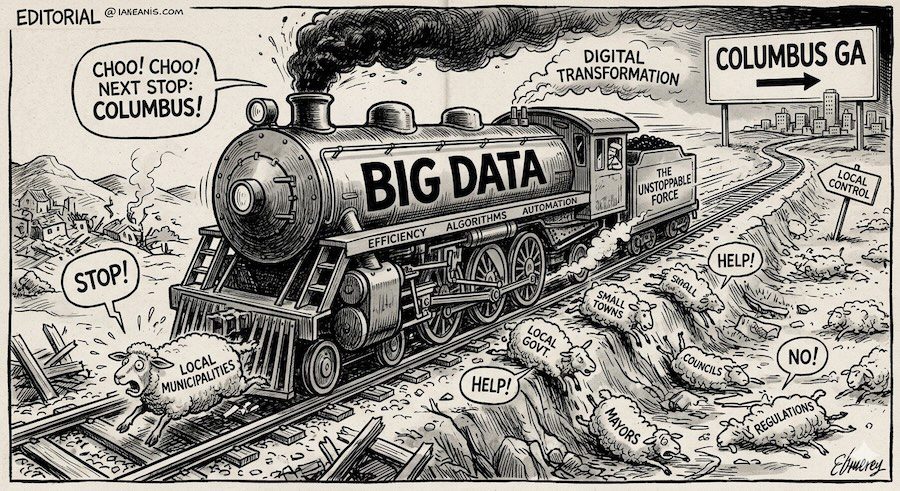

What Columbus Residents Need to Know About the Financial Risks
A Plain-Language Financial Analysis for Columbus, Georgia Residents and City Council
PROJECT RUBY AND YOUR WALLET — IMPORTANT UPDATE
IT’S MUCH WORSE THAN I FIRST THOUGHT.
We took a closer look at the Development Agreement that is being proposed and discovered some issues that every citizen should be aware of.
What Is Project Ruby?
Project Ruby is a proposed 5 billion hyperscale data center campus planned for approximately 865 acres in northeastern Muscogee County, near Upatoi, bordering Harris and Talbot counties. The project is being developed through Habitat Real Estate Partners, a Georgia-based firm, which created a company called Muscogee Property 1 LLC specifically for this purpose. Atlas Development is also involved. The actual technology company that would operate the facility has not been publicly disclosed and will not be until a permit is filed.
The campus would consist of four large buildings and is planned to be built out between 2027 and 2030. It has requested a 600-megawatt electrical grid connection — an enormous amount of power — from Flint Energies, a rural electric cooperative that serves the area.
City officials from Choose Columbus and the Development Authority of Columbus have promoted the project as a transformational economic investment. This article does not dispute that data centers can bring genuine economic benefits. However, several specific financial details of this deal — largely absent from public discussion — deserve serious scrutiny before any vote is taken.
This analysis focuses exclusively on financial and tax revenue risks. Questions about water usage, environmental impact, and electricity supply are important and are being addressed elsewhere. What has received far less attention is how the city’s budget could be directly affected — and who pays if the projected revenues don’t materialize.
Section 1: Columbus Has Given Up Its Leverage — for Free
One of the most striking facts about Project Ruby is buried in Choose Columbus’s own public FAQ. Unlike many comparable data center deals across the country, Columbus is offering no local financial incentives — no tax breaks, no abatements, and critically, no Payment in Lieu of Taxes (PILOT) agreement.
At first glance, that might sound like a good thing: the city isn’t giving anything away. But the Choose Columbus FAQ itself acknowledges the consequence of this approach in plain language:
“Because we are not providing any incentives, we cannot require that a company perform to any commitments.”
— Choose Columbus, Project Ruby FAQ
Read that again carefully. By declining to structure a formal incentive agreement, Columbus has also declined its most powerful tool for holding the developer accountable. There is no enforceable job creation target. There is no minimum tax payment guarantee. There is no clawback provision if the project underperforms or is abandoned. There is no contractual floor on how much revenue the city will receive in any given year.
The city’s approach appears to be: let the project proceed on its own terms, collect whatever taxes the law requires, and trust that the numbers will work out. That is a significant gamble with public finances.
Section 2: How the Tax Revenue Actually Works — and Why It’s Fragile
Choose Columbus projects that Project Ruby could generate up to .7 million per year in property tax revenue by 2030 — before depreciation. That is a compelling headline number. But understanding where it comes from reveals serious vulnerabilities.
A data center’s taxable value is largely determined by the computer hardware inside it — specialized chips, server racks, and memory equipment that must be completely replaced every three to five years to remain competitive. The price of that hardware swings dramatically based on global supply and demand for semiconductors.
A Real-World Example
During a period of global chip shortages — when semiconductors are scarce and expensive — a data center might spend million on a hardware refresh. At Columbus’s 9% tax rate, that generates million in a single year. Now imagine global chip manufacturers have caught up with demand and prices normalize. The same hardware refresh now costs million. Tax revenue drops to .5 million — a 50% cut — while every city expense remains exactly the same.
This is not speculation. The semiconductor industry runs in well-documented boom-and-bust cycles. The projections being used to promote Project Ruby are based on current market conditions — a period of historically high AI chip prices driven by extraordinary global demand. Those conditions will not last forever.
The .7 million annual projection assumes peak-era hardware valuations held constant. If chip prices normalize — as they have repeatedly throughout history — that figure could shrink dramatically. And because it is tied to hardware depreciation as well, even without a price crash, the taxable value of the equipment inside the building drops 80 to 90 percent within three years of purchase, regardless of how busy or profitable the facility is.
Section 3: Georgia’s Tax Exemption Makes It Worse
Georgia offers a substantial sales and use tax exemption to data center operators — servers, IT equipment, and related hardware can be purchased tax-free once a minimum investment threshold is crossed. In Muscogee County, that threshold is 250 million, with a sunset date of December 31, 2031.
This exemption creates a compounding problem. When chip prices are low, the data center can buy far more hardware before reaching the million threshold. That means Columbus waits even longer before collecting its first dollar of taxable hardware revenue — the very revenue that is supposed to justify the project.
The city also loses the option of collecting a simple, reliable sales tax at time of purchase. Instead, it must rely on property taxes that depreciate rapidly and valuations that move with global chip markets. This is precisely the kind of structural trap that has caught other municipalities off guard.
Section 4: Flint Energies — A Rural Co-op Facing an Industrial-Scale Ask
Project Ruby has requested a 600-megawatt electrical grid connection from Flint Energies — phased in starting with 200 megawatts in 2029 and expanding through 2034. To put that in perspective, 600 megawatts is enough electricity to power hundreds of thousands of average homes.
Flint Energies is a rural electric cooperative. It was not designed to deliver industrial-scale power loads of this magnitude. As a town hall representative noted publicly in March 2026, Flint Energies does not currently have that capacity — meaning Georgia Power would likely have to become involved to deliver the required power.
This matters financially for two reasons. First, expanding grid infrastructure to serve a 600-megawatt load in a rural area is extraordinarily expensive, and it is not yet clear who bears that cost — the developer, Flint Energies members, or some combination. Second, and more critically, Flint Energies is a co-op: its costs are shared among its member-ratepayers. Those are not Fortune 500 corporations. They are farmers, small businesses, and rural households in and around Muscogee County.
Flint Energies does not have 600 megawatts of capacity. Georgia Power would likely have to be involved — which means this is no longer simply a local utility question. It is a statewide power infrastructure question with costs that could flow back to rural ratepayers.
Section 5: The PSC’s Own Staff Raised the Alarm — and Were Overruled
Perhaps the most important piece of evidence in this entire debate comes not from outside critics, but from the Georgia Public Service Commission’s own Public Interest Advocacy staff — the team whose job is specifically to represent the interests of ordinary ratepayers.
That staff found that large industrial customers — the category that includes data centers like Project Ruby — drive up average fuel costs for all other electricity customers by approximately 5 to 11 percent per month.
This is not a fringe estimate. It is the finding of the state agency’s own consumer protection arm, submitted as part of a formal regulatory proceeding. The PSC commissioners voted to approve the Georgia Power fuel agreement anyway, without requiring changes to how data center costs are allocated.
For Flint Energies members specifically — the rural ratepayers who would be most directly connected to Project Ruby’s power demand — a 5 to 11 percent monthly fuel cost increase represents a real and recurring financial burden. A household currently paying a month in electricity costs could see to added to every single monthly bill, indefinitely, simply because a data center is drawing power from the same grid.
What 5–11% Looks Like on a Real Bill
Current monthly electric bill:
At 5% increase: +/month = more per year
At 11% increase: +/month = more per year
For a rural Flint Energies household, this is not a one-time cost. It recurs every month, every year, for as long as the data center operates.
Section 6: The 4% Franchise Fee — Running the Real Numbers
Columbus is expected to receive a 4% franchise fee on the electricity consumed by the data center. Supporters point to this as a meaningful community benefit — a reliable revenue stream that doesn’t fluctuate with chip prices. That much is true. But let’s put actual dollar figures to it and see what it really means for the average household.
The Back-of-the-Envelope Math
Project Ruby has requested a 600-megawatt power connection. At industrial electricity rates, that translates to an estimated million to .8 million in annual franchise fee revenue for Columbus. The U.S. Census Bureau puts the Columbus-Muscogee consolidated government area at roughly 81,400 households.
If the city were to pass every single dollar of that franchise fee revenue directly back to residential ratepayers as a bill credit — a best-case, hypothetical scenario — here is what each household would see:
| Scenario | Hypothetical Household Benefit |
|---|---|
| Low-end estimate (M ÷ 81,400 households) | .70/year | .30/month |
| High-end estimate (.8M ÷ 81,400 households) | .10/year | .15/month |
A savings of to per month sounds useful — until you put it next to the full picture of what’s happening to electricity bills in Georgia right now.
How the Numbers Stack Up Against Reality
The franchise fee does not exist in a vacuum. Georgia Power customers have absorbed dramatic rate increases in recent years, and the PSC’s own findings confirm that large industrial loads like data centers are a contributing driver of fuel cost increases. When you line up all the numbers side by side, the franchise fee’s value comes into sharp focus:
| Item | Monthly Impact on Your Bill |
|---|---|
| Project Ruby franchise fee credit (hypothetical best case — 100% passed to residents) | − to − / month |
| Georgia Power’s promised PSC rate relief (projected, by 2029) | −.50 / month |
| Actual rate increases already absorbed by customers since 2022 (grid upgrades & fuel changes) | +.00 / month |
| Net position: even in the best case, the franchise fee credit covers roughly one-third of the rate increases already absorbed since 2022 — before factoring in any additional fuel cost increases driven by data center loads. | |
That bottom line deserves to be stated plainly: even if Columbus collected every dollar of the franchise fee and handed it directly back to residents — which is not how municipal franchise fees work in practice — it would still only offset about one-third of what Georgia Power customers have already absorbed in rate increases since 2022, increases driven in significant part by the infrastructure buildout for the very tech boom Project Ruby represents.
The franchise fee is real money and a genuine, stable revenue stream. But it is not a rebate program, and it should not be presented as one. The city’s general fund and the average household’s monthly utility bill are two different ledgers, and conflating them significantly overstates the direct benefit to residents.
In short: the franchise fee is a floor, not a foundation. It provides the city with some stable income, but it does not offset the costs residents are already paying — and may continue to pay — as Georgia builds out grid capacity for the tech boom.
Section 7: When Everything Goes Wrong at Once
Consider what happens if several of these risks materialize simultaneously — which is not an unlikely scenario, but a plausible one based on historical patterns:
| ▼ Revenue Falls | ▲ Costs Rise |
|---|---|
|
|
| Result: The gap is filled by Columbus residents — through higher taxes, higher utility rates, or cut services | |
Section 8: Questions the City Council Must Answer Before Voting
The following questions are not rhetorical. They are the specific financial safeguards that responsible municipal governance requires before approving a deal of this scale. Residents should demand clear, written answers to each one.
- The .7 million annual revenue projection — is it based on current peak chip prices, or on normalized long-term average semiconductor prices? What does the projection look like if chip prices revert to pre-AI-boom levels?
- Without a PILOT agreement, what is the legally guaranteed minimum amount of tax revenue Columbus will receive in any single year? What is the worst-case floor?
- Who pays for the grid infrastructure required to deliver 600 megawatts to this site — the developer, Flint Energies members, or taxpayers? Is that commitment in writing?
- Has the city modeled the impact on Flint Energies ratepayers if the PSC’s own staff finding of 5–11% monthly fuel cost increases proves accurate?
- The 4% franchise fee on electricity — what is the projected annual dollar amount, and is it contractually guaranteed regardless of whether the project reaches full capacity?
- If the project is built but never reaches its promised scale — or is sold to a different operator — what obligations transfer, and what enforcement mechanisms does Columbus hold?
- Given that Choose Columbus has stated Columbus cannot require the company to perform to any commitments, what protections does the city actually have if this project underdelivers?
The Bottom Line
Project Ruby may be a genuine economic opportunity for Columbus. A billion investment, nearly 200 jobs, and significant tax revenue are not things any city dismisses lightly.
But the financial structure of this deal, as it currently stands, is troubling. There is no minimum payment guarantee. There is no clawback clause. The revenue projections are built on volatile global chip prices. The power demand falls on a rural cooperative not designed for this scale. The PSC’s own consumer protection staff has documented that large data center loads drive up fuel costs for everyone else on the grid. And the city has explicitly acknowledged it has no leverage to hold the developer to any commitments.
That is not a deal. That is a hope.
Columbus residents and their elected council members deserve to know these facts — not to kill the project, but to demand that it be structured in a way that genuinely protects the public. A project this size, built on this site, drawing this much power, should come with enforceable guarantees. Without them, Columbus is taking all of the risk and the developer is taking all of the upside.
The City Council should not approve Project Ruby in its current form without receiving clear, written answers to the questions in Section 8 — and without contractual protections that guarantee a minimum revenue floor and hold the developer accountable to its commitments.
Sources: Choose Columbus Project Ruby FAQ (choosecolumbusga.com); Georgia Public Broadcasting; Data Center Dynamics; WTVM Columbus; Inside Climate News; Georgia Public Service Commission; Southern Environmental Law Center. This article is intended for general public information and civic engagement purposes.
