

706REPORT.COM · COLUMBUS, GEORGIA · JUNE 3, 2026
We support smart development. We oppose a blank check.
Here is our alternative — and why it matters before June 9.
THE OPEN LETTER
To the Columbus City Council: We Deserve a Better Deal.
We are Columbus residents, Muscogee County taxpayers, and members of the community that will live with whatever decision you make on Project Ruby. We are not here to stop all development. We are here because the deal being offered is not good enough — and we have written a better one.
On June 2, several hundred of our neighbors showed up to City Hall. We want to be clear about what that turnout meant. It was not a ‘no to technology.’ It was not a rejection of economic development. It was something more specific and more important: it was a community telling its elected representatives that something about this process feels wrong — and asking to be heard before it is too late.
We have heard the concerns, and we have done the homework. Over the past several weeks, we have studied the proposed Chamber of Commerce Technology Overlay ordinance, the independent analysis of that document, the PSC filings, the Georgia Power IRP, and the documented experience of communities that approved data centers before us. What we found is serious.
“The city has publicly acknowledged it cannot require the developer to perform to any commitments — because no formal incentive agreement was signed.”
There is no guaranteed minimum tax payment to protect Columbus’s budget if global chip prices fall — and they have fallen before, sharply, in every semiconductor cycle. The property tax projections being used to sell this project are based on today’s peak AI-era chip prices. When those prices normalize, the revenue could shrink by half while every city expense stays exactly the same.
There is no reclamation bond — money posted upfront so that if this project is abandoned, Columbus is not left holding an 865-acre industrial site with no funds to clean it up. Reclamation bonds are standard practice for quarries, landfills, and power plants. This project apparently doesn’t need one.
There is no protection against PFAS — the ‘forever chemicals’ — in data center cooling systems. The Chamber ordinance permits immersion cooling while simultaneously asserting PFAS is not a concern. Those two statements cannot both be true. Columbus Water Works is currently spending $200 million to remove PFAS from our drinking water. Adding more industrial PFAS loading without an explicit prohibition is not an oversight. It is a choice — and it is the wrong one.
There is nothing preventing this from becoming not one data center but many. The 130-acre Project Ruby campus occupies 15% of the 865-acre site. The other 85% — 735 acres — remains in the same developer’s hands, with no binding limit on how many additional campuses could follow once the power lines, water mains, and roads are already in place.
We are not asking the Council to reject Project Ruby. We are asking for something much simpler: give us a deal worth saying yes to.
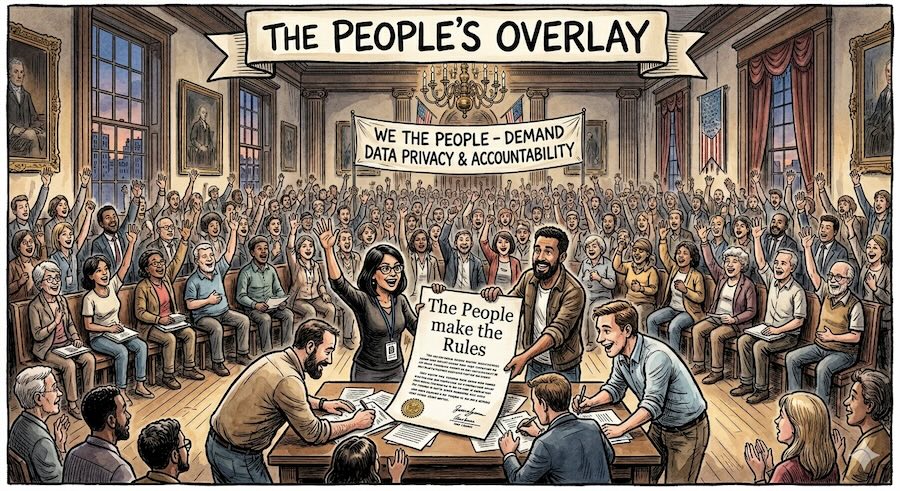
That is why we have written The People’s Overlay — a complete, legally formatted alternative ordinance that addresses every gap in the Chamber draft. It has been submitted to the city attorney’s office for legal review. It has been sent to every member of the Columbus City Council. And now we are asking you — Columbus residents — to stand behind it.
WHAT WE’RE ASKING FOR
Six Protections Missing from the Current Draft
The People’s Overlay adds each of these to the Chamber ordinance. None of them are radical. All of them are standard practice in comparable industrial agreements across the country.
01 A Guaranteed Minimum Tax Payment (PILOT)
A legally binding annual revenue floor that doesn’t collapse when global chip prices fall. Without it, Columbus’s budget is tied to the most volatile commodity market on earth. Choose Columbus’s own FAQ admits the city cannot require the developer to meet any financial commitments.
02 A Reclamation Bond
Money posted upfront — sized by an independent engineer — to fully remediate the 865-acre site if the project fails or is abandoned. Standard practice for quarries, landfills, and power plants. Conspicuously absent from the Chamber draft.
03 A Real Noise Buffer
A 500-foot setback from the full property boundary — not the building — with pre-construction acoustic modeling for low-frequency (dBC) sound. The Chamber committee spent more time on noise than any other topic, then admitted standard barriers cannot stop the primary complaint, and recommended the shorter setback anyway.
04 No PFAS in the Cooling System
An explicit prohibition on fluorinated cooling fluids — closing the gap created by permitting immersion cooling while ignoring that two-phase immersion systems use PFAS-based dielectric fluids. Columbus Water Works is spending $200 million on PFAS remediation now. This is not the time to add more.
05 A Site-Wide Development Cap
A binding megawatt limit for the entire 865-acre parcel — recorded as a deed restriction — so that approving Phase 1 does not automatically open the door to five or six more campuses on the same land once the infrastructure is in place.
06 Independent Legal Counsel for Columbus
The city’s Development Agreement negotiations must be supported by independent outside legal counsel — paid for by the developer. Columbus should not negotiate alone against the outside legal team of Microsoft, Meta, Google, Amazon, or Apple.
HONEST ANSWERS
We Know What You’re Thinking. Here’s Where We Stand.
Are you just against all data centers and technology?
No. Data centers are real economic infrastructure. High-paying jobs are real. Tax revenue is real. The question is not whether to welcome technology — it is whether this specific deal is structured to protect Columbus long-term. A deal with no minimum revenue guarantee, no reclamation bond, and no cap on future development on the same land is not a good deal, regardless of what it is for.
Is this already a done deal? Did council decide before the public had a say?
The ordinance has not passed. The first reading was delayed on June 2 after several hundred residents appeared in opposition. The next vote is scheduled for June 9. Nothing is final yet. That is exactly why this week matters — and why we are moving fast.
Is the Chamber of Commerce working for residents or for the developer?
The Chamber committee included architects, construction firms, utility representatives, and business leaders — many of whom stand to benefit directly if this project proceeds. That does not make them dishonest. It does mean their recommendations are worth scrutinizing. Their committee produced no land use economist, no representative from neighboring counties, no independent financial analyst, and no resident from the neighborhoods closest to the site. We are not accusing anyone of bad faith. We are saying the composition of the committee shows in the conclusions.
Will signing this hurt Columbus’s chances of getting good economic development?
The opposite. A city that negotiates strong protections attracts serious, responsible operators — not developers who need a weak framework to make their numbers work. The communities that have lost control of data center development are the ones that approved the first project without asking hard questions. We are asking the hard questions now, before we have no leverage left.
What exactly is The People’s Overlay?
It is a complete, legally formatted alternative ordinance — written in the same statutory structure as the Chamber draft, amending the same sections of Columbus’s Unified Development Ordinance. It has been submitted to the city attorney’s office for legal review and to every member of the City Council. It adds six protections the Chamber version lacks. It does not prohibit data centers. It establishes the conditions under which they can be built responsibly.
What does signing this actually accomplish?
It puts a number on the record. It tells every council member that Columbus residents are organized, are watching, and have a specific documented alternative in hand. Numbers matter in local politics. Several hundred people showed up June 2. This petition shows that those people represent a much larger community that could not be there in person but is paying attention.
ADD YOUR NAME
Stand Behind The People’s Overlay
Signing on tells the Columbus City Council that you support the six protections in The People’s Overlay — and that you want them considered before any vote on June 9.
TO ADD YOUR NAME:
- Email: Send your name, neighborhood, and a brief comment (optional) to [email protected] with the subject line “I support The People’s Overlay”
The People’s Overlay · Columbus and Muscogee County, Georgia · June 2026
Published in partnership with 706Report.com · Questions: [email protected]
The People’s Overlay is a citizen initiative. Not affiliated with any political party, campaign, or commercial organization.
