

Author’s note: The author submitted an alternative ordinance — The People’s Overlay — to all Columbus City Council members, the city attorney, and the mayor before the June 9, 2026 public hearing, and spoke at that hearing. 706Report.com has covered Project Ruby since its February announcement. Prior coverage is linked throughout this series.
Most Columbus residents following the overlay debate had assumed there was a single set of proposed rules. By the time the dust had settled at the end of the first reading, there were actually three, plus many more demands and suggestions.
Understanding what each document proposed — and how the process that produced the final ordinance actually worked — requires stepping back to where the drafting started.
The Process That Was Supposed to Happen
After Project Ruby was announced in February, the Planning Advisory Commission began work on an overlay ordinance. On March 4, the PAC convened its first substantive work session. It was a meeting that Columbus resident Paul Olson would later allege violated the state’s Open Meetings Act because it hadn’t been properly advertised in the legal organ. Olson filed a complaint with the Georgia Attorney General’s Office and wrote directly to the mayor and council arguing they should not vote until the legal question was resolved. The attorney general had not responded as of June 16, the day the overlay passed. The council voted anyway. A finding in Olson’s favor would not necessarily invalidate the overlay since the complaint concerns the PAC’s preparatory work, not the council’s legislative action. However it would place documented procedural questions in the public record, potentially relevant to any future legal challenge.
Whatever happened at that March 4 session, the PAC voted 5-1 on March 23 to recommend the overlay to the council with a dissenting member’s formal reasoning calling for a 500-foot buffer along residential property lines. That number appeared in the PAC’s own recommendation record but did not make it into the draft ordinance forwarded to council. It would then just as quietly reappear in the final amended document. Nobody ever publicly explained either movement.
Simultaneously, the Greater Columbus Chamber of Commerce had convened a select committee to review the overlay and produce its own recommendation. The committee included architects, engineers, utility representatives, and business professionals. It also included, as I reported in an investigation published before the final vote, representatives of Georgia Power (which would benefit from a massive new electricity load on its system), a construction firm that builds data centers professionally, and Columbus Water Works (which would become a captive service provider to the project) — each with a direct financial stake in the project’s approval. No land-use economist, independent financial analyst, public health professional, or representative of the neighborhoods closest to the site was included. They produced an overlay document and shared it at the June 2 First Reading.
The city had its own document written by the PAC, so now there were two ordinances in play. But a third one was about to appear. It came from 706report.com a day later with copies sent to Council. It was called “The People’s Overlay” so now there were three differing visions of a path forward. (more about how it got there in a moment)
Three Visions of the Same Problem
What did each document actually propose? The differences are sharpest when the key provisions are placed side by side.
| Provision | PAC Draft (June 2) | Chamber Overlay | People’s Overlay |
|---|---|---|---|
| Buffer from residential property line | 200 ft | 200 ft | 500 ft from full owner parcel boundary |
| Noise measurement | A-weighted (dBA) only | A and C-weighted | A and C-weighted |
| Pre-construction acoustic study | Not required | Required | Required |
| Diesel generators | Permitted | Not addressed | Prohibited |
| Generator emissions standard | None | Not addressed | Tier IV |
| PFAS in cooling fluids | Not addressed | Open-loop cooling prohibited; no explicit PFAS ban | Explicitly prohibited at permitting |
| Development agreement | 3 sentences | Detailed, multi-element (8 elements) | Detailed, multi-element |
| Site-wide megawatt cap | No | No | Deed restriction on full parcel (cap recorded on the property title — not increaseable without a full new public rezoning) |
| Minimum revenue guarantee (PILOT — a legally binding annual payment floor, independent of market conditions) | No | No | Yes |
| Independent legal counsel for Columbus | No | No | Yes |
| Phased approval with council review | No | No | Yes |
One detail in that table is worth pausing on: both the PAC draft and the Chamber document proposed a 200-foot buffer. At the June 2 meeting, Chamber representatives explained why: they didn’t want a developer to be forced to sacrifice too much usable land from a 75-acre minimum parcel, and they believed technical solutions could be engineered to handle the low-frequency noise problem without the need for greater distance. The final ordinance rejected both arguments. It adopted a 500-foot buffer and then also required C-weighted noise measurement and a pre-construction acoustic study.
The message was that distance and engineering are complementary requirements, not alternatives. It’s also worth noting what the Chamber’s reasoning was calibrated to: the minimum parcel size. Project Ruby sits on 987 acres. The 500-foot buffer that appeared in the final ordinance came from neither the PAC draft nor the Chamber document. It originated in the People’s Overlay and in the condition noted by the PAC’s lone dissenting member in March, a condition that had quietly disappeared in the drafting and just as quietly reappeared in the amended document.
The PAC draft, the document formally before the council at the June 2 reading, was the thinnest of the three by a significant margin. The Chamber submission, produced by the Data Center Zoning Committee, focused its recommended improvements on noise: adding dBC measurement, the rolling 30-minute average standard, and the pre-construction acoustic study requirement. Retired Columbus public defender Steve Craft, who was involved in the committee’s work, had argued publicly that Columbus was being asked to make “a 50-plus-year land and infrastructure commitment based on a 20-year economic projection made by people who will not be in this community in 20 years.” The People’s Overlay was the only document of the three that addressed the city’s financial exposure, enforcement architecture, and long-term development footprint directly.
None of these documents replaced the PAC draft as the controlling version before the council. What ultimately passed was an amended version of that original thin document and the amendments. When they appeared, they were not explained.
June 2: The Council Hears From the Public
An overflow crowd of concerned citizens, most of them opposed to a hyperscale data center attended the June 2 first reading. Their concerns were specific: the water demand figures in Choose Columbus materials appeared to reflect a single building at startup, not the full 600-megawatt campus at operation. A report mentioning a comparable hyperscale data center using two to nearly four million gallons per day, not 330,000 was ignored. The PFAS prohibition was missing. There was no minimum revenue guarantee. There were no generator standards. Agricultural land was being used. The list was long.
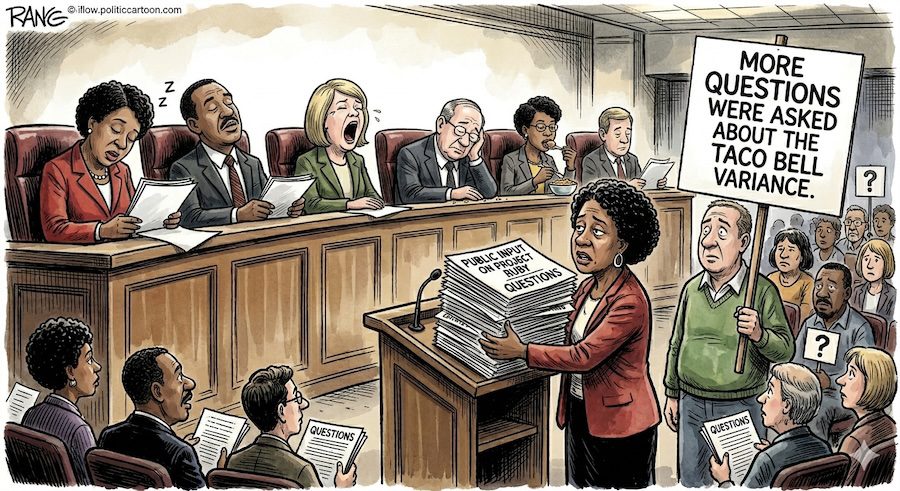
The council listened. It proposed no amendments. It asked, by the count of multiple attendees, essentially nothing. It was a striking posture for a body being asked to create the regulatory framework for a $5.18 billion project. Observers noted that routine zoning variances such as a traffic flow change, a request to add a second drive-through and the like, routinely drew more council questions at first reading than Project Ruby received that evening.
Due to the long line of individuals who still had yet to speak, the council decided to continue the first reading to June 9. Something happened in the intervening week.
The Amendments That Appeared Without Explanation
On June 3, I published an open letter on 706Report.com announcing the People’s Overlay and asking Columbus residents to support it. On June 4, I submitted the complete People’s Overlay ordinance text and the Declaration of Protections to every council member, the city attorney, and the mayor. Both documents appeared on 706Report.com the same day. Many of the same residents who had spoken on June 2 returned at 9 a.m. on June 9 to speak again, along with others who had learned of the session in the days between.
The council again said it was there to listen. It again proposed no amendments from the dais. It again asked essentially nothing.
Between the two sessions, however, the Council overlay document had already changed. The June 9 agenda packet contained a document titled, “AS AMENDED BY SUBSTITUTE”, a revised version that no council member called attention to publicly. The noise section had been rewritten: C-weighted (dBC) measurement added, the rolling 30-minute average standard specified with no-resetting language, the pre-construction acoustic study required, generator testing restricted to weekday business hours with 72-hour notice to neighbors. The development agreement had grown from three sentences to eight required elements. The 200-foot buffer was unchanged. There was no diesel ban. No PFAS prohibition. Who drafted those changes, between June 2 and June 9, was never disclosed.
Then the document changed again. The version voted on at the June 16 second reading, stamped confusingly “AS AMENDED 06-09-26” was not the same document that had been in the June 9 agenda packet. The 200-foot buffer had become 500 feet. Diesel generators were banned. The PFAS prohibition appeared. Tier IV emissions standards were required. Who drafted those changes, between June 9 and June 16, is not in any public record. They simply appeared, as the first round of amendments had appeared, without explanation from anyone on the council or in the administration.
What changed across both rounds was significant.
| Provision | June 2 Draft | June 9 Substitute | June 16 Adopted |
|---|---|---|---|
| Buffer | 200 ft | 200 ft (unchanged) | 500 ft with required vegetation screening |
| Noise measurement | A-weighted (dBA) only | A and C-weighted (dBC) | A and C-weighted (dBC) |
| Noise measurement method | Not specified | Rolling 30-minute average; no resetting permitted | Rolling 30-minute average; no resetting permitted |
| Pre-construction acoustic study | Not required | Required before any building permit | Required before any building permit |
| Diesel generators | Permitted | Not addressed | Prohibited outright |
| Generator emissions standard | None | Not addressed | Tier IV, or Tier II with SCR |
| Generator testing | Not addressed | Weekday business hours only; 72-hour notice to neighbors | Weekday business hours only; 72-hour notice to neighbors |
| PFAS in cooling fluids | Not addressed | Not addressed | Explicitly prohibited |
| Development agreement | 3 sentences | 8 required elements | 8 required elements |
| Decommissioning fund | Not mentioned | Required; amount to be negotiated | Required; amount to be negotiated |
| Adjacent sewer connection costs | Not addressed | Developer responsible for neighboring residents | Developer responsible for neighboring residents |
The improvements arrived in two rounds, neither explained. The first, in the June 9 substitute, addressed the technical: noise measurement upgraded to include dBC, the rolling average standard specified, the acoustic study required, the development agreement expanded from three sentences to eight elements. The second, in the document voted on June 16, addressed the structural: the 500-foot buffer restored from the PAC’s March dissent; the diesel ban; the PFAS prohibition that residents had argued for since March.
Both rounds of changes were real improvements. Both arrived with no explanation of their origin, no public record of who proposed them, and no opportunity for comment.
What Made It In — and What Didn’t
The final ordinance adopted on June 16 was meaningfully stronger than what was introduced on June 2. It was also meaningfully weaker than what either the Chamber document or the People’s Overlay had proposed. Three protections in particular were absent and their absence is not an insignificant detail.
| Protection | In Adopted Ordinance? | Why It Matters |
|---|---|---|
| 500-ft buffer with vegetation | Yes | Protects adjacent residential neighbors |
| PFAS prohibition | Yes | Closes cooling fluid chemistry loophole |
| Diesel generator ban | Yes | Reduces localized air emissions |
| Pre-construction acoustic study | Yes | Requires engineering proof before permits |
| dBC noise measurement | Yes | Captures low-frequency hum standard dBA misses |
| Decommissioning fund | Partially — required but amount not set | City held; amount negotiated in the development agreement before any permit issues |
| Minimum revenue guarantee (PILOT) | No | Without it, revenue tracks chip prices, not a floor |
| Site-wide megawatt cap as deed restriction | No | 837 undeveloped acres remain available under same overlay |
| Independent legal counsel for Columbus | No | City negotiates development agreement without specialist counsel |
| Reclamation bond sized by independent engineer | No | Decommissioning amount is negotiated, not independently assessed |
The three missing protections; the revenue floor, the megawatt cap recorded on the deed, and independent legal counsel, are the ones that govern Columbus’s financial exposure, its long-term development footprint, and the equity of the negotiation that comes next. They were not adopted. They are not gone. They remain achievable in the development agreement, which has not yet been negotiated.
The council voted 6-2 to adopt the ordinance on June 16. That same day, Isaiah Hugley won the mayoral runoff. He takes office in January 2027. In the months before he does, the development agreement will be negotiated by the administration that produced this ordinance, the same council that asked essentially no questions at two public hearings, and the same mayor whose process delivered an ordinance with three structural protections missing. Whether those negotiations close the remaining gaps or cement them is the subject of Parts 3 and 4.
Next: What the adopted ordinance actually requires, provision by provision, and what it means. The hardest negotiations haven’t started yet.
