
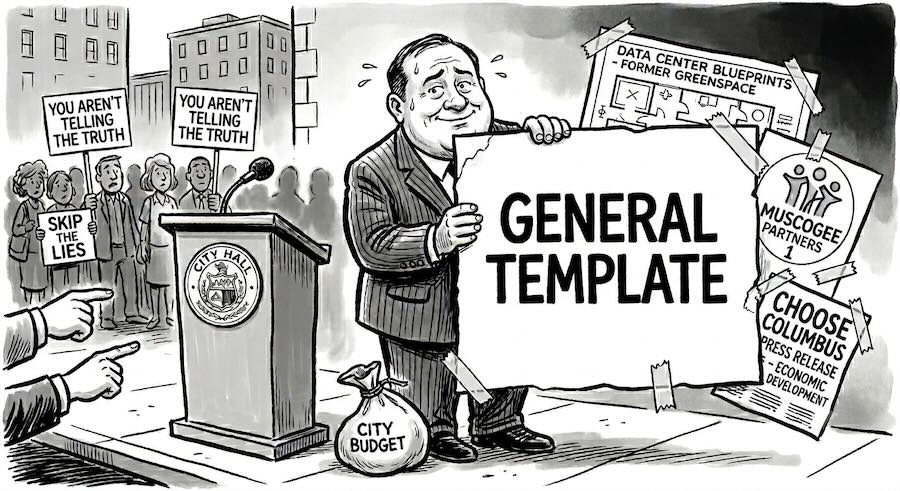

The city of Columbus issued a statement Tuesday responding to the lawsuit filed by eight Upatoi residents challenging the Technology Overlay Ordinance. The statement runs four sentences. Three of them describe the process. One of them does all the legal work.
“This protective overlay is not an approval of a zoning application for any particular project.”
That sentence is the defense. Everything else in the statement — the hours-long hearings, the multiple Council meetings, the promise of vigorous defense — depends on it being true. If the overlay is general legislation, the city’s process argument has force. If it is project-specific action dressed in general-purpose language, three of the lawsuit’s five counts get stronger at the same time.
The record raises serious questions about which one it is.
What the City Said
Mayor Skip Henderson’s office released the following Tuesday afternoon:
“The adoption of the Technology Overlay Ordinance was done in strict compliance with Georgia law. While Plaintiffs complain of, among other things, the lack of due process in their Complaint, just the opposite is true. In fact, the Plaintiffs received extensive opportunity to participate in the process, including a public hearing spanning hours and multiple Council meetings where the pros and cons of the Technology Overlay Ordinance were debated. As has been emphasized, this protective overlay is not an approval of a zoning application for any particular project.”
Three claims. Strict compliance. Extensive process. Not a specific project.
Here is what the record shows on each.
The City’s Claims vs. The Record
| City’s Claim | What the Record Shows |
|---|---|
| “Thorough analysis by City staff and Council” | The Chamber of Commerce’s Data Center Zoning Committee — not city staff — wrote the technical draft. The panel included Georgia Power, a professional data center construction firm, and Columbus Water Works. All three had been named in the February 12 Choose Columbus press release as supporting the project. |
| “Extensive input from the public” | The three most significant provisions in the final ordinance — a 500-foot buffer, a PFAS ban, and a diesel generator ban — did not exist when the public testified. They appeared between the June 9 session and the June 16 vote. No new public hearing was held. |
| “Strict compliance with Georgia law” | The Georgia Zoning Procedures Law is the first count in the lawsuit. A separate Open Meetings Act complaint about the PAC’s March 4 foundational work session is currently before the Georgia Attorney General. The city’s statement addresses neither. |
| “Not an approval of a specific project” | On February 12, Choose Columbus announced a specific developer (Habitat Partners), a specific investment ($5.18 billion), a specific timeline (2027–2030), a specific job count (195 permanent positions), and a specific tax projection ($68.7 million annually). The overlay drafting began 20 days later. |
Why “Not a Specific Project” Is Doing Heavy Legal Lifting
The distinction between general legislation and project-specific action runs through three of the lawsuit’s five counts.
The Georgia Zoning Procedures Law claim is about whether material amendments between readings required a new public hearing. The city’s answer is that the public had hours of opportunity to participate. That is true, in a narrow sense. The problem is that the three most significant protections in the final ordinance — the 500-foot buffer, the PFAS ban, the diesel ban — were not in the document when the public participated. You cannot exercise a right to comment on provisions that did not exist when you testified. The city’s “extensive process” argument answers a different question than the one the lawsuit is asking.
The due process claim rests on the same foundation. Meaningful notice and a meaningful opportunity to be heard require that the public know what it is being heard on. The document voted on June 16 was materially different from the document the public saw on June 9. The difference was not disclosed. It was not explained. It arrived, as the first round of amendments had arrived before it, without public accounting of its origin.
The spot zoning claim is where “not a specific project” matters most directly. Georgia courts examining spot zoning look at legislative intent, not just the instrument’s label. A general framework available to any qualifying parcel is more defensible than an ordinance written to accommodate a known applicant. The legal question is which one Columbus actually created. The court will decide that based on the record. The record includes the February 12 press release.
The lawsuit’s Open Meetings Act count names the Chamber committee. The city’s statement does not mention it. There are potentially two Open Meetings Act questions in the public record now — one before a court, one before the Attorney General — at opposite ends of the same drafting process. The city’s statement addresses neither.
The Timeline That Doesn’t Fit
| Date | Event | Why It Matters |
|---|---|---|
| Feb 12, 2026 | Choose Columbus announces Habitat Partners project: $5.18B, 2027–2030 timeline, 195 jobs, $68.7M annual taxes. No project name used. | All material specifics of Project Ruby on the record before any zoning process begins. |
| Mar 4, 2026 | PAC convenes foundational overlay work session. | The meeting Paul Olson alleges violated the Open Meetings Act. Complaint pending before the Georgia AG. |
| Mar 5, 2026 | Ledger-Enquirer covers petition: thousands already opposing “Project Ruby” by name. | A named, specific project was generating organized opposition the day after the overlay’s drafting process began. |
| April 2026 | Chamber of Commerce assembles drafting panel. | Panel includes Georgia Power, a data center construction firm, and Columbus Water Works — all with named interests in the February 12 project. |
| Jun 2, 2026 | First reading. 200-foot buffer. No PFAS ban. No diesel ban. | The document the public was asked to comment on. |
| Jun 9, 2026 | Second session. “AS AMENDED BY SUBSTITUTE” appears. Noise provisions strengthened. Buffer still 200 feet. No PFAS ban. No diesel ban. | Who drafted the substitute, at whose direction, was never disclosed. |
| Jun 16, 2026 | Council adopts overlay 6–2. Final document: 500-foot buffer, PFAS ban, diesel ban added since June 9. Stamped “AS AMENDED 06-09-26.” | The most significant provisions added after the last public session. No explanation offered. |
| Jun 23, 2026 | Eight Upatoi residents file SU2026CV001406. | Five counts. Four grounded in facts this series documented before the vote. |
| Jun 24, 2026 | City responds. “Not a specific project.” | The defense. |
A genuine general-purpose template would have been drafted by land-use planners, comparative zoning experts, and community representatives — people without stakes in any particular applicant. What Columbus got was a document produced by parties with established relationships to a project that had been publicly announced six weeks earlier.
What the Court Has to Decide
The court does not decide whether the overlay is good policy. It decides which story about the overlay’s origins is true.
The city’s legal team will argue general legislation, extensive process, Georgia law compliance. The plaintiffs will argue a documented sequence: February 12 press release, March 4 PAC meeting, April Chamber panel, June amendments without a hearing.
The evidentiary record is largely public. This series documented most of it before the lawsuit was filed. The lawsuit is, in significant part, that documentation translated into legal claims.
The city’s statement describes a public process. The lawsuit points at a private one. The court will have to account for both.
Whose Interests Are Being Served
The legal challenge asks a procedural question. The civic question underneath it has been visible since February 12 — the day Choose Columbus announced a specific project in the language of a general opportunity, with the developer’s name, the investment figure, the timeline, and the mayor’s endorsement already in hand.
The overlay was drafted by parties with interests in that project. The amendments that strengthened it most were made after the public’s comment window closed. The committee that wrote the rules met without a public record. When residents sued to ask why, the city’s response was: the public had every opportunity to participate.
That response tells you something. Not about the legal merits — a court will sort those out. But about whose interests this process was designed to serve, and whether the people running it believe they owe Columbus residents an accounting.
The city says it will vigorously defend its position. So far, it has not explained it.
706Report.com has covered Project Ruby since February 2026. The author submitted an alternative ordinance — The People’s Overlay — to the Columbus City Council in June 2026 and spoke at the June 9 public hearing. Prior coverage is linked throughout this series.
