
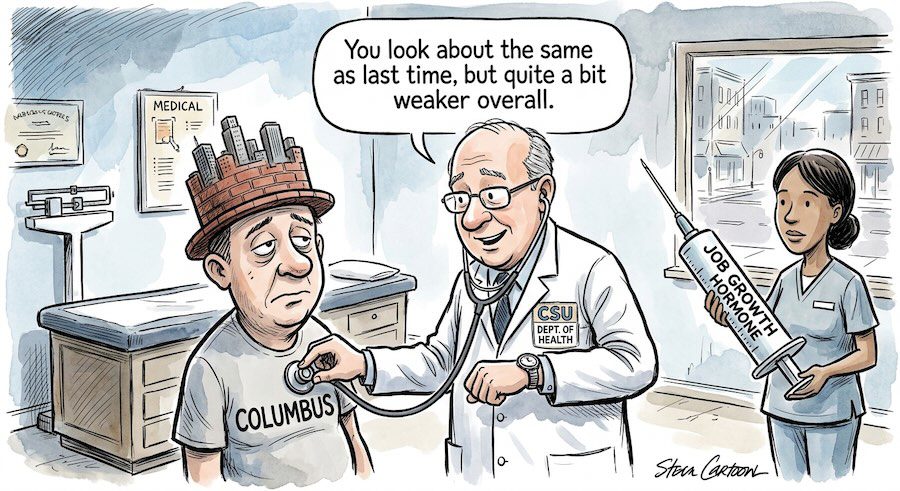

A new Columbus State University report looks at pay, jobs and housing. It finds a city holding steady — and families falling behind.
Part one of two: what Columbus earns
A new report says the Columbus economy has stopped falling.
It also says most families here are losing ground.
Both things are true at the same time. Here is how that works.
The report is called the 2026 Columbus Economy Report. It comes from the Butler Center at Columbus State University. Fady Mansour runs the center. He wrote the report with two research assistants, Jordan Mills and Nhi Do.
The report uses a lot of “typical” numbers. A typical number is the one in the middle. Half of people are above it. Half are below it.
A home costs more than a family can pay
In August 2025, a typical Columbus home cost $267,750.
A typical Columbus family earns $54,382 a year. That number has not gone up in three years.
To get a home loan on that house, a family would need to earn about $82,700. That is roughly $28,000 more than most families here make.
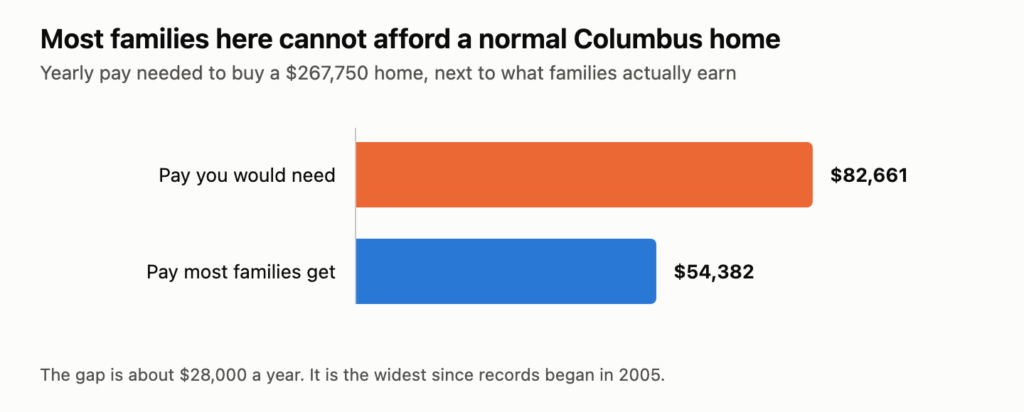
The Federal Reserve Bank of Atlanta has tracked this gap since 2005. It has never been this wide.
A home loan payment here now costs about $2,068 a month. Renting costs less. A two-bedroom apartment runs about $1,108. A three-bedroom runs about $1,463.
Fewer people own their homes here than in most of the country. In the city, about 52 out of every 100 homes are owned by the people living in them. Across the country, it is about 65 out of 100.
Pay here keeps falling behind
The average Columbus worker earns $52,188 a year.
In Georgia, the average is $68,575. In the country as a whole, it is $74,181.
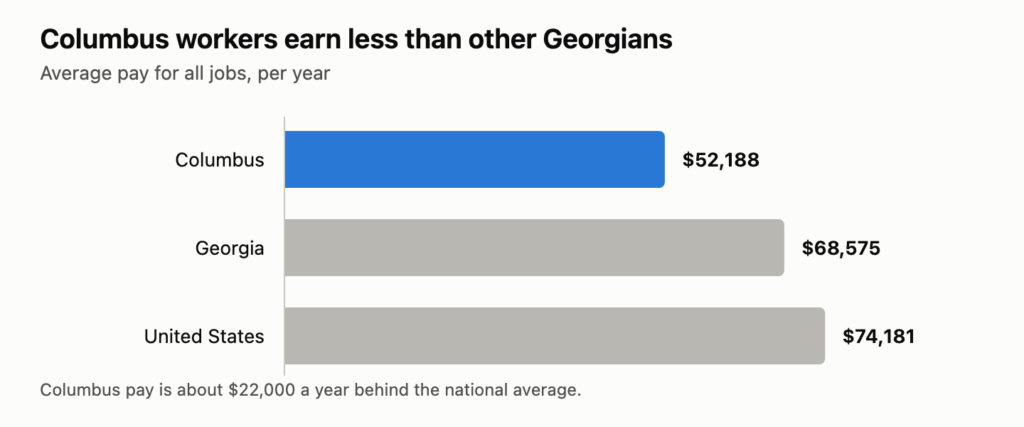
Pay here went up 3.2% last year. But it went up faster in Georgia, and faster still in the rest of the country. So the gap is growing, not closing.
Families are borrowing to fill it. For every $100 a Columbus family earns, it now owes $179. Across Georgia, families owe $150 for every $100 they earn.
The good jobs left. Lower-paying jobs took their place.
This is the part of the report that is easy to miss. It sits in a table near the middle.
Over three years, Columbus lost 1,337 jobs at banks and insurance companies. Those jobs paid about $89,787 a year.
It lost another 448 jobs in company management. Those paid about $163,201 — the best pay in the city.
In the same three years, it added 788 jobs in restaurants and hotels. Those pay about $22,873.
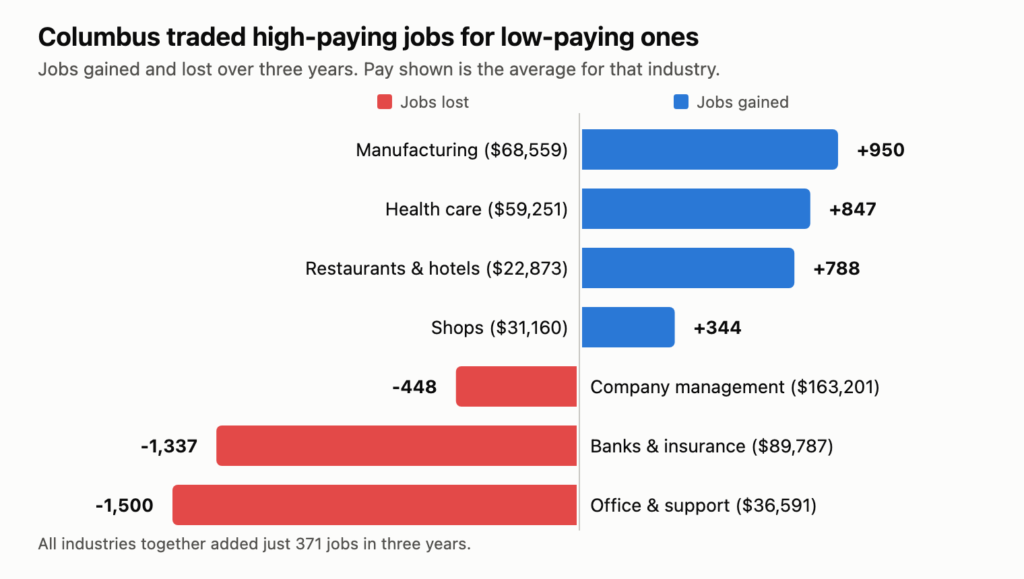
Add every industry together, and Columbus gained 371 jobs in three years. That is a change of 0.1%.
So the city did not really lose jobs. It traded good ones for lower-paying ones and ended up about where it started.
That is a different problem than people being out of work. It also needs a different fix.
One industry went the other way. Factories added 950 jobs, and they pay $68,559. That is well above the local average. The report says the city should push hard for more of that kind of work.
Right now, shops, restaurants and hotels employ 28,626 people here. That is close to one job in four. And only about one job in four needs a college degree.
The city has stopped shrinking
About 324,000 people live in the Columbus area. That number has held steady for two years.
But three things are moving underneath it.
The city is getting older. There are more people over 65 and fewer young and working-age people. That is one reason health care is the largest private employer here, with 20,226 workers.
People keep leaving. Every year this decade, more people have moved away to other parts of the country than have moved in. But that number is dropping fast. In 2022, Columbus lost 3,371 people this way. In 2024, it lost 720.
People are arriving from other countries. In 2020, 54 people moved here from abroad. In 2024, it was 792.
Put simply: Columbus is holding steady because fewer people are leaving and more are arriving from other countries.
Births are down as well. The report says local birth rates are below the level needed to keep the population the same. Over time, it says, that could cost the area about 11,000 people every generation.
Fort Benning holds a lot of this in place. It supports 45,000 to 50,000 jobs. Those jobs do not go away when the economy slows down. That steadies the whole city.
Two Columbuses
The report did something unusual. It looked at credit and debit card sales at named stores on the north and south sides of town.
The pattern was clear.
Stores on the north side sell more. Shoppers there spend more each visit.
Shoppers on the south side go to the store more often but buy less each time. That is what people do when money is tight. The report calls it “a more stressed consumer environment.”
Dollar stores sold less in 2025 than in 2024, even though prices rose. Publix sold a little more, about in line with prices. Families with more money kept up. Families with less did not.
One caution about this data: it counts only what people bought in a store. Online orders are not included.
What the report asks for
The report ends with four requests.
Grow factory work and other jobs that pay well. Match schools and training to the jobs employers actually need. Build more homes people can afford, and help people buy them. Keep working on crime, which has fallen since 2023 but is still higher here than in the state or the country.
“Long-term resilience will depend on strengthening private-sector job creation and improving job quality,” Mansour writes.
Creating jobs is the easier half. Making them pay well is the hard part.
This is part one of two. Part two looks at what Columbus households are committed to paying over the next several years — for water, for a new jail, and for the borrowing behind both.
Source: 2026 Columbus Economy Report, Butler Center for Research and Economic Development, Turner College of Business and Technology, Columbus State University, January 2026.
