
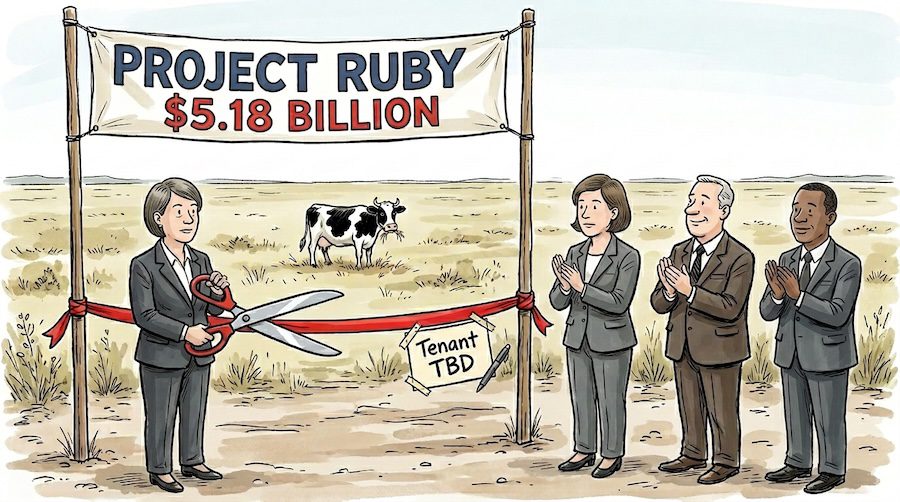

A public authority named this project, priced it, and told Columbus how many jobs it would bring. The city’s own lawyers now tell a judge the data center is hypothetical. Both come from the same government. Here is everything that actually exists.
The short version
- Choose Columbus is the Development Authority of Columbus, a public body. It published the numbers. It is also the party dealing with the developer.
- The numbers are $5.18 billion, $68.7 million a year in taxes, and 195 jobs. The authority has never published the math behind any of them.
- It said the work runs 2027 to 2030. The developer’s power request, public thirteen days later, runs to 2034. Nobody corrected it.
- Nothing is signed. No tenant. No development agreement. No power contract. No overlay on the land. No application to build.
- The public was heard twice, on June 2 and June 9. The diesel ban, the PFAS ban and the 500-foot buffer were in neither version it saw. All three appear first in the text adopted June 16, in a document dated June 9.
- In August, the city told a judge the data center is “perceived and hypothetical.”
COLUMBUS, Ga. — There is no data center.
No company has agreed to build one. No company has agreed to occupy one. There is no development agreement. There is no power contract. There is no application to build anything. The land is zoned today exactly as it was zoned in February, for farming and rural homes.
What there is: 987 acres, a land company, a new category in the zoning code that has been applied to nothing, and three numbers.
Columbus rewrote its zoning ordinance anyway. Council voted 6 to 2 on June 16. The mayor signed it two days later. Eight residents sued four days after that, and a judge hears the city’s motion to throw out their case on Sept. 9.
In that motion, lawyers for the City of Columbus call it “a perceived and hypothetical, future data center.” Their own government spent six months promoting it.

They are describing the record accurately.
The whole thing, on one page
| What exists | What does not | |
|---|---|---|
| The land | 987 acres off Layfield Road, sold | |
| The owner | Habitat Real Estate Partners, through Muscogee Property 1 LLC | |
| The tenant | No company named. None known to have committed. | |
| The zoning | A Technology Overlay District, as a category in the code | No overlay on this land |
| The land’s status | Still zoned for farming and rural homes | No application to build |
| The power | A study saying the wires could carry 600 megawatts | No contract to sell any |
| The agreement | No development agreement of any kind | |
| Demolition money | Required by the ordinance | Amount not set. It is set by the agreement that does not exist. |
| The numbers | Three, published by Choose Columbus | No arithmetic behind them |
| The lawsuit | Eight residents. Hearing Sept. 9. |
Habitat buys land, gets it approved for building, and hands sites to corporations. It does not run data centers.
A citizen who wanted to read what Columbus had committed to, before council voted, could not do it. Not because anyone withheld the documents. Because there were none.
Who told you it was real
The three numbers came from Choose Columbus. $5.18 billion in investment. $68.7 million a year in property taxes. 195 permanent jobs paying $80,000 to $120,000.
Choose Columbus is not a chamber of commerce. It is not a private booster club. It is the Development Authority of Columbus, Georgia, operating under a brand name. The authority is a public body. Missy Kendrick is its president and chief executive.
The same public authority that published those figures is the party negotiating with the developer. Choose Columbus said so in February. The Development Authority of Columbus is working with Habitat Real Estate Partners to prepare a “private and secure site” for an undisclosed company.
So a public authority is both the promoter of this project and its counterparty. It published specific figures about a facility with no tenant, no agreement and no power. Those figures have circulated in this city since February as though they were settled.
It is also the only place Columbus can go for information about any of it.
There is one thing the authority genuinely cannot tell you. Companies shopping for data center sites demand secrecy. The authority’s own words concede it. It is preparing “a private and secure site.”
Refusing to name the tenant is normal in that business. It is not the failure here.
This is the failure.
The authority published a property tax figure and has never published the arithmetic behind it. No breakdown of buildings against equipment. No year-by-year figure. No explanation of what “before depreciation” costs.
It published a jobs number without saying that number describes a completed campus.
And it published a construction timeline of 2027 to 2030 on Feb. 12.
Thirteen days later, on Feb. 25, the developer’s own power request became public. 200 megawatts in 2029. The full 600 not until 2034.
Six months have passed. The 2027 to 2030 figure is still in circulation. It has never been corrected.
None of that is protected by anyone’s nondisclosure agreement. A public authority asked this city to change its zoning code on the strength of three numbers, and has never shown its work on any of them.
Where the three numbers stand
They are projections about a building that does not exist, on land not zoned for it, for a company not named, powered by a contract not signed.
They may be reasonable projections. That is a different thing from a fact, and they have been handled in this city as facts since February.
Two things are knowable about them right now.
The jobs figure describes a finished campus. 195 people would run 600 megawatts. The power schedule does not reach 600 megawatts until 2034. The first 200 megawatts arrive in 2029. The public was told the work happens between 2027 and 2030.
The tax figure cannot be checked by anyone outside the authority.
Choose Columbus has never published how it arrived at $68.7 million a year.
706report tried to work it out and could not. The reason is worth knowing.
Georgia taxes property at 40 percent of its market value. That part is settled by statute. The Muscogee County School District levies 23.075 mills. That is published.
But Columbus does not have one property tax rate. It has a General Services District and several Urban Services Districts, taxed at different rates. Which rate applies to 987 acres in the northeast corner of the county depends on which district the land sits in.
So there is no single number a resident can multiply.
Two things would have to be known. Which rate applies to this land. And how much of the $5.18 billion becomes taxable property here, rather than land already on the tax rolls or equipment bought somewhere else.
Neither has been published. So the figure cannot be checked.
That is where Columbus has been for six months. A public authority published a tax figure to justify a change in the zoning code, and no citizen can work out whether it is right.
There is one thing the authority did disclose. The projection is labeled “before depreciation.”
Georgia does not let a county guess at depreciation. State rule 560-11-10 sets a table, and it puts computer equipment in the fastest-falling group the state has.
| Age of the equipment | Taxed on this share of its cost |
|---|---|
| Year 1 | 76% |
| Year 2 | 51% |
| Year 3 | 30% |
| Year 4 and after | 10% |
Servers are the single largest thing a data center buys. Under Georgia’s own table they are taxed on a tenth of their cost by year four.
The rest of it holds up better. Cooling and power equipment falls more slowly. Buildings are taxed as real estate and barely fall at all.
So the whole $68.7 million does not collapse. Part of it drops fast and part of it holds. Which part is which depends on how much of the project is equipment and how much is building, and Choose Columbus has never published that split.
What is certain is this. The figure is not a steady payment. It is a high point. The equipment starts losing taxable value the year it is installed, and nobody has drawn that curve for the public.
It is also a high point that needs a finished campus. The campus is not finished until 2034.
What council voted on
The sequence is not in dispute.
February. Choose Columbus announces Project Ruby, with the developer named, the price named, the jobs named and the taxes named.
Three weeks later. Work begins on an ordinance to allow data centers on land zoned for farming and rural homes.
March 4 and 18. The Planning Advisory Commission takes it up. It recommends approval, 5 to 1, on one condition. Double the buffer between a data center and its neighbors, from 200 feet to 500.
The application did not come from a developer. The city’s own planning staff letter says it plainly: “This application comes at the request of Columbus Consolidated Government.” The city applied to itself.
June 2. First reading, and a public hearing. Residents turn out with questions.
June 9. Because of the volume of those questions, council does not close the first reading. It continues the hearing and takes public comment a second time. The ordinance is amended by substitute that day.
June 16. Second reading. Council votes 6 to 2.
What changed after the hearings closed
The ordinance council adopted is not the ordinance the public commented on. It is not even the one council saw a week before the vote. Both earlier versions sit in the city’s own meeting packets, available to anyone.
| June 2, first hearing | June 9, second hearing | Adopted June 16 | |
|---|---|---|---|
| Buffer from neighbors | 200 feet | 200 feet | 500 feet |
| Noise limits | none | added | yes |
| Decommissioning fund | none | added | yes |
| Ban on diesel generators | none | none | added |
| Ban on PFAS in cooling fluid | none | none | added |
| Cleaner backup generators required | none | none | added |
None of this was concealed. Every version sits in a public agenda packet anyone can download, and that is where 706report found them.
And the city deserves credit for one thing. When residents turned out on June 2 with questions, council did not close the reading and move on. It continued the hearing to June 9 and listened again.
But look at what the table shows.
The diesel ban, the PFAS ban and the requirement for cleaner generators are in neither version the public was asked about. Not the one from June 2. Not the one from June 9. They appear for the first time in the text adopted on June 16, after the hearings were over.
The 500-foot buffer the planning commission asked for in March did not make the June 9 version either. It surfaces on June 16.
Two public hearings, and the strongest protections in this ordinance were written after both of them closed.

The document holding them is stamped “AS AMENDED 6-9-26.”
And that is a problem in its own right. The adopted text carries a date a week earlier than the provisions inside it. Anyone reconstructing this history from the ordinance alone would conclude the diesel ban, the PFAS ban and the 500-foot buffer were written on June 9. They were not. A public body produced a public record that misstates when its own provisions came into being, and nobody has explained why.
The check that came from outside Columbus
Buried in the same ordinance is a line its own title advertises. The ordinance was written in part “to redefine Developments of Regional Impact.”
A Development of Regional Impact is a large project that gets reviewed by a regional body. The review happens because the effects cross city and county lines. It is the one check that comes from outside the government doing the approving.
This land touches two other counties. The electricity would come from a cooperative serving 17. The water comes from a utility that already sells into two of them.
Columbus struck its own definition of a regionally significant project out of the code entirely. It replaced the definition with a pointer to “the thresholds listed at [a state web address], or as otherwise adopted by the Georgia Department of Community Affairs.”
A link. Whatever that page says, now or whenever it changes, is the rule. Council never votes again.
The utility never said yes, and the man who would decide is leaving
Project Ruby asked for 600 megawatts.
Every home and every business in Columbus, added together, uses about 550 megawatts, according to Georgia Power. Flint Energies, the cooperative that would serve this project, peaks near 500 and runs around 450 today.
The customer would be larger than the utility.
Flint has no shareholders. Its members own it, and its members elect its nine trustees. It serves 17 counties and more than 97,000 meters.
Kendrick has said Flint will write “a completely separate contract” for Project Ruby. No member has read it. It has not been written.
Flint’s chief executive, Jeremy Nelms, told his board in July that he is leaving for another cooperative. His last day is Jan. 27, 2027. As of mid-August no successor had been named.
There is also a power plant one county over.
Oglethorpe Power sells Flint its wholesale electricity. It runs the 679 megawatt Talbot Energy Facility, in Talbot County. It is adding about 240 megawatts to it, a $360 million job expected to start running in 2029.
2029 is the year Project Ruby wants its first 200 megawatts.
Jake Hopkins, Flint’s vice president of power supply, said the Talbot plant “would not be part of the Project Ruby power.”
Nobody has asked him why in public.
The rest of the land
The site map shows four buildings on roughly 130 acres.
The parcel is 987 acres.
Asked about the remainder, Kendrick said the developer “has not made public what they want to do with the rest of the property.”
That is more than 850 acres, held by a limited liability company, sitting against two county lines, with no stated purpose.
Habitat did not answer the Ledger-Enquirer’s questions.
What the state charges Columbus
One fact about the neighboring counties belongs on the record, because it is a fact and not a forecast.
Georgia waives sales tax on data center equipment and building materials. What a project must spend to earn that break depends on which county it builds in. In 2022 the state cut those thresholds, and cut them only in the smaller counties.
| County | Before 2022 | Now |
|---|---|---|
| Muscogee | $250 million | $250 million |
| Harris | $150 million | $75 million |
| Talbot | $100 million | $25 million |
| Marion | $100 million | $25 million |
| Taylor | $100 million | $25 million |
| Chattahoochee | $100 million | $25 million |
Spend $250 million to earn it in Columbus. Spend $25 million to earn it in Talbot County, served by the same electric cooperative. Columbus is the only county on that list whose number did not move.
On Jan. 1, a separate federal tax break for investment in poorer census tracts gets larger, and the increase applies only outside cities of 50,000 people. Columbus is too big. The counties around it are not.
Whether that moves anything, nobody can say yet. Talbot County’s own sales records show no unusual land buying through August. 706report checked.
The account
A public authority published three numbers in February and has never shown the arithmetic behind any of them.
The tax figure cannot be reproduced by anyone outside the authority, and it describes a completed campus that the power schedule does not deliver until 2034. It was presented as the figure for 2030.
The same public authority is the counterparty to the developer, and the only source of information about the deal.
It published a timeline the engineering record contradicted within thirteen days, and has not corrected it in six months.
The city applied to itself to change its own zoning code.
The public was heard twice, on June 2 and June 9. Neither version it commented on contained the diesel ban, the PFAS ban, the generator standard or the 500-foot buffer. All four were written after the hearings closed.
The adopted ordinance is dated a week before the provisions it contains.
The one review that would have come from outside Columbus was replaced with a hyperlink.
Eight residents had to hire a lawyer to find out what their own government had done.
And when those residents reached court, the city’s attorneys told the judge the data center was hypothetical.
They were right. Nothing is signed. Nothing is zoned. Nobody is named. No power has been promised. And a zoning code was rewritten anyway.
There is a defense available here and it deserves to be named. A development authority cannot discuss a client’s plans. Confidentiality in that business is real and it is ordinary.
But confidentiality is a reason to say nothing. It is not a reason to say this.
Choose Columbus gave the project a name. It gave it a price. It gave it a jobs count, a wage range, a tax figure and a construction schedule. It put all of that into circulation in February and left it there for six months.
A public authority cannot invoke a client’s privacy to explain why the arithmetic is unavailable and at the same time publish the conclusions that arithmetic is supposed to support. Either this project was confidential or it was announceable. Choose Columbus announced it, named it, priced it, and then declined to show its work.
Whether any of it was true is not something this newspaper can tell you. That is not a failure of reporting. The authority has never published enough for anyone outside it to check.
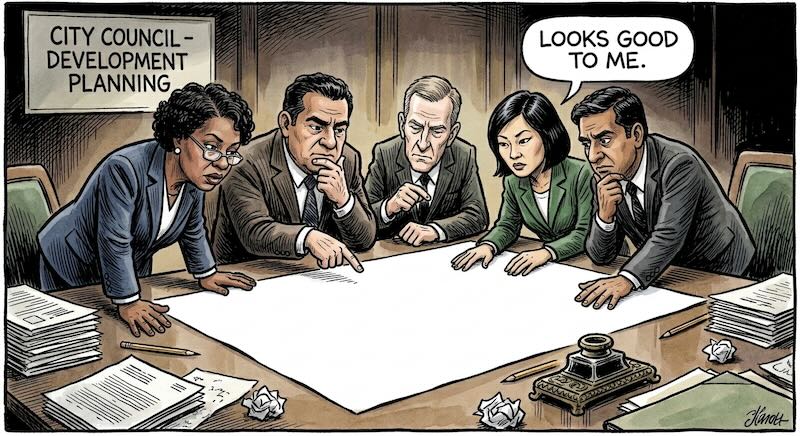
A public body asked this city to rewrite its zoning code on three numbers no citizen can verify. For a project its own government’s lawyers now call hypothetical.
Both things cannot be true
The ordinance Columbus adopted goes into considerable detail about what a data center would do to the people living near it.
A 500-foot buffer along every property line that abuts a residential district. Noise limits measured at the property line: 65 decibels during the day and 55 at night where the property touches homes. A ban on diesel backup generators. A requirement for cleaner generators where they are allowed. A ban on PFAS and several related compounds in cooling fluid. A fund, held by the city, to tear the buildings down when they are finished.
Columbus wrote all of that in June.
In August it told a judge the data center is “perceived and hypothetical.”
You do not set a nighttime decibel limit for a hypothetical. You do not ban a class of coolant, or require a demolition fund, or double a buffer to 500 feet, for something that does not exist.
Both positions cannot be right. Either the effects on the neighbors were concrete enough to legislate in June, or the project is too speculative in August for those neighbors to be heard about them.
The city has chosen whichever answer suits the room it is standing in.
And there is a cost to that.
If Judge Martin agrees with the city on Sept. 9, the eight residents who sued never get to argue any of it. Not the buffer. Not the noise. Not the water. Not what it does to the value of their land.
Not because those questions were answered. Because the city says there is nothing yet to answer.
706report has not read the neighbors’ complaint. We have requested it. What those eight people allege, and what the court makes of it, is a story for after the hearing.
Questions worth asking, and the rooms to ask them in
To Choose Columbus and the Development Authority of Columbus. Has any company signed anything? Show the arithmetic behind $68.7 million, and the split between buildings and equipment. Was council told that 195 jobs describes a completed 600 megawatt campus? You published a 2027 to 2030 timeline on Feb. 12, and the power schedule became public on Feb. 25 running to 2034. Why has that never been corrected? None of these answers would name your client.
To City Council. The diesel ban, the PFAS ban and the 500-foot buffer are in neither version the public commented on. Who wrote them, and when? Why is the document dated June 9?
To City Council, again. You were shown a 2027 to 2030 buildout. The only engineering schedule in the record runs to 2034. Which did you vote on?
To the Planning Department. What did the Development of Regional Impact rule say before June, and does a project touching two other counties still get reviewed by anyone outside Columbus?
To the Flint Energies board, elected by its members. Why is the Talbot Energy Facility not part of this? What protects the other 97,000 meters under a contract that has not been written, decided by a chief executive who leaves in January?
To the Board of Water Commissioners, four of whose five members council appoints. Will Columbus sell water to a data center outside Muscogee County?
Notes on sourcing. Nothing in this piece rests on an unverified assumption. Every figure is either quoted from a public document or attributed to the party that published it. Where a number could not be confirmed, this piece says so instead of estimating.
Two limits, stated plainly. The $68.7 million cannot be reproduced from outside. 706report tried and stopped, because Columbus taxes property at different rates in different service districts, and the authority has not said which applies or how much of the $5.18 billion becomes taxable property here. That is a fact about whether the figure can be checked, not a claim that it is wrong. And the acreage varies across outside reporting, from 865 to 987. This piece uses 987, the figure attached to the sale.
Two things remain unknown, and the text says so. The wording of the Development of Regional Impact rule before June, which appears in neither agenda packet. And the split between buildings and equipment behind the tax projection.
Investment, tax and jobs figures are as published by Choose Columbus. Power figures, the method of service study, and quotations from Jake Hopkins, Mathew Kent and Missy Kendrick are as reported by the Columbus Ledger-Enquirer, Feb. 25, 2026. Site layout and Kendrick’s remark about the rest of the property are from Georgia Public Broadcasting, May 4, 2026. The identification of Choose Columbus as the Development Authority of Columbus is from the authority’s own award release. Talbot Energy Facility figures are from Oglethorpe Power. Equipment tax factors are from Georgia Department of Revenue Rule 560-11-10. Sales tax thresholds are from the Georgia Department of Revenue. The ordinance versions, the planning commission vote, the buffer, the diesel, PFAS and generator provisions, the decommissioning clause, the overlay application process, the staff letter and the Development of Regional Impact language are all from the City of Columbus council agenda packets for June 9 and June 16, 2026, items 15 and 7. Talbot County land sales are from the Talbot County Board of Assessors. The description of the data center as “perceived and hypothetical” is from the city’s Aug. 7 motion, as reported by the Ledger-Enquirer. The lawsuit is Keep It Rural LLC et al. v. City of Columbus et al., SU2026CV001406, Muscogee County Superior Court.
