

In 2014 the Downtown Development Authority lent its tax exemption to a $10.5 million rehabilitation of the Ralston. In August it agreed to do it again, larger, and to take the deed this time. Everything below comes from public records.
The short version
- On August 26 the Downtown Development Authority agreed, after an executive session, to issue $25 million in tax-exempt bonds for the Ralston and to take title to the building.
- The same authority bond-financed a rehabilitation of the same 269 units in 2014. That deal ended with the federal housing contract cancelled, the building closed, and more than 200 people put out of their homes.
- The 2023 renovation was real, permitted at $9.1 million and inspected floor by floor. Across 269 units that is $33,829 a unit.
- The new proposal is $27 million to $30 million. That is $100,372 to $111,524 a unit, roughly three times as much, three years later.
- HUD scored the building 93 out of 100 in July 2024, and its published file still shows no inspection since.
- No public hearing has been noticed. Four public chokepoints are still ahead.
COLUMBUS, Ga. — On August 26 the Downtown Development Authority of Columbus held a special called meeting, shut the public out for the closed portion known as executive session, and came out having agreed to issue $25 million in tax-exempt bonds for the Ralston and to take ownership of the building.
The authority has done this before.
In 2014 the same body issued $10.5 million in revenue bonds to rehabilitate the same 269 units at 211 12th Street. There was a public hearing on February 28 of that year. Columbus Council approved the deal on March 11.
That deal ended with the federal housing contract cancelled, the building closed, and more than 200 people put out of their homes.
Nobody involved in the current proposal has mentioned the previous one.
First, how a deal like this works
The authority does not put up money. It puts up its name. Because a government body is the official borrower, the investors who actually lend the cash owe no federal tax on the interest they earn. Tax-free interest is worth more to them, so they accept a lower rate, and the developer gets a cheaper loan than a bank would write.
That discount is the subsidy. It is paid by the U.S. Treasury, which collects less tax than it otherwise would. It never appears as a line in anyone’s budget, which is part of why these deals draw so little attention.
If the project fails, the lenders lose their money. The authority guarantees nothing and the city guarantees nothing. This is the part most often gotten wrong. Columbus taxpayers are not on the hook for these bonds, in 2014 or now.
What is new in 2026 is the deed. The authority would take ownership of the Ralston on paper and lease it back to the developer. Governments do not pay property tax, so for as long as that arrangement lasts, neither does the building. That is a second subsidy, and this one is local.
What the 2014 deal was
The resolution is still on the city’s system, and it says what it says.
The Downtown Development Authority issued the bonds. The borrower was Schoolhouse Road Estates, Inc., a New York nonprofit corporation. The money was to “assist the Borrower in financing the acquisition, rehabilitation and equipping a multi-family residential rental facility containing two hundred sixty-nine (269) units for individuals and families of low and moderate income.”
The amount was $10,500,000. The public hearing was held February 28, 2014, as federal tax law requires. Council approved it March 11, 2014, under Section 147(f) of the Internal Revenue Code. Teresa Pike Tomlinson was mayor.
Title did not go to the nonprofit. On July 2, 2014, it went to PF Ralston LLC for $500,000.
PF Ralston LLC had been formed on December 18, 2013. That is ten weeks before the public hearing. Its principal office was on Hill Street in Newark, New Jersey. It listed no business purpose.
The authority never owned the building in 2014. It lent its tax exemption and a private company held the deed. That distinction matters, and it is the thing that changes in 2026.
The building went tax-exempt, and then it fell apart
Look at what Muscogee County billed this parcel in property tax.
2017: $10,673. 2018: $9,146. 2019: $11,205.
Then 2020: $179,875.
The assessor’s own category code on the parcel reads “MOVED FROM X ACCT 2020.” In the county’s system an X account is an exempt account, meaning nobody was being charged. Georgia does not tax real estate that is owned and used for charity. The bills go from about $10,000 a year to about $180,000 a year at exactly the point the nonprofit arrangement ends and the building closes.
So the public was carrying this building two ways at once. Washington gave up the tax it would have collected on the bond interest. Muscogee County gave up the property tax, something on the order of $170,000 a year.
And while that was running, the federal government was also sending a Section 8 rent payment into the building every month on behalf of the people living there.
Here is what the money bought.
In September 2017 the building scored 65 on its federal physical inspection. In July 2019 it scored 42. On October 23, 2019, on re-inspection, it scored 30. Passing is 60.
That November, HUD cancelled the Section 8 contract. In August 2020 the building closed and its residents, most of them elderly, had to be relocated. A resident died in the building in 2017, and published reports say ownership of the Ralston was contested in wrongful death litigation that followed.
One more thing about who was responsible. The State of Georgia administratively dissolved PF Ralston LLC on September 7, 2018, for failing to file its annual registrations. It did not convey the property until May 2021. So the record owner of a 269-unit federally subsidized high-rise was a dissolved company through the 42 HUD score, through the 30 score, through the contract cancellation, and through the closure.
Nothing in the public record indicates anyone noticed.
Who actually lost money in 2014, and who did not
It’s important to note that Columbus taxpayers were not on the hook for any of this.
These bonds get paid back out of the building’s own income and nothing else. Neither the Downtown Development Authority nor the Columbus Consolidated Government put up a dollar, pledged an asset, or promised to cover the debt if the project failed. When Missy Kendrick says individual taxpayers are not responsible for repaying bonds like these, she is correct.
Two of the 2014 bonds are traceable. A 4.000 percent series maturing December 1, 2025, and a 5.500 percent series maturing December 1, 2049. Neither was insured. In February through June of 2021, both traded at roughly 31 to 33 cents on the dollar.
Put plainly, an investor who had lent this project $1,000 could sell that debt in 2021 for about $310. Anyone who sold took the hit. Anyone who held on may have come out better or worse, depending on how the debt was eventually settled, and the public record does not say which. Bonds like these are owned mostly by high-yield municipal bond funds and the ordinary savers whose money sits in them. Whatever was lost there was lost by them, and not by Columbus taxpayers.
The cost to the people of Columbus sits in a different column. The federal tax never collected on the bond interest. Roughly $170,000 a year in county property tax never billed. Section 8 rent paid every month into a building that scored 30. And the residents, more than 200 of them, who lost their homes.
Private investors lost money. The public lost tax revenue, paid subsidy and absorbed the human cost. Those are different ledgers and they should not be mixed, but neither one should be ignored.
The second owner, and what it actually bought
The building sat closed. A court put it into receivership, which means an outside firm was appointed to take control of it and answer to the court. That firm was GlassRatner Management & Realty Advisors.
On August 24, 2020, the same month the Ralston closed, a Delaware company called Ralston Towers MF II LLC registered to do business in Georgia. Nine months later it took the building.
It took it through two deeds on consecutive days in May 2021. One from the receiver, stating $3,850,000. One from PF Ralston LLC, stating $850,000. The Muscogee County assessor flagged both as not arms length, the term for a sale that is not an ordinary deal between an unrelated buyer and seller at market price.
We are not printing an acquisition price, and neither should anyone else. Two deeds one day apart, both flagged that way, one of them from a receiver, do not add up to a purchase price. The dollar figure on a receiver’s deed is often an accounting number, or the value of debt the buyer already held, rather than cash that changed hands.
Ralston Towers MF II LLC shares a principal office address and a registered agent with Infinity Real Estate Advisors, LLC. Greg Jones, chief investment officer of Infinity Capital Partners, has spoken publicly for the property. That is the documented connection.
What was worth buying was not the real estate. The county values the building today, after renovation, at $7,998,090.
What was worth buying was what could be attached to it.
HUD wrote a new Section 8 contract on the building. Not a renewal of the one it cancelled in 2019. A new one. In plain terms it is a twenty-year written promise from the federal government to pay the rent on 223 apartments. Contract GA060509209, effective September 1, 2024, running to August 31, 2044, at $978 an apartment a month. That is $2,617,128 a year, and roughly $52 million over the term.
A closed 1914 hotel does not support a renovation loan. Twenty years of guaranteed federal rent does. There is no FHA-insured mortgage here. HUD’s own record classifies the property “Subsidized, No HUD Financing.” The debt is conventional, with Ameris Bank named as lender and Berkadia doing the mortgage banking.
The site also sits in a federal Opportunity Zone, which HUD’s record flags. That is a designation that lets investors cut or delay the tax on their profits if they stay in long enough. And the project team included Rosin Preservation, which prepares the applications that qualify an old building for historic tax credits, and Sugar Creek Capital, whose business is turning state tax credits into cash by selling them to companies looking to lower their own tax bills. Rosin Preservation also prepared the Georgia Register nomination that listed the building on December 3, 2024, filed in the name of Ralston Towers MF II LLC.
Whether historic rehabilitation credits were claimed is not something the public record shows. What it shows is that the team assembled to pursue them.
The renovation was real, and it was small
This needs saying plainly, because the easy version of this story is wrong.
The work happened. Master permit CBLD-07-22-4583, “ALTERATIONS TO RALSTON,” was issued July 11, 2022 and finaled December 12, 2023. Behind it sits a full set of trade permits for plumbing, mechanical and gas. The job was phased floor by floor across four phase permits. The city inspected all of it and signed off. The building reopened August 30, 2023 with a ribbon cutting attended by the mayor, the city manager and two congressmen.
The money did not vanish. Nobody faked anything.
The permit valuation was $9,100,000.
Across 269 units, that is $33,829 a unit.
A gut renovation of a 1914 high-rise runs several times that.
There is a fair explanation for the number, and it should come before the critical one. In 2021 the twenty-year HUD contract did not exist. HUD had cancelled the old one in 2019, and the new one did not take effect until September 2024. You cannot borrow thirty million dollars against a contract you do not yet have. Infinity financed a closed building with conventional debt. It is entirely possible that $9.1 million was close to the ceiling of what could be raised at the time.
If that is true, it does not settle the matter. It moves it. The renovation was sized to what the financing allowed, not to what the building needed. And then HUD signed a twenty-year contract on the result, the city issued a certificate of occupancy, and elected officials cut a ribbon in front of it.
Who was responsible for determining whether the 2023 rehabilitation was sufficient to keep a 1914 high-rise viable for the 20 years of the new federal contract?
What has happened since
Start with the fact that cuts against everything above, because a story that hides it deserves to be taken apart.
On July 8, 2024, HUD inspected the Ralston and scored it 93 out of 100. Passing is 60. The same building scored 30 in October 2019. A year after the renovation finaled, it passed with room to spare.
Then the sequence.
On March 27, 2025, eight Georgia properties owned by Infinity affiliates sued their former property manager, RPM Living, in Fulton County Superior Court. The combined claim is about $34 million. The Ralston’s share is $2.9 million. Four more suits followed in Cook County over Chicago properties.
Read what the suits actually allege, because it matters. They are about revenue, not maintenance. Failure to certify and recertify tenants for HUD assistance. Failure to collect rent. Failure to communicate with HUD contract administrators. At one Chicago property, Infinity says 42 residents were dropped from the HUD system.
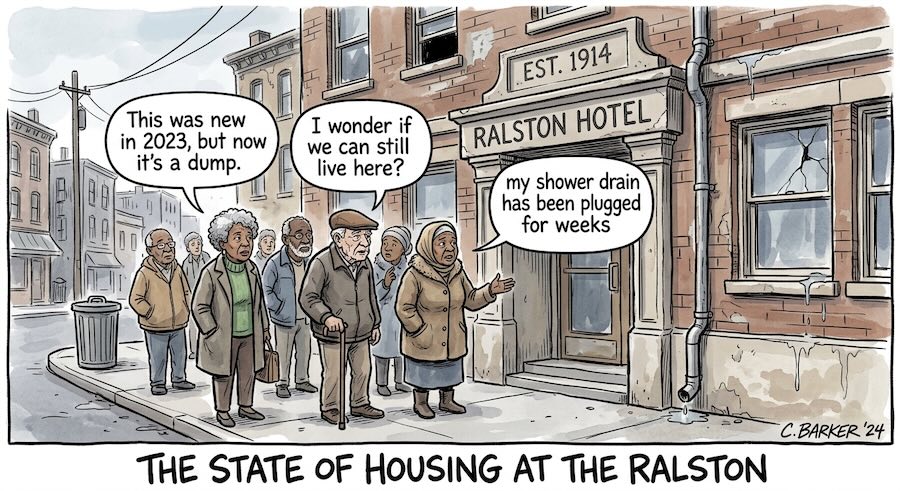
In June 2025, residents described raw sewage in a shower for two months, elevators that did not run, and roof leaks. On July 1, 2025, Columbus code inspectors documented at least 13 safety and code issues over three weeks, including broken air conditioning in six units, leaking roofs and unsanitary conditions. Ryan Pruett directs Columbus code enforcement. The building was about 90 percent occupied.
Infinity Real Estate’s public response was that it has “been responsive, making repairs in any of the cases,” and that “All work orders and complaints delivered to ownership will be addressed timely, as they have been since we bought the property.”
Both accounts can be true, and they explain different things. A manager who fails to file recertifications creates a revenue hole, and $2.9 million is close to a year of this building’s contract income. A manager does not cause a 1914 sewer riser to fail. That is a capital failure.
And here is where the federal record stands. As of data published August 7, 2026, HUD’s inspection file for the Ralston shows one inspection. The July 2025 city inspections found at least 13 safety and code issues in less than a month. The two records are not necessarily contradictory. They are different inspections, at different times, under different standards. What matters is that the federal inspection record now provides no subsequent inspection against which the city’s 2025 findings can be measured.
The city has documented failures the federal record does not reflect, because the federal landlord does not appear to have looked since.
In 2019 the inspection regime caught the decline. It is not looking now.
The 2026 deal, next to the 2014 one
| 2014 | 2026 | |
|---|---|---|
| Issuer | Downtown Development Authority | Downtown Development Authority |
| Amount | $10,500,000 | $25,000,000 |
| Structure | authority lends its tax status only | authority lends its tax status and takes the deed |
| Who holds title | PF Ralston LLC, private | the Authority |
| Property tax break | exempt because a charity owned it | abated because the authority owns it |
| Borrower | Schoolhouse Road Estates, Inc. | Blue Ridge Cascade |
| Public hearing | February 28, 2014 | not yet noticed |
| Council approval | March 11, 2014 | not yet |
| Outcome | contract cancelled, building closed, 200-plus displaced | ? |
Every row of that table comes from a public record.
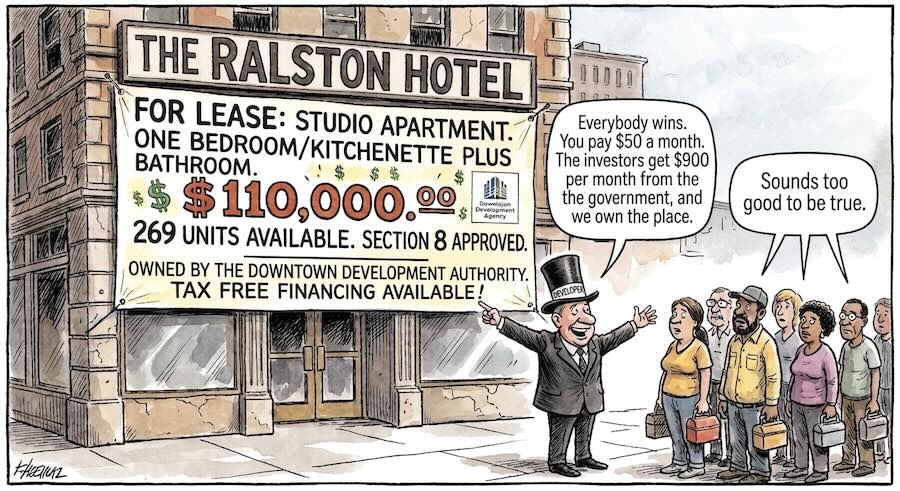
The new developer is Blue Ridge Cascade, with John Maddox as vice president of development. The project is put at $27 million to $30 million. Across 269 units that is $100,372 to $111,524 a unit, roughly three times what the celebrated renovation cost per unit three years ago. The scope includes replacing sewer stacks, adding electrical panels, elevator work, security and unit interiors, and adding kitchenettes. Seven units may go offline because they are not elevator accessible.
The plan is a low-income housing tax credit application to the state at the end of September 2026, an award in early 2027, and a closing in the third quarter of 2027.
It is worth saying why $27 million estimate works now when $9.1 million was the ceiling then. Blue Ridge Cascade is not writing a check for $27 million. It is arranging it. Part is the tax-exempt bonds, paid back out of the building’s own federal rent. Part is cash raised by selling tax credits to corporations that want to lower their tax bills. Part is the property tax it will not have to pay. And it works now because the thing Infinity had to build from nothing already exists. There is a proven twenty-year federal contract with eighteen years left on it.
That is also normal. Putting fresh tax credit money into an aging subsidized building is the standard way big repairs get paid for in this country. It is entirely possible this round finally does the job.
Two things about the abatement should be understood. It does not shield the building’s current $147,596.76 tax bill. It shields tax on the rehabilitated value, which is the value after $27 million or more of work. Nobody has published the schedule, the millage breakdown, or what the county and the Muscogee County School District would give up.
The second thing is the title. In 2014 the Authority never owned the Ralston. In 2026 it becomes the record owner of an occupied 269-unit high-rise full of elderly people. If this deal goes the way the last one went, the Downtown Development Authority is holding that deed.
One clarification, because published coverage has blurred it. The Downtown Development Authority and the Development Authority of Columbus are two separate bodies with two separate boards. The Ledger-Enquirer reported that the Downtown Development Authority voted while quoting Missy Kendrick as president and chief executive of the Development Authority. The two authorities’ minutes also appear on each other’s pages on the county’s board system. Which body is accountable for this deal is not a trivial question.
Four times this has to come back into the open
Bonds like these cannot be issued in secret, and federal tax law is the reason. Because the interest comes tax-free, the deal has to be aired in public before it closes. The 2014 deal had to clear a published public hearing and a Council vote in open session, and so must this one. There are four points ahead where the public gets a say, all of them on a calendar and none of them optional.
A published notice of that hearing. The hearing itself, where any member of the public may speak. A Columbus Council vote in open session. And a court proceeding called bond validation, in Muscogee County Superior Court, where a judge has to sign off before the bonds can be sold. Under O.C.G.A. § 36-82-77 any Columbus resident may join that case as a party.
None of it has started. As of today, no notice has published, and there is no Ralston item and no Blue Ridge Cascade item anywhere on the Columbus Council agenda.
The pace of the paperwork is worth noting on its own. This morning, September 8, 2026, Council received a batch of board minutes for the record. Among them were the minutes of the Downtown Development Authority for June 11, 2025.
The authority that voted on August 26 of this year to issue $25 million and take title to the Ralston is a body whose minutes reached Council fifteen months after the meeting.
Council meets the second Tuesday of the month at 9 a.m. and the fourth Tuesday at 5:30 p.m. The agendas are posted publicly before each one.
Meanwhile 269 units, most of them single rooms occupied by elderly people, stay where they are. They remain under the current owner, who is currently suing the property manager. That’s how things are until the sale closes, which is not expected before late 2027. Nobody has said publicly whether they stay in the building during construction.
Sources
Columbus Consolidated Government e-CAP, “Resolution concerning the issuance of revenue bonds by the Downtown Development Authority of Columbus, Georgia for the benefit of Schoolhouse Road Estates, Inc.,” 2014, including the February 28, 2014 public hearing and the March 11, 2014 Council approval.
Muscogee County Tax Commissioner and Board of Tax Assessors, parcel 004 005 016: sales history, deed book and page references, annual valuations and property tax billed by year.
Columbus Consolidated Government, Tyler EnerGov Citizen Self Service permit records for 1204 2nd Avenue and 211 12th Street, including master permit CBLD-07-22-4583 and the associated phase and trade permits.
Georgia Secretary of State corporate records for Ralston Towers MF II LLC, Infinity Real Estate Advisors, LLC and PF Ralston LLC.
U.S. Department of Housing and Urban Development, Multifamily Assistance and Section 8 Contracts database, property 800253737 and contract GA060509209; Multifamily Housing Physical Inspection Scores, data as of August 7, 2026; FHA insured multifamily mortgage datasets.
Municipal Securities Rulemaking Board trade records for the 2014 Ralston Towers Project Series A bonds.
Georgia Department of Community Affairs, Georgia Register of Historic Places listing, December 3, 2024.
Jordyn Paul-Slater, Columbus Ledger-Enquirer, August 28, 2026, on the Downtown Development Authority’s August 26 action.
Atlanta Journal-Constitution and The Real Deal on the Fulton County and Cook County litigation against RPM Living.
WTVM and Columbus Ledger-Enquirer reporting on 2019 inspection scores, the 2019 contract cancellation, the 2020 closure, and the June and July 2025 conditions and code enforcement.
Columbus Council agenda and packet for September 8, 2026, and the Columbus board and commission records maintained by the Consolidated Government.
O.C.G.A. § 36-42-1 et seq., O.C.G.A. § 36-82-77, and 26 U.S.C. § 147(f).
