
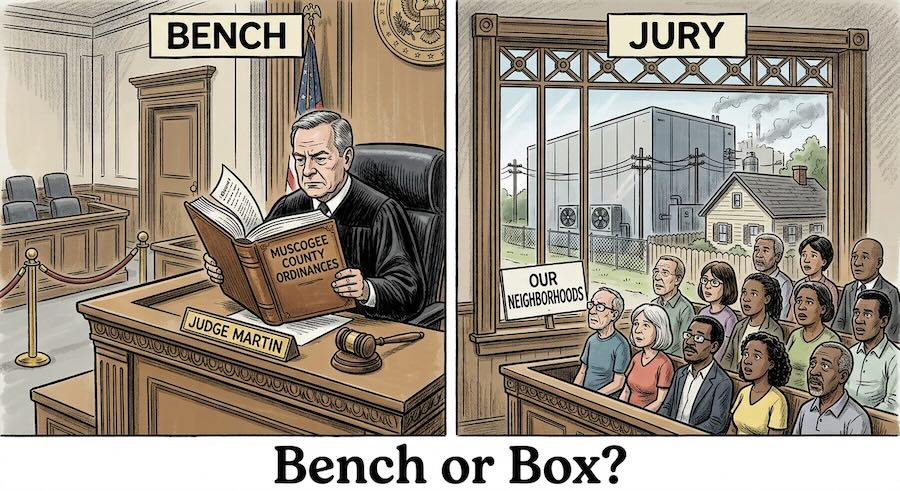

Columbus asked a judge to end the data center lawsuit on Wednesday. He spent the hearing planning discovery and a trial instead. The open question now is whether a jury hears any of it.
The short version
- The eight Upatoi neighbors got their first hearing Wednesday. They did not get a ruling.
- The city had asked the judge to end the case without a trial. Published accounts of the hearing contain no ruling on that request.
- What the judge worked on instead was whether a jury should decide any of it, and how long each side gets to demand documents.
- Plaintiffs must file their argument for a jury by end of business Monday, Sept. 14. Then 60 days of discovery, then a hearing between Thanksgiving and Christmas.
- No order ever froze the ordinance. It has been the law in Columbus for 83 days.
- The defense asked that John Anker, who lost his reelection bid, be dropped as a defendant.
COLUMBUS, Ga. — Eight neighbors from Upatoi and a small company sued Columbus in June over the way the city wrote its data center rules. On Wednesday afternoon they got their first hearing in front of a judge.
They did not get a ruling. What they got was a calendar.
Superior Court Judge John T. Martin Sr. heard from both sides and then turned to the thing he said he has to settle first. Not whether the case is any good. Who decides it. 706report was not in the courtroom. What follows is drawn from the Columbus Ledger-Enquirer’s account of the hearing, which had a reporter there, and from the court’s own records.
“The main thing I’ve got to figure out is bench versus jury,” Martin said. “From where I sit, I’m not really sure what the jury can tell me that I didn’t resolve myself as the finder of fact.”
That is the question in front of this case now, and it will start to be answered on Monday.
What the city asked for, and what the hearing looked like instead
On Aug. 7 the city asked Martin to throw out all seven counts without a trial. The court’s own calendar listed Wednesday’s matter as a motion for judgment on the pleadings, which is a request to end a case on the paperwork alone, without hearing evidence.
The city’s argument is that there is nothing to decide yet. Its filing calls the lawsuit “a premature attempt at blocking a perceived and hypothetical, future data center.” No company has applied to build anything. The ordinance rezoned no land.
Published accounts of Wednesday’s hearing contain no ruling on that motion.
What they describe instead is a judge working out how long discovery should run and whether to seat a jury. Those are the steps of a case that is going forward. A judge who meant to end a lawsuit on Wednesday does not need a discovery schedule.
That is an inference, and we mark it as one. Martin can still rule on the motion later. But the city went in asking for the case to be over, and it came out with a trial to prepare for.
Why bench or jury is not a technicality
In a bench trial the judge is the only one who decides. He hears the evidence, decides what the facts are, applies the law and rules.
In a jury trial, residents of Muscogee County decide what the facts are.
Both sides told Martin what they wanted. Thomas Gristina, for the defense, asked him to set a date and be done with it. “Let’s get a trial date set for a bench trial,” he said.
Jonathan Waters, for the neighbors, pushed the other way. He told the court that concerns like noise and water “would be appropriate for a jury to consider.” Afterward he told the Ledger-Enquirer the plaintiffs believe they are entitled to a trial before the judge “or possibly some of the issues before a jury,” and that it is the judge’s call.
Strip out the law and the disagreement is plain. The city wants a judge weighing a zoning process. The neighbors want their neighbors weighing what it is like to live next to the thing.
Martin was candid that this is not routine work. “These are issues you don’t deal with every day,” he said. “These are things that the court kind of has to educate itself on.”
The calendar, which is now the story
Friday, Sept. 11. A scheduling conference by Zoom.
Monday, Sept. 14. Waters has until the end of business to file his argument for why a jury is warranted, along with a proposed schedule for discovery.
Then 60 days of discovery. Discovery is the stage where each side can demand the other’s documents and question witnesses under oath. Martin did not want it open-ended. He gave it a window and said why.
“This is an important issue for a lot of people, the community, the city,” he said. “I do understand it’s important, and I want to, without rushing it, make sure that we do reach some resolution to this.”
A hearing between Thanksgiving and Christmas.
Martin thinks the shape of the case will be settled before the year is out. He reached for football to say so. “This ball has advanced downfield significantly,” he said. “We haven’t just had the kickoff. I mean, we’re already in the third or fourth quarter.”
Sixty days of discovery on a case filed in June, with a hearing near Christmas, is not a fast track. It is also not a case being thrown out.
What has not changed
The neighbors asked for two things when they sued in June. One was to have the rules struck down. The other was faster: an order freezing everything while the case was heard, which would have stopped Columbus from taking or processing any data center application.
The court record shows no such order was ever entered. There is no restraining order on the docket and no injunction.
So Ordinance 26-034 has been the law in Columbus since Mayor Skip Henderson signed it on June 18. That is 83 days, and counting through a discovery period that runs toward Christmas and a trial that has no date.
The city says nobody has applied to build a data center. Nothing in the record stops anyone from applying tomorrow.
One defendant may be about to leave the case
Counsel for the defense asked Martin to drop councilors who are no longer serving. That means John Anker, who lost his reelection bid to Cathy Cook.
The suit named twelve defendants: the City of Columbus itself, Mayor Henderson, and ten councilors. If Anker comes out, the caption changes and so does a count that most coverage has been getting wrong anyway.
Choose Columbus president and chief executive Missy Kendrick sat in the courtroom and watched. So did the eight landowners and about a dozen other people. Some of them wore red, which Martin noticed from the bench.
What to watch
Monday’s filing is the next real document. It will contain the plaintiffs’ argument for why some part of this belongs to a jury, and it will propose how long the two sides get to dig through each other’s files.
Whether Martin agrees decides what kind of hearing these residents get. A bench trial is one man reading a zoning record. A jury trial puts the question to people who live in the county.
That choice is his, and he has not made it yet.
Case: Keep It Rural LLC et al. v. City of Columbus et al., SU2026CV001406, Muscogee County Superior Court. Docket and scheduling information is taken from the court’s own case record and from Judge Martin’s published civil and domestic calendar for Sept. 9. Accounts of what was said at Wednesday’s hearing, including quotations from Judge Martin and from counsel, are as reported by Kala Hunter of the Columbus Ledger-Enquirer, which had a reporter in the courtroom. 706report has not obtained a transcript. Quotations from the city’s Aug. 7 motion are as previously reported by the Ledger-Enquirer.
