

A promise that is not in the signed deal is not a promise. Part 2 covers jobs, power, water and what happens after the vote, and ends with the full Recommended Council Negotiating Playbook.
The short version
- A promise that is not in the signed deal is not a promise.
- Most data center jobs last only as long as construction does.
- Tie benefits to money the city can collect, not to a job count.
- State rules may not protect Columbus power customers. Write the protections into the deal.
- Put a hard limit on water, in writing.
- After the vote, someone has to check. Name them.
COLUMBUS, Ga. — Part 1 covered the first three choices: where a data center should go, who is behind it, and how the money works. Part 2 is about keeping promises.
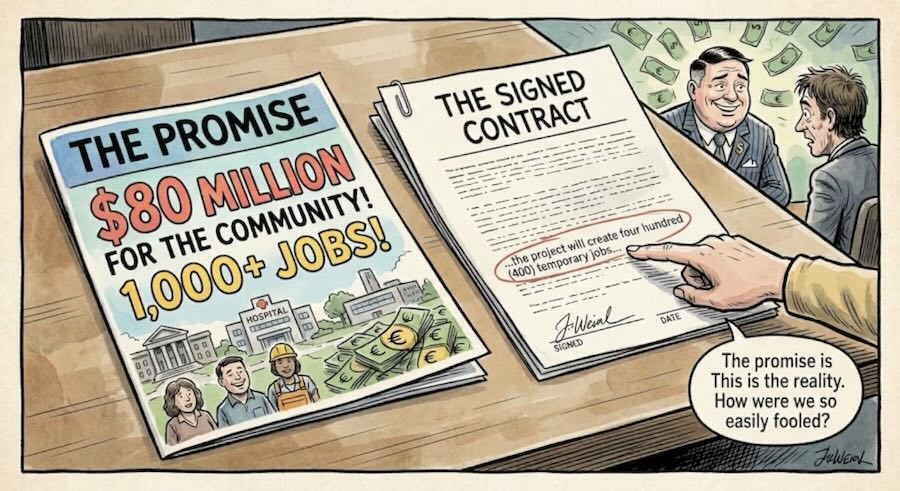
Go back to Effingham County, near Savannah. OpenAI’s data center there was announced in July. County leaders talked up the company’s promise of $80 million for the community. But that pledge is not in the signed agreement.
Here is what the agreement does say. It sets a goal of at least 400 jobs. OpenAI owes extra money if the project’s combined jobs-and-investment performance falls below an 80% compliance threshold.. The only report it must give is a yearly report to the development authority.
That is the gap this part of the guide is about: the gap between what is announced and what is signed.
The idea from Part 1 still holds here. The public gave council its trust. That means residents should help shape the benefits, and they should hear every year whether the promises were kept.
Disclosure: 706report wrote the People’s Overlay, a set of proposed protections sent to council in June. Some of the ideas below appear in it.
Plain words for deal words
- Community benefits agreement (CBA): a signed contract listing what a company will do for the community.
- Letter of credit: a bank’s promise to pay the city if the company does not. The city can draw on it directly.
- Recoupment: money a company must pay back if it falls short of its promises.
- EMC: “electric membership corporation.” A power co-op owned by its members. Flint Energies is one.
- Large-load tariff: special power-rate rules for very big customers.
- Minimum bill, or take-or-pay: the customer pays for a set amount of power even if it uses less.
- MGD: million gallons a day, a measure of water use.
- Decommissioning bond: money set aside up front to tear down and clean up a site if the company leaves.
Stage 4: Jobs and benefits
In plain words: two kinds of jobs
Building a data center takes a lot of workers. Running one takes very few.
- Virginia studied this closely. Its auditors found that up to 1,500 people work on a site at the height of construction. Once it opens, a typical large data center has about 50 full-time workers, and about half of those are contractors.
- Georgia’s own study of its data center tax break counted 8,505 construction jobs and 1,641 operations jobs.
- Researchers at Brookings found that a county’s first big data center adds roughly 100 to 200 jobs. Wages did not go up. Their conclusion: data centers “do create local jobs, though fewer than industry advocates claim.”
For its sales tax break, Georgia asks a county the size of Muscogee for only 25 jobs.
Construction jobs are real, and they matter to the workers who get them. But they end. A deal should be judged on what lasts. Also don’t merely ask how many jobs the developer promises. Ask what the contract considers a job.
Do
- Tie benefits to dollars, not to a job count. New Albany, Ohio, gives data centers a partial tax break, but in return they make guaranteed minimum yearly payments. “A data center campus with 200 to 250 employees has the same impact on the city’s bottom line as an office complex or production facility with 2,000 workers,” the city’s development director told News 5 Cleveland. The money has paid for a bigger police station and parks.
- Put every benefit in the signed contract, backed by money the city can reach. Lancaster, Pennsylvania, signed a community benefits agreement in November 2025. The owners will put $10 million into each of two community funds. If they miss a payment, the city can go to court or draw the money directly from a letter of credit. The amount of that letter of credit is not public. One weak spot: the agreement promises “strong local hiring efforts,” but the actual hiring goals are left to a later plan.
- Shape the benefits with residents, in public. Ask people near the site what they need. Roads? Parks? Job training? Then write it down.
- Make promises survive if the project is cancelled. In 2025, Microsoft paused a $1 billion plan in Licking County, Ohio. The company said it was “following through with our development agreements to fund roadway and utility upgrades,” even without the buildings. That is the goal: promises that hold even if the project doesn’t.
Don’t
- Don’t count a pledge in a press release. Effingham’s $80 million is not in the signed agreement. The agreement’s jobs goal is “at least 400.” A handout from the development authority says the project will support “more than 1,000 permanent jobs.” Goals are not guarantees.
- Don’t accept job numbers no one can check. In Louisiana, Meta’s job figure for a giant data center has changed several times. In August, state utility regulators voted 3-1 not to make Meta show how it got its numbers. In Washington State, the job rule for a data center tax break was weakened within a month. No one can tell whether the jobs were ever created, ProPublica and the Seattle Times found.
- Don’t trade big breaks for few jobs. In Rockland County, New York, a board approved about $77 million in tax breaks for a data center that would add one permanent job.
Questions to ask at this stage
- How many permanent, full-time jobs will there be, not counting contractors?
- Where is each benefit written in the signed agreement?
- What money can the city collect if a promise is broken? Is it backed by a letter of credit or a bond?
- Who chose these benefits? Did residents near the site have a say?
- If the project is cancelled, which promises still hold?
What this could look like in Columbus (a made-up example)
A developer’s press release promises “up to 200 jobs” and a community fund. Council says: put both in the agreement. The fund becomes a fixed dollar amount, paid on set dates, backed by a letter of credit. The jobs become a yearly report, checked by an outside auditor. The developer can still say “up to 200.” But the city counts only what is signed.
Stage 5: Power and water
People are already worried about their power bills. In a Pew survey this spring, 3 in 4 adults said their home energy costs have gone up in recent years. Most said data centers’ growing energy use is at least a part of the reason. A 2025 poll by Ipsos was done for PowerLines, a group that speaks for utility customers. In it, 4 in 5 Americans said they feel powerless over what they are charged.
A data center can use as much power as a small city. Who pays for that, and who carries the risk?
In plain words: who sets your power rates?
In Georgia, the Public Service Commission (PSC) regulates Georgia Power.
In January 2025, the PSC adopted rules for Georgia Power customers that use more than 100 megawatts. The rules let Georgia Power charge these big users a minimum bill and sign long contracts. They allow those protections. They do not require them in every case.
But many Georgians get power from an EMC, a member-owned co-op. Flint Energies, which serves parts of Muscogee County, is one. The PSC says it has “limited regulatory authority” over EMCs. Each co-op’s own board sets its contracts with big customers.
So if a data center gets its power from a co-op, the PSC’s rule for big customers does not apply. Any protections for other customers exist only if someone writes them in.
What does the research say about rates? The honest answer is that it depends.
- A review by the Lawrence Berkeley National Laboratory found that, in the past, more power use has often kept rates flat or even lowered them. That’s because the fixed costs get split over more sales.
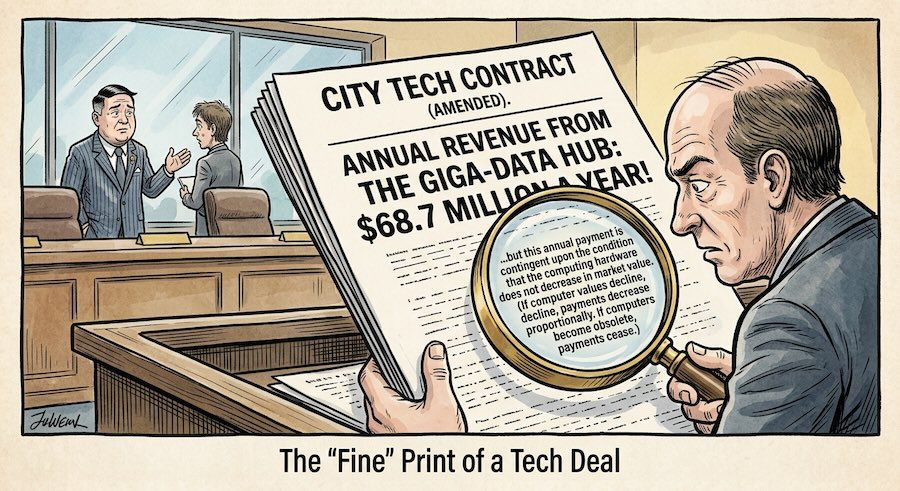
- But in PJM, the large power market that serves 13 states and Washington, D.C., including Virginia and Ohio, the market’s independent monitor found that data center demand accounted for $21.3 billion, or 45%, of capacity costs over three recent auctions. Those costs reach household bills.
- One study found that Amazon’s data centers pay utilities more than it costs to serve them. Amazon Web Services paid for that study, and it left out the cost of new power plants and long-distance lines. That doesn’t make it wrong. But council should always ask who paid for a study, and what it left out.
Do
- Make the developer pay for every hookup. That means new power lines, substations, and water and sewer lines. If only the data center needs them, only the data center should pay for them.
- Push for take-or-pay power contracts. In Ohio, AEP’s data center rules require new data centers to pay for at least 85% of the power they reserve, for up to 12 years, even if they use less. They must also pay an exit fee if they leave, and show they have the money to cover it. Ohio’s watchdog for power customers backed the deal. Council doesn’t set power rates. But it can ask the developer and the utility to put terms like these in writing before the vote.
- Set a hard water limit, in writing. In Botetourt County, Virginia, Google’s data center is capped at 2 million gallons a day until the water system is upgraded. Google pays for those upgrades.
- Make big water use a public vote. Tucson, Arizona, turned down a data center called Project Blue in 2025. Then the city made a new rule. Now any big water user needs a council vote, and its request is made public.
- Plan for drought. Decide now who gets cut back first in a dry year: homes or the data center.
Don’t
- Don’t assume state rules protect local customers. As explained above, the PSC’s rule for big users covers Georgia Power only. Check which utility would serve the site.
- Don’t accept a range in place of a number. A guess that runs from a little water to three or four times as much is not a limit. Columbus Water Works holds the state permit to draw water from the river. That permit does not cap what any one customer uses. Only a contract can.
- Don’t take one study as the final word. Ask who paid for it, and ask your own expert.
Questions to ask at this stage
- Which utility will provide the power: Georgia Power or a co-op?
- Who pays for new lines and substations? Is it in writing?
- Will the data center pay for its reserved power even if it uses less? What happens if it leaves?
- What is the most water it can use per day? Is that a number in a contract?
- In a drought, who gets cut back first?
- If the data center closes, who pays for the equipment built to serve it?
What this could look like in Columbus (a made-up example)
A proposal would get its power from a co-op. Council writes three things into the development agreement. First, the developer pays for every new line, substation and water main. Second, there is a firm daily water limit, with monthly public reports. Third, the developer shows council a signed power contract with a minimum bill and an exit fee before final approval. If the developer won’t sign, council knows where the risk would fall.
Stage 6: After the vote
The vote is not the end. It is the start of years of checking. A promise no one checks is not much of a promise.
Do
- Name one person who owns compliance. Give one staff member the job of tracking every promise in the agreement. Have that person report to council in public every year.
- Require outside audits. The company’s own report is a start, not the end. An independent auditor should check the jobs, the payments and the water use.
- Require a decommissioning bond. Bradford County, Pennsylvania, has proposed rules that would require data centers to set aside money for cleanup. It would come as a bond, a letter of credit or cash, enough to cover the cost of removal, checked by an outside engineer. One weak spot: the proposal lets the estimate subtract what the scrap is worth, which can shrink the bond.
- Keep listening. Hold a yearly public check-in on the project. If you set up a resident advisory group, give it a written charter that says what council must do with its advice. Prince William County, Virginia, had a resident and industry group that met in public for two years on noise rules. Then it was disbanded.
Don’t
- Don’t assume a clawback will ever be used. Texas audited 20 of its 138 data centers getting a state tax break and found 6 that broke the rules. The state says they must repay the taxes they skipped. It has not said how much. We could not find a documented case of a government getting money back from a data center for missing its job promises.
- Don’t let the company grade its own homework. In Effingham, the company must send just one report a year, to the development authority. The authority may check only once a year.
Questions to ask at this stage
- Who on city staff tracks this agreement? When do they report to council?
- Who checks the company’s numbers?
- How much money is set aside for cleanup if the company leaves? Who holds it?
- How will residents hear, every year, whether promises were kept?
What this could look like in Columbus (a made-up example)
It is year three. The company’s report says it has 60 permanent jobs, not the 100 in the agreement. What happens next depends on what the agreement says.
- If it says nothing, nothing happens.
- If it has a clawback, a fixed payment comes due.
- If that payment is backed by a letter of credit, the city can collect it without a lawsuit.
The same shortfall has three very different endings. Council picks the ending before the vote.
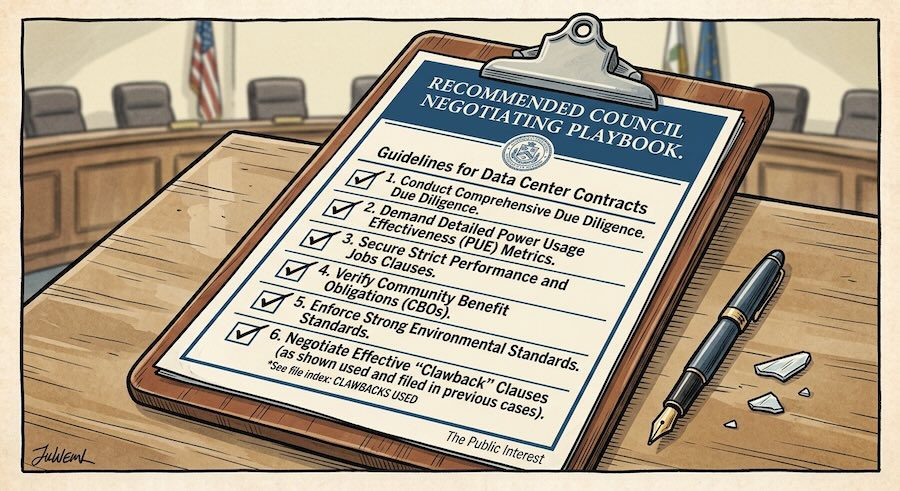
The Recommended Council Negotiating Playbook
A one-page checklist for any hyperscale data center proposal
Who you work for
☐ Residents heard from before any decision, not after
☐ Key facts public with time to read them
☐ Public concerns answered on the record
☐ The legal minimum treated as the floor, not the goal
Before anyone signs
1. Where
☐ Community meeting near the site
☐ Siting rules in place before the application
☐ Site checked for floods, water, power, roads, noise and homes
☐ Plan for the next applicant
☐ Every legal notice checked by the city attorney
2. Who and how big
☐ End user named at least 90 days before the vote
☐ Maximum power and water use in writing
☐ No NDA blocking council or the public
☐ Council’s own expert, paid for by the developer
3. The money
☐ Draft deal and independent money study public before the vote
☐ Guaranteed minimum payment, rising every year
☐ “No tax break” option considered
☐ School board shown the math
☐ Clawbacks written in
☐ No ongoing tax cuts funded by one-time money
Making it stick
4. Jobs and benefits
☐ Benefits tied to dollars, not a job count
☐ Every benefit in the signed agreement
☐ Benefits backed by a letter of credit or bond
☐ Residents helped choose the benefits
☐ Promises hold even if the project is cancelled
5. Power and water
☐ Serving utility known, and which rules apply
☐ Developer pays for all lines, substations and mains
☐ Signed take-or-pay power contract with exit fee
☐ Firm daily water cap in a contract
☐ Large water use requires a public vote
☐ Drought plan in place
6. After the vote
☐ One named staff owner for compliance
☐ Yearly public report to council
☐ Independent audits
☐ Decommissioning bond held by the city
☐ Yearly public check-in, and a resident group with a charter
Notes on sourcing. Every figure in this piece is either quoted from a public document, attributed to the party that published it, or labeled as 706report’s own arithmetic. The Columbus examples marked “a made-up example” are illustrations, not predictions about any project or official.
Effingham County terms are from the memorandum of understanding between the Effingham County Industrial Development Authority and Octans GA LLC, dated for reference July 21, 2026, and from county and authority materials. Job figures are from Virginia’s Joint Legislative Audit and Review Commission, Data Centers in Virginia 2024 (Dec. 9, 2024); Georgia’s December 2025 tax incentive evaluation of the data center exemption; and Dany Bahar and Greg Wright, Brookings Institution (May 4, 2026, updated Aug. 10, 2026). The Lancaster agreement is as posted by the City of Lancaster. Microsoft’s Licking County statement is as reported by WSYX/Fox 28; 706report has not confirmed the payments themselves.
Polling is from Pew Research Center with SSRS (May 8, 2026) and from Ipsos for PowerLines, a ratepayer advocacy group (April 23, 2025). The Georgia Public Service Commission’s large-load rule is from its Jan. 23, 2025 announcement. The PSC’s description of its authority over EMCs is its own. AEP Ohio terms are as reported by POWER Magazine on the Public Utilities Commission of Ohio order of July 9, 2025. PJM capacity figures are from the PJM Independent Market Monitor, as reported by Utility Dive. The finding that Amazon’s data centers pay more than they cost to serve is from a study by E3 funded by Amazon Web Services, as reported by POWER Magazine.
The Bradford County, Pa., decommissioning language is a proposal, not an adopted rule. The Texas audit is as reported by The Texas Tribune, July 27, 2026. The statement that 706report found no documented case of money recovered from a data center reflects our own research and is not a claim that none exists.
