
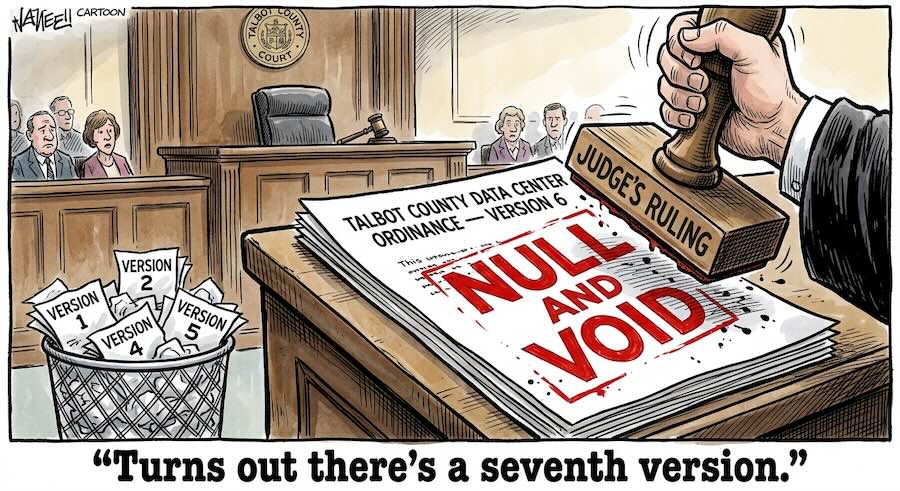

In a consent judgment signed Thursday, Talbot County agreed its July 6 data center amendment was adopted without the notice and hearings state law requires. The judge declared it void from the start and barred the county from processing any data center permit under it.
The short version
- Talbot County’s data center zoning amendment is void ab initio. In plain words, the law treats it as if it never passed.
- The county admitted it did not follow the Georgia Zoning Procedures Law, the state’s notice and public hearing requirements, or its own zoning rules when it adopted the amendment July 6.
- The county is permanently barred from accepting, processing or approving any data center application or permit under the amendment.
- Data centers are not an allowed use anywhere in Talbot County under the zoning ordinance now in force.
- The county can try again, but only by following the full legal process, including Planning Commission review and a public hearing.
- Chief Judge John T. Martin Sr. signed the order Oct. 22. It ends the case.
Updated Oct. 23 with comments from the plaintiffs’ attorney and plaintiff Ronnie Wilson.
COLUMBUS, Ga. — Talbot County has conceded that it broke Georgia zoning law when it added data centers to its zoning ordinance in July, and a judge has thrown the change out.
Chief Judge John T. Martin Sr. of the Chattahoochee Judicial Circuit signed a Consent Final Judgment and Order on Thursday, Oct. 22. The circuit covers Muscogee, Harris, Chattahoochee, Marion, Talbot and Taylor counties. The Talbot County Clerk of Superior Court e-filed it at 5:55 p.m.
A consent judgment is one both sides agree to before the judge signs it. In this one, the county agreed to more than ending the case. It agreed that it did the thing it was sued for.
The plaintiffs’ legal team provided a copy of the order to 706report on Friday.
What the county admitted
The order says Talbot County, “by and through its Board of Commissioners, acknowledges and agrees” that the text amendment “was not adopted in compliance with the procedures required by law.”
It lists three sets of rules the county did not follow:
- State zoning law: the Georgia Zoning Procedures Law, O.C.G.A. § 36-66-1 and following;
- Notice and hearing: the state’s notice and public hearing requirements in O.C.G.A. § 36-66-4;
- The county’s own rules: the zoning amendment procedures in Section 18 of its Zoning Ordinance.
The county also agreed “that the County did not properly conduct the zoning process with respect to this matter.”
What the order does
- The amendment is void: the parties agreed, and the court found, that the text amendment “is void ab initio and of no force or effect.” The amendment was adopted July 6. It “for the first time authorized ‘Data Centers’ and ‘Hyperscale Data Centers'” as uses in the county’s zoning districts, the order says.
- The old ordinance is back: Talbot County’s zoning ordinance “as it existed immediately before July 6, 2026, remains in full force and effect.” Under it, neither data centers nor hyperscale data centers are allowed in any zoning district.
- No permits: the county, “and all persons acting in concert with it,” are permanently barred from enforcing the amendment. They also cannot accept, process or approve “any application, conditional use permit, development agreement, land disturbance permit, or building permit for any data center” under it.
- Each side pays its own lawyers: the court keeps the power to enforce the order, which “fully and finally resolves all claims asserted in this action.”
- Who signed: Waters prepared and presented the order for the plaintiffs. Edward N. Davis signed it as “Attorney for Defendants,” consenting on the county’s behalf.
A second try has rules
The order says the amendment “must be set aside and readopted in accordance with law.” If the county wants to allow data centers again, it must first comply fully with:
- state zoning law, including the notice and public hearing requirements;
- its own Section 18 procedures, “including submission to and recommendation by the Talbot County Planning Commission, and a noticed and conducted public hearing”;
- the due process guarantees of the Georgia and U.S. constitutions.
What they said
“This judgment restores the rule of law to Talbot County’s zoning decisions,” Waters said in a press release Friday. “Our clients asked only that the County follow the procedures the law requires before permanently reshaping the rural community they call home. The County agreed that the amendment is void.”
“We are thankful for this victory, as it is good for all the residents who weren’t able to be heard,” Ronnie Wilson, one of the plaintiffs, said in the release. “I believe once all the facts are before the commissioners, it is our hope that Hyperscale Data Centers and Data Centers will not be allowed in Talbot County’s rural agricultural zoning districts.”
County Attorney Edward N. Davis told 706report he will discuss the case on Monday.
How the case started
The suit was filed Aug. 7 in Talbot County Superior Court. The plaintiffs are Ronnie Wilson, Aaron Bridwell III, Penny Bridwell, Eric Williamson and WCR LLC, according to the press release from their lawyer.
- Ronnie Wilson: he lives in Muscogee County and owns property on both sides of the Muscogee-Talbot line, according to the Columbus Ledger-Enquirer.
- The defendants: Talbot County and its five commissioners.
- The complaint: it said the commission adopted the amendment “without proper notice, proper hearing, meaningful planning-commission review, comment, or discussion,” the Ledger-Enquirer reported. It also said the vote came 14 days after neighbors in Upatoi sued Columbus over its own data center zoning.
- What it asked for: void the amendment and block the county from processing data center permits. The consent judgment does both.
“(The ordinance proposal) wasn’t even on the agenda,” Wilson told the Ledger-Enquirer in August. “They voted unanimously, and no one knew about it.”
The amendment would have opened the county’s agricultural and forestry land to hyperscale data center campuses on tracts of at least 100 acres, with buildings up to 75 feet tall, on-site backup power generation and around-the-clock operation, according to the plaintiffs’ press release. Talbot County had 5,709 residents at the 2020 Census. The complaint says most of them rely on well water.
The Columbus case is still going
The lawyer who brought the Talbot case, Jonathan Perry Waters of Macon, also represents Keep It Rural LLC and eight Upatoi landowners in their suit against Columbus over the Technology Overlay. Judge Martin is presiding over that case too.
The two cases are not the same.
- Talbot: the suit focused on whether the county followed the required steps at all, and the county has now admitted it did not.
- Columbus: the city has defended its overlay in court. On Oct. 8, Martin denied the neighbors’ request for a jury. A bench trial is set to begin Monday, Dec. 14.
“Our case with Keep It Rural against the City of Columbus is still underway,” Jenny Wright, a legal assistant to Waters, wrote in an email to 706report on Friday.
Questions we are still asking
706report is working to answer these and will update this story.
- Will Talbot County try again? The order lets the county readopt a data center amendment if it follows the full process. We have asked whether the commission plans to.
- When did the commission approve the settlement? The order says the county consented “by and through its Board of Commissioners.” We are checking when, and whether, the board voted on it in an open meeting.
- What about the individual commissioners? The suit named the five commissioners as defendants. The order says it resolves “all claims,” and Davis signed for “Defendants.” We are confirming that it covers all of them.
- Who drafted the amendment? The complaint said the adopted document was labeled “version 6.” We have asked who wrote the earlier versions.
- Was any data center application filed in Talbot County while the amendment was on the books?
- What does the county say? County Attorney Edward N. Davis has said he will talk with 706report on Monday.
706report will publish responses from any of the people or boards named in this story. Send yours through our contact form.
Notes on sourcing.
The case: WCR, LLC, et al. v. Talbot County, Georgia, et al., Civil Action File No. 2026-CV-084, Talbot County Superior Court.
The order: Consent Final Judgment and Order, signed Oct. 22, 2026, and e-filed that day at 5:55 p.m., which 706report has read in full. It was provided to 706report by the plaintiffs’ counsel. It is a public court record.
Background on the suit: the defendants, filing date, complaint language and Wilson’s August quote are as reported by Kala Hunter of the Columbus Ledger-Enquirer, Aug. 10, 2026. 706report has not yet read the Talbot County complaint.
Press release: “Talbot County Landowners Prevail,” issued Oct. 23, 2026, by Jonathan Perry Waters, attorney for the plaintiffs, and sent to 706report at its request. It is the source for the full list of plaintiffs, the description of what the amendment would have allowed, Davis’s title, and the Waters and Wilson quotes in “What they said.”
The Columbus case: Keep It Rural LLC et al. v. City of Columbus, Georgia et al., SU2026CV001406, Muscogee County Superior Court.
Disclosure: 706report wrote the People’s Overlay, a set of proposed protections submitted to Columbus Council during the Project Ruby overlay debate.
