

Preface · June 2026
When the people promoting a project are also the people evaluating it, confirmation bias isn’t a personality flaw — it’s a structural inevitability
Before asking whether Columbus has been told the truth about Project Ruby’s water demands, it is worth asking a prior question: has the process by which Columbus gathered information about this project been designed to produce accurate answers — or has it been designed, however unintentionally, to produce reassuring ones?
That question is not an accusation. It is a structural observation. And the answer, on examination, has significant implications for how the Columbus City Council should weigh the information it has received.
What Confirmation Bias Actually Means
Confirmation bias is one of the most thoroughly documented findings in the psychology of human judgment. In its simplest form, it describes a tendency that all people share: we process information that confirms what we already believe more readily, and more generously, than information that challenges it. We seek out sources that agree with us. We remember supporting evidence better than contradicting evidence. We apply higher scrutiny to conclusions we dislike than to conclusions we want to reach.
This is not a character flaw. It is a feature of how human cognition works under conditions of uncertainty and competing pressures. It affects experts as readily as laypeople, and it intensifies when the stakes are high, when there is social or professional investment in a particular outcome, and when the information environment is controlled by parties with a stake in the conclusion.
All three of those conditions are present in Columbus right now.
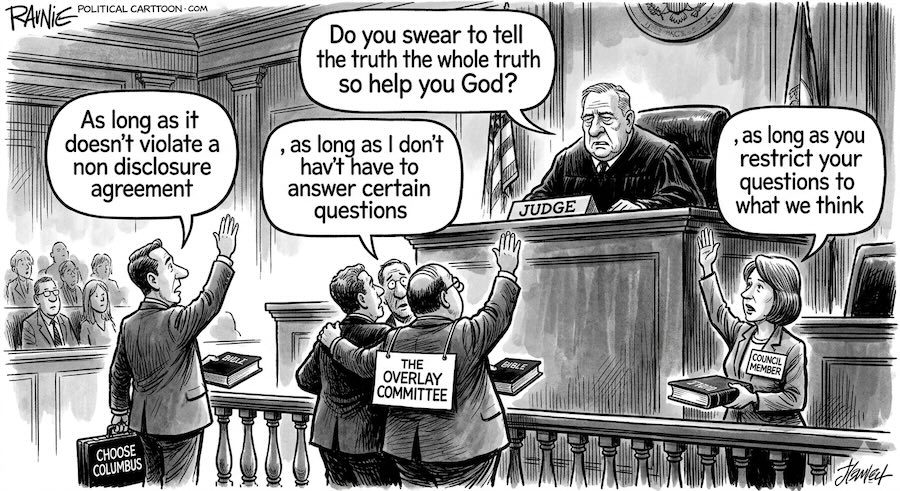
The Columbus City Council has publicly championed Project Ruby as a transformational economic opportunity. The $5 billion figure has been repeated approvingly at town halls and council sessions. Choose Columbus — whose institutional purpose is to attract exactly this kind of investment — has served as the primary source of information about the project’s scale, costs, and demands. The Chamber of Commerce — whose membership has a direct financial interest in major development activity — was asked to develop the regulatory framework under which the project would operate.
None of the people and institutions involved are necessarily acting in bad faith. Most of them probably believe what they are saying. But the information architecture of this decision has been constructed in a way that makes it structurally difficult to surface inconvenient truths — and structurally easy to accept reassuring ones.
The Source Problem
In any major decision, the quality of the conclusion depends heavily on the quality of the sources. And source quality, in this context, means something specific: it means whether the institutions providing information have a structural incentive to give you accurate information, or a structural incentive to give you favorable information.
Choose Columbus is the city’s economic development marketing organization. Its mission is to attract investment. When it tells the council that Project Ruby’s water demand will be manageable, it is not conducting an independent engineering assessment. It is relaying a developer’s representation. Choose Columbus has no independent expertise in water systems engineering, no institutional incentive to scrutinize the developer’s claims, and no track record of having done so for comparable projects.
The Chamber of Commerce Overlay Ordinance was developed by a committee whose membership is drawn from the business community. That community has a legitimate and entirely understandable interest in welcoming major development to Columbus. But welcoming development and rigorously evaluating development are different activities, and the ordinance that emerged from that process — as the People’s Overlay’s detailed drafting notes document point by point — contains no binding minimum revenue guarantee, no reclamation bond, no prohibition on fluorinated cooling fluids, and no independent water demand study requirement. It is an enabling document, not a protective one.
This is not a criticism of the people who wrote it. It is an observation about what happens when you ask a group with a shared interest in a project’s approval to write the rules under which that project will be evaluated. The outcome is predictable regardless of anyone’s intentions.
The Structural Conflict — and Its Parallel Elsewhere
The conflict of interest problem in data center approvals is not unique to Columbus. It has been documented formally across the country.
A University of Mary Washington sociology professor, Eric Bonds, examined 31 local governments in Virginia where data centers had been proposed in 2024 and 2025. He found that 25 of them — 80 percent — had signed non-disclosure agreements with the developers. His concern was explicit: “The use of NDAs is part of the reason public discussion has been so limited. Locally, landowners and homeowners are going to be impacted by the construction of new electrical utility lines and water pipelines. Up until recently, these projects were approved with very little public debate about the cumulative environmental impacts.”
An NBC News investigation found that in a majority of 30 data center projects examined nationally, local officials had signed NDAs with developers, often while also working with shell company names to further conceal the identity of the companies behind the projects.
In Lowndes County, Alabama — where a data center project called “Project Red Clay” is under review — a resident formally requested that the county commission’s vice chairman recuse himself from any vote on the project, on the grounds that he simultaneously held an officer position in the economic development authority that had recruited the developer to the county. The commission’s attorney disagreed that any conflict existed. Residents responded by requesting all records showing how the economic development authority had proposed the project — and by questioning whether the authority was operating, as one resident put it, as “a private club” rather than a public body.
The parallel to Columbus is not identical but it is instructive. Choose Columbus recruited Project Ruby to Columbus. Choose Columbus is providing the primary information about Project Ruby to the council. The council is being asked to evaluate a project on the basis of information supplied primarily by the organization that recruited it.
What Motivated Reasoning Looks Like in Practice
There is a related concept that goes slightly further than confirmation bias: motivated reasoning. Where confirmation bias describes how we process information, motivated reasoning describes how we construct arguments. The conclusion comes first — we want this project — and the reasoning is assembled afterward to support it.
The evidence of motivated reasoning in the Project Ruby process is not direct or provable. But several patterns are consistent with it.
The water demand figure — 330,000 gallons per day — has no publicly disclosed methodology. It originated with the developer and was accepted and repeated without independent verification. When the figure was challenged by the megawatt-to-water math, there was no response from Columbus Water Works or Choose Columbus addressing the discrepancy. The figure simply continued to be repeated.
The “closed-loop cooling” assurance was offered as a sufficient answer to water concerns without any binding legal commitment, any specification of what technology would actually be used, or any reference to the fact that another Georgia data center developer made the same assurance and then drew nearly 30 million gallons from the county supply in excess of its planning limits.
The Chamber ordinance was presented as a regulatory framework without the features that communities in Northern Virginia, Michigan, and Newton County, Georgia had learned — from painful experience — were essential. The absence of those features was not acknowledged or explained. The ordinance was simply presented as adequate.
Each of these is a pattern consistent with reasoning that starts from a desired conclusion and works backward, rather than reasoning that starts from evidence and follows wherever it leads.
The NDA Question Columbus Has Not Asked
There is one question that has not been asked publicly in Columbus but that cuts to the heart of whether the council is operating with full information.
Has Columbus Water Works signed, or been asked to sign, a non-disclosure agreement with the Project Ruby developer or with Habitat Real Estate Partners that limits what it can disclose to the council or the public about the project’s water demands?
This is not a hypothetical concern. Research published by the University of Mary Washington found that 80 percent of Virginia localities with data center projects had signed NDAs with developers. A nationwide investigation found NDAs in a majority of 30 projects examined across the country. The NDAs “typically call for governments to share as little information as possible,” according to Professor Bonds.
If Columbus Water Works is operating under an NDA with any party related to Project Ruby, then the council is not receiving the full picture — not because officials are lying, but because they are contractually prohibited from sharing what they know. That is a condition that no council member should accept when voting on a decision of this magnitude.
The question should be asked directly, on the record, in open session: has any party involved in this process signed a non-disclosure agreement with any representative of Project Ruby or its developer?
Why This Matters for How the Series Should Be Read
The three articles that follow this preface examine specific factual questions about Project Ruby’s water demands: where the 330,000-gallon figure comes from, what the cumulative upstream risk to the Chattahoochee looks like, and what Georgia communities have learned after approving projects on the basis of assurances similar to those Columbus has received.
Those articles present evidence. They cite sources. They are designed to be checked.
But evidence and sources only matter if the people evaluating a decision are genuinely open to information that challenges their existing conclusions. That openness is harder to maintain — for anyone — when:
- The council has publicly invested reputational capital in a project’s success.
- The primary information source is the organization that recruited the project.
- The regulatory framework was written by a committee with a shared interest in the project’s approval.
- Key agreements may be subject to non-disclosure obligations that limit what officials can say publicly.
- The institutional culture treats scrutiny of the project as opposition to economic development rather than as the exercise of the due diligence that every public official owes to the people they represent.
Confirmation bias does not require malice. It does not require dishonesty. It requires only that the information architecture around a major decision be structured in ways that make reassuring information easy to accept and challenging information easy to dismiss.
That is a description of the current situation in Columbus. And recognizing it is the first step toward correcting it — not by rejecting Project Ruby, but by insisting on the independent verification, the binding legal commitments, and the genuine public transparency that any decision of this magnitude deserves.
What Independent Verification Looks Like
The solution to confirmation bias in public decision-making is not skepticism for its own sake. It is independent verification — analysis conducted by parties whose interests are not aligned with any particular outcome.
For Project Ruby, that means:
- A water demand study prepared by an engineer retained by the city — not the developer — referencing facilities already operating at comparable power loads.
- A legal review of the Development Agreement conducted by outside counsel retained specifically for that purpose, loyal to Columbus and funded by the developer, as the People’s Overlay requires.
- A public disclosure of whether any party in the Project Ruby process has signed an NDA limiting what can be shared with the council or the public.
- A formal response from Columbus Water Works to the upstream demand question — what does projected Chattahoochee River flow look like under a scenario of materially increased upstream data center withdrawals, reviewed against Georgia EPD’s current and pending permit data?
- An acknowledgment, by the council, that the information it has received to date comes primarily from sources with a structural interest in this project’s approval — and that independent verification is not obstruction, but obligation.
The articles that follow are an attempt to supply some of that independent analysis. They are offered in the spirit of the question that should be at the center of every major public decision: not “how do we approve this?” but “what do we actually know?”
Sources
Confirmation bias and motivated reasoning in public decision-making: established findings in cognitive psychology; for review, see Kahneman, D., Thinking, Fast and Slow (2011); Nickerson, R.S., “Confirmation Bias: A Ubiquitous Phenomenon in Many Guises,” Review of General Psychology (1998).
University of Mary Washington NDA study (25 of 31 Virginia localities): Bonds, E. and Newby, V., Virginia Mercury, April 30, 2025; expanded reporting in Virginia Mercury, April 24, 2026; cited in Pennsylvania Centre Square, April 2026.
Eric Bonds quote on limited public discussion: Virginia Mercury, October 25, 2024 / April 2025.
NBC News investigation, NDAs in majority of 30 national data center projects: cited in Oil and Gas Watch, February 2026.
NDAs “typically call for governments to share as little information as possible”: Professor Eric Bonds, cited in Pennsylvania Centre Square, April 2026.
Lowndes County, Alabama Project Red Clay conflict of interest complaint and commission attorney response: Lowndes Signal, May 2026.
Ohio state senator quote (“elected officials should not be under NDAs when taking votes about public resources”): Journal-News / Ohio Capital Journal, June 2026.
Columbus Water Works and Choose Columbus Project Ruby statements: WTVM, February 16 and March 18, 2026; Inside Climate News, April 13, 2026.
People’s Overlay ordinance independent counsel and water demand study requirements: Community-Protective Technology Overlay District — Proposed Alternative Draft, Sections (i) and (j)(13), June 2026.
This Series: Water & Project Ruby
Preface: Can Columbus Trust the Information It Has Been Given?
Article 1: Where Does the 330,000 Gallon Number Come From?
