
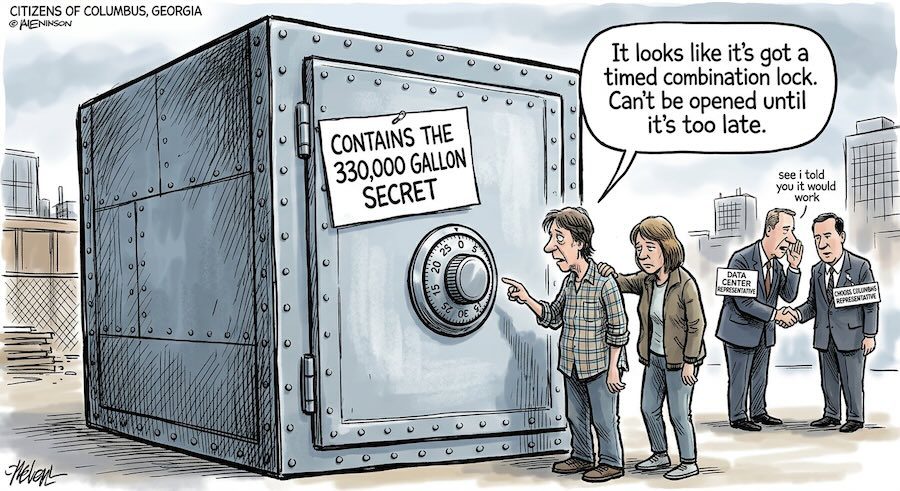

Article 3 of 3 · June 2026
A pattern of redacted agreements, broken promises, and buried data raises a question Columbus deserves answered: are our officials ignorant — or are they not telling us everything?
The first two articles in this series raised questions about numbers. Where does Project Ruby’s 330,000-gallon-per-day water demand figure come from? Does it hold up against the facility’s 600-megawatt power request? What happens to Columbus’s water supply when upstream data centers on the Chattahoochee begin drawing at full capacity?
This article raises a harder question. Not whether the numbers are wrong — but whether the public is being allowed to see the real numbers at all.
The Phrase That Keeps Appearing
There is a phrase you will hear repeatedly from Columbus Water Works and Choose Columbus when the subject of Project Ruby’s water use comes up. It appears in town hall presentations, in media interviews, in official statements. The phrase is “closed-loop cooling system.”
The reassurance embedded in that phrase is clear: closed-loop means the water circulates inside the system and comes back, rather than evaporating into the air. Minimal consumption. Nothing to worry about.
It is worth knowing that the same phrase — word for word — was used by Quality Technology Services (QTS), the developer of a massive data center campus in Fayetteville, Georgia, after investigators discovered the company had drawn nearly 30 million gallons of water from the county supply without paying for it. The excess consumption, QTS explained, occurred “while temporary construction-related activities” were underway. Their data centers, the company said, use “a closed-loop cooling system that continually circulates the same water so there’s no impact to the local water supply.”
The 29 million gallons — equivalent to 44 Olympic-size swimming pools — exceeded the peak limit the developer had agreed to during the original planning and approval process. Residents in the nearby Annelise Park neighborhood had been told by county officials to stop watering their lawns to conserve water. Nobody told them that a data center had quietly connected two industrial-scale hookups to the public water system — one installed without the utility’s knowledge, the other simply never linked to a billing account.
That is the gap between what communities are told and what actually happens. And in Georgia, that gap is not an accident. It is, in many cases, the result of deliberate policy choices about what the public is permitted to know.
The Redactions
In November 2025, WSB-TV Channel 2 in Atlanta filed open records requests — the standard tool journalists and citizens use to obtain government documents — for the water use agreements between data center developers and Georgia counties. What they received back was revealing not for what it said, but for what had been removed.
The agreement between Google and Douglas County came back with every reference to water use specifics and water requirements blacked out. The water use figures for a Microsoft data center were also hidden. The investigation turned up formal non-disclosure agreements — contracts that legally prohibit the parties from sharing information — in multiple cases. In one agreement, even the name of the company had been redacted from what is supposed to be a public record.
Chris Manganiello, Water Policy Director for the Chattahoochee Riverkeeper — the environmental organization that monitors the health of the river that supplies Columbus’s drinking water — has spent years trying to answer a simple question: how will data center operations affect a community’s water supply? His conclusion, after reviewing what Georgia counties have been willing to share: “In an absence of information, we’re left with more questions than answers.”
The industry’s response to questions about why this information is kept secret is consistent. A data center industry representative told WSB-TV that “the data center industry, just like any other industry, has to consider confidentiality in terms of protecting proprietary and competitive information.” The representative also acknowledged that data centers do provide local governments with their actual water use numbers — it is just that the public is not permitted to see them.
Read that again carefully. The public utility — whose water belongs to the public, and whose infrastructure was built with public money — has the numbers. It has simply agreed, contractually, not to share them with the people who own the water.
Georgia’s Legislature Noticed
The redaction story did not stay buried. It reached the Georgia General Assembly.
In January 2026, State Senator RaShaun Kemp introduced Senate Bill 421, the Data Center Transparency Act. The bill was straightforward: it would prohibit local governments and public authorities from entering into non-disclosure agreements that prevent utilities from disclosing data centers’ water and electricity usage to the public. Senator Kemp explained his reasoning directly: “It was alarming to learn that cities can enter into nondisclosure agreements that prevent the public from seeing just how high these usage numbers are.”
SB 421 was introduced, sent to committee — and received no hearing. The committee never met to discuss it. No vote was ever taken.
A companion bill, HB 528, would have required data centers to report their water consumption, electricity usage, and community impacts directly to the state — putting the information in one place where any Georgia resident could access it. Also introduced. Also never heard in committee.
A separate bill, SB 34, would have prohibited Georgia Power from passing the costs of serving data centers on to residential and small business customers. It came close to a floor vote in February 2026. The Georgia Senate abruptly adjourned — ended the day’s session without explanation — just as it appeared the stronger version of the bill had enough votes to pass. The data center industry had lobbied for a weaker substitute version. The Senate chose adjournment over putting the question to a vote.
In total, Georgia legislators introduced at least seven bills in the 2026 session aimed at reining in data center impacts on water, electricity costs, and taxes. Most received no committee hearing. The transparency bill — the one that would have forced public disclosure of the water use numbers currently hidden behind redacted agreements — is still listed as awaiting its first reading.
What “Closed Loop” Doesn’t Tell You in Practice
The phrase “closed-loop cooling” is technically meaningful. It describes a design approach in which water or coolant circulates within a sealed system rather than being sprayed into the air to evaporate. Done correctly, it genuinely does reduce how much water a facility consumes.
But it is a description of intent, not a legal commitment. And the Fayette County case shows exactly how the gap between the two plays out.
QTS told Fayette County it used closed-loop cooling. It also drew 29 million gallons from the county supply at volumes that, according to Politico’s investigation, “far exceeded the peak limit agreed to during the data center planning process.” The explanation offered was construction activity. That detail matters directly for Columbus, because Project Ruby is scheduled to be under construction from at least 2027 to 2030. The construction phase is not a brief or incidental period — it is multiple years during which, if the Fayette County pattern holds, actual water demand can dramatically and quietly exceed what was promised during the planning approval.
The Fayette County water director’s account of how the unauthorized hookups went undetected for months — possibly more than a year — is also instructive. “Fayette County is a suburb, it’s mostly residential, and we don’t have much commercial meters in our system anyway. And so we didn’t realize our connection point wasn’t working.” She added that her staff is small and stretched: “I’ve got one person that’s doing inspections and plan review, and so he’s spread pretty thin.”
Columbus Water Works serves a far larger community than Fayette County, with more staff and more sophisticated systems. But the underlying conditions that produced the Fayette County failure — agreements whose specifics the public cannot see, monitoring that depends partly on the developer’s self-reporting, and a utility that is ultimately accountable to its operating budget — are not unique to a small suburban county. They are structural features of how data center water agreements have been written across Georgia.
The People’s Overlay ordinance requires the developer to fund a dedicated compliance position inside Columbus’s Inspections and Code department for the full duration of the facility’s operation. That provision exists precisely because the Fayette County problem is not a Fayette County problem. It is a template.
The “Largest Customer” Problem
There is one sentence in Politico’s investigation of the Fayette County case that deserves to be read carefully by every Columbus city councilor.
When asked why the county did not fine QTS for the unauthorized water use — water drawn without the utility’s knowledge, during a drought, while residents were being asked to conserve — Fayette County water system director Vanessa Tigert said: “They’re our largest customer and we have to be partners.”
Not: the public’s water belongs to the public, and unauthorized use will be penalized regardless of who the customer is.
Not: we have an enforcement responsibility that does not change based on the size of the account.
“They’re our largest customer and we have to be partners.”
That sentence describes regulatory capture — the condition in which the regulator begins to serve the interests of the entity it is supposed to oversee. It is the predictable outcome when a public utility’s largest customer is a corporation whose legal and financial resources vastly exceed the utility’s enforcement capacity — and when the consequences written into the original approval are not strong enough to make compliance cheaper than violation.
The People’s Overlay ordinance sets fines at $5,000 per day for non-compliance and establishes a mandatory timeline leading to revocation of the facility’s certificate of occupancy if violations continue. These provisions exist because the Chamber of Commerce ordinance’s $1,000-per-day fine — as the People’s Overlay drafting notes bluntly observe — is “rounding error for a $5 billion facility.” A penalty that costs less than continued violation is not an enforcement mechanism. It is a licensing fee for non-compliance.
Ignorance or Deception — and Why the Distinction Matters
There is a charitable interpretation of how Columbus officials have handled the water question so far. The project is still in the pre-application phase. Detailed engineering studies have not formally been required yet. It may be premature to expect precise water consumption figures before a formal application exists. The 330,000 gallon figure is a planning estimate from the developer, not a final sworn commitment. Everyone, on this reading, is acting in good faith with the information currently available.
That interpretation is possible. It may be partially true.
But it does not sit comfortably next to several things we already know.
We know that Georgia’s data center water agreements routinely contain redacted figures — not at the pre-application stage, but after projects are approved and operating, when those numbers should be unambiguously public.
We know that a bill to require disclosure of those figures was introduced in the Georgia legislature, never heard in committee, and effectively killed — after the data center industry signaled its opposition.
We know that the 330,000 gallon figure has no publicly disclosed methodology and has shifted by 27 percent between official statements, with no explanation.
We know that a comparable Georgia data center — one that also promised closed-loop cooling — drew water at volumes that exceeded its planning commitment, connected hookups the utility did not know about, and was not fined because it was the utility’s largest customer.
And we know that Columbus Water Works has acknowledged there are no pipes to the Project Ruby site — meaning infrastructure must be planned, sized, and built — but has produced no independent engineering study to establish what that infrastructure should be designed to carry.
The question is not whether Columbus officials are lying. Most of them probably believe what they are saying. The more important question is whether what they are saying is based on information they have actually verified — or on representations made by a developer whose financial interests and the public’s interests diverge at every point where money and water meet.
Five Questions That Would Settle It
There is a straightforward test for whether Columbus Water Works and Choose Columbus are working from verified information or accepted developer representations. Ask them to produce:
The source document. What is the original document — not a summary slide, not a press briefing — that states the 330,000 gallon per day figure, and who prepared it?
The methodology. How was that figure calculated? What cooling technology was assumed? What power load was modeled? What comparable operating facilities were used as benchmarks?
The contract language. What specific water consumption limit is the developer legally obligated to stay within? What are the contractual consequences if that limit is exceeded — during construction, at first occupancy, and at full buildout?
The monitoring plan. Who meters the actual water use? How often? Who has access to that data? Is it available to the public?
The agreement terms. Is any portion of the water use agreement between Columbus Water Works and the developer subject to a non-disclosure agreement, or otherwise shielded from public records requests?
That last question is the one that determines whether this is a story about ignorance or something else. If Columbus Water Works has entered into — or is planning to enter into — a water use agreement whose specifics the public is not permitted to see, then this community is being asked to approve a 40-year industrial facility on the basis of numbers it is not allowed to examine.
That is not a partnership with the public. It is a transaction conducted over the public’s head, using the public’s water, underwritten by the public’s infrastructure.
A Note on This Series
The three articles in this series have moved from the specific to the systemic. The first asked whether a single number — 330,000 gallons per day — holds up against what we know about how much power Project Ruby will draw. The second asked whether Columbus’s water supply is as secure as officials claim, given the cumulative upstream demand building across the Chattahoochee basin. This third article asks whether the public is being given the information it needs to evaluate either question — or whether the secrecy that has characterized Georgia’s data center water agreements is already shaping what Columbus is and is not being told.
We do not yet have definitive answers. But the questions are legitimate. They have been raised by journalists, by the Chattahoochee Riverkeeper, by Georgia state legislators, and by communities across the state that approved projects on the basis of assurances that did not survive contact with reality.
Columbus Water Works and Choose Columbus are welcome to respond to any question raised in this series. We will publish their responses in full.
Sources
QTS / Project Excalibur Fayette County water use, unauthorized hookups, “closed-loop” claim, and “largest customer” quote: Politico / E&E News, May 2026, as reported by Gizmodo, Tom’s Hardware, Cybernews, and Winbuzzer.
Water consumption exceeding planning peak limit: Gizmodo citing Politico, May 2026.
Fayette County water director staffing quotes: Politico / E&E News, cited in Tom’s Hardware and Winbuzzer, May 2026.
WSB-TV open records investigation, redacted Google/Douglas County agreement, Microsoft redactions, NDAs, unnamed company agreement: WSB-TV / Yahoo News, November 2025.
Chattahoochee Riverkeeper Chris Manganiello quote and data center industry confidentiality response: WSB-TV, November 2025.
Georgia SB 421 (Data Center Transparency Act), Senator Kemp introduction and quote: Georgia Senate Press Office, January 23, 2026; Georgia Public Broadcasting, January 28, 2026; Science for Georgia legislative tracker.
SB 421 status (referred, no hearing): Science for Georgia 2025–26 GA General Assembly Legislation Monitoring.
SB 34 abrupt adjournment: Georgia Recorder, February 26, 2026.
Columbus Water Works infrastructure acknowledgment (capacity exists, pipes do not): WTVM, March 2026.
Project Ruby official water figures (90,000 / 260,000 / 330,000 gallon range): WTVM, February 2026; Inside Climate News, April 2026.
People’s Overlay ordinance enforcement provisions ($5,000/day fine, compliance position, certificate of occupancy revocation) and drafting notes: Community-Protective Technology Overlay District — Proposed Alternative Draft, Sections (h) and (j), June 2026.
This Series: Water & Project Ruby
Preface: Can Columbus Trust the Information It Has Been Given?
Article 1: Where Does the 330,000 Gallon Number Come From?
Article 2: The River Doesn’t Stop at the County Line
Article 3: What They Won’t Tell You About the Water
