

Article 2 of 3 · June 2026
Columbus Water Works says it has plenty of Chattahoochee water. What happens when Georgia’s data center boom changes that?
The first article in this series raised a question about Project Ruby’s water demand figure — where it came from, whether it is consistent with the facility’s 600-megawatt power request, and why no independent engineering study has been produced to support it.
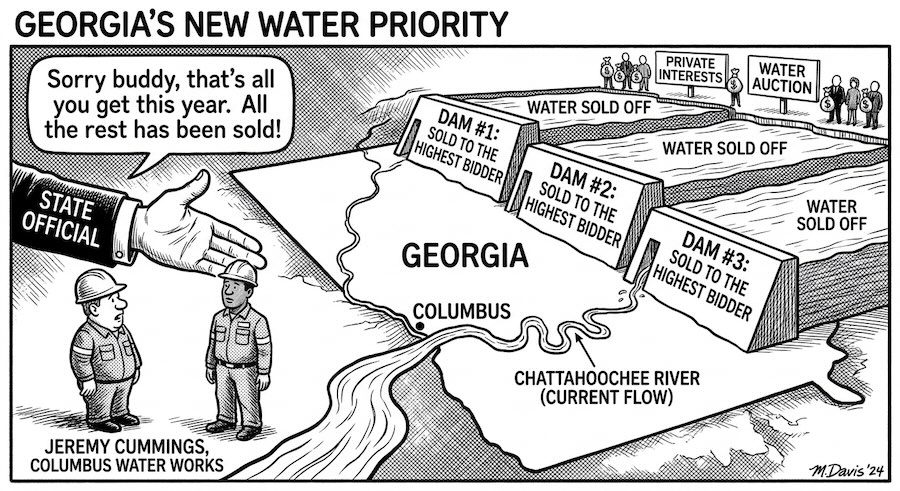
This article raises a different but related question. Even if Columbus Water Works’ capacity figures are accurate today, the Chattahoochee River is not Columbus’s private resource. It is shared with every community, farm, industry, and data center upstream. And what is happening upstream right now should concern anyone who assumes that today’s water availability is a reliable guide to tomorrow’s.
The Chattahoochee Is a Shared Resource
Columbus sits near the bottom of the Chattahoochee River basin. Everything that happens upstream — every withdrawal, every drought, every new industrial demand — affects how much water flows through the city.
This is not a new or theoretical concern. The state of Alabama sued the U.S. Army Corps of Engineers in 1990 to prevent Georgia from increasing water withdrawals from the river near Atlanta. Alabama’s argument was straightforward: when communities and industries upstream take more water out of the river, less is available for everyone downstream — including Columbus. That lawsuit dragged through the courts for more than thirty years. Georgia and Alabama only reached a settlement framework recently, built around legally guaranteed minimum water flows at Columbus and at the Alabama state line.
That settlement assumed a particular level of upstream water use. It did not anticipate what is now happening.
What Is Happening Upstream
Georgia now has at least 213 data centers statewide, and the pipeline of new projects is enormous. The strain these facilities are placing on the state’s rivers is beginning to show up in real, measurable ways — and the communities bearing the consequences draw from the same river basin that supplies Columbus.
The clearest example is Newton County, about 90 miles northeast of Columbus on the Yellow River, a Chattahoochee tributary. In 2018, Meta broke ground on a $750 million data center there. Since then, residents have reported dry taps, sediment buildup, brown water, and broken appliances. The director of the Newton County Water and Sewerage Authority, Mike Hopkins, described the situation plainly: that single data center now accounts for about 10 percent of the entire county’s daily water use. “What the data centers don’t understand,” Hopkins said, “is that they’re taking up the community wealth. We just don’t have the water.” A 2025 government report found Newton County is on track for a total water deficit by 2030. Water rates are projected to increase 33 percent within two years — compared to the typical annual increase of about 2 percent.
Upstream pressure on the Chattahoochee basin is not limited to Newton County. Project Sail, a proposed hyperscale data center in Coweta County situated directly on the Middle Chattahoochee River basin, has requested up to 6 million gallons of water per day alongside 900 megawatts of power. Coweta County residents have filed a legal appeal to stop it; the proposed site sits on land the state of Georgia has designated a “Most Significant Groundwater Recharge Area” — one of the highest environmental protection classifications in Georgia law, indicating land that is critical to replenishing underground water supplies.
The Butts County data center backed by Lt. Governor Burt Jones is projected to use more than 4.5 million gallons of water per day at full build — more than tripling that county’s entire current water usage. That project draws from the Ocmulgee River basin, which eventually flows into the same Apalachicola-Chattahoochee-Flint river system that Columbus depends on.
Fletcher Sams, executive director of the Altamaha Riverkeeper — an environmental organization that monitors river health in the region — has been tracking 25 data center projects in the Ocmulgee basin alone. Of the nine that have submitted state impact filings, he estimates they will collectively withdraw close to 10 million gallons per day, on top of all existing withdrawals. “I’m worried about us over-issuing withdrawal permits in the Ocmulgee basin for these data centers,” Sams said, “when there is no backup.”
The “Data Vacuum” Problem
Here is the structural problem at the heart of all of this: Georgia has no statewide system for tracking the cumulative water demand of its data center boom.
Think of it this way. Each county approves its own data center projects. Each utility signs its own water agreements. No agency is adding up what all of those projects together will draw from the state’s rivers. Nobody is maintaining a running total.
Kristen Stampfer, director of Coastal Communities United, a nonprofit working to preserve rural communities, described this in a public comment to the Georgia Department of Community Affairs as a “data vacuum.” Her letter was blunt: “These projects, collectively, represent an immense and largely unaccounted-for draw on Georgia’s finite resources.”
The Chattahoochee Riverkeeper’s water policy director Chris Manganiello has spent years trying to get basic numbers from data center operators in Georgia. What he has found instead is a wall of secrecy — a pattern of redacted public records and non-disclosure agreements that we will document in detail in the third article in this series. The consequence for planning is straightforward: Columbus Water Works cannot account for upstream competition it is not permitted to measure.
The Science of Downstream Impact
The science of how upstream water withdrawals affect downstream communities is not new or contested. The U.S. Geological Survey — the federal agency responsible for monitoring the nation’s water resources — has been documenting it in the Chattahoochee basin for decades.
The key concept is consumptive use. When a community or industry withdraws water from a river, not all of it is permanently removed. Wastewater treatment plants, for example, clean water and return most of it to the river. But some water is permanently consumed — it evaporates into the atmosphere, gets incorporated into industrial processes, or is transferred somewhere else entirely. That water does not come back. It is no longer available to anyone downstream.
The USGS stated this plainly in its Georgia Water Science Center documentation: “The cumulative consumptive use for a specific river reach is not only the water withdrawn from that reach, but the sum of all water consumed upstream from that location.” In plain terms: what matters to Columbus is not just what Columbus takes from the river — it is the sum total of everything consumed by every user above Columbus on the same river system.
Data center cooling, particularly in large facilities that use evaporative cooling towers, is a high-consumption use by design. The water that evaporates from those towers never returns to the river. Every gallon permanently consumed upstream of Columbus is a gallon that is not in the Chattahoochee when it reaches the city’s water intake.
Columbus Water Works’ 90-million-gallon-per-day treatment capacity is just that — a measure of how much water the city’s equipment can process. It is not a guarantee of how much water will actually be in the river. Under a future scenario where dozens of hyperscale data centers upstream are consuming millions of gallons per day — particularly during the drought conditions that are becoming routine across Georgia — the river’s flow at Columbus could be materially lower than the historical averages on which capacity planning was based.
Drought Is Not a Future Scenario
Water availability projections are typically based on average river flow conditions. But Georgia is not currently experiencing average conditions. Governor Brian Kemp declared a state of emergency earlier this year as severe wildfires burned across the southern part of the state. According to the U.S. Drought Monitor, nearly 63 percent of the country is currently experiencing drought conditions, with the Southeast among the hardest-hit regions.
Drought reduces river flow directly. When flow drops, every intake point on the system — including Columbus — has less to draw from. Every data center upstream that continues drawing during a drought is competing, in real time, with Columbus Water Works’ ability to keep its treatment plant supplied.
The Georgia-Alabama settlement that ended decades of water litigation was built around minimum flow guarantees at Columbus. Those guarantees were negotiated against a baseline of upstream demand that existed before the current data center boom. Whether those minimums hold as upstream demand grows dramatically — particularly during back-to-back drought years — is a legal and hydrological question that has not been publicly answered.
What This Means for Columbus
Columbus Water Works says it currently uses about 31 million gallons per day and can process up to 90 million — leaving roughly 59 million gallons per day of unused treatment capacity. Project Ruby, using the official 330,000-gallon-per-day figure, would consume about half a percent of that buffer. Manageable, if the demand figure is right and if the river keeps delivering.
But the relevant question is not just what Project Ruby alone uses. It is what the city’s actual water availability looks like in 2035, when Project Ruby is at full capacity, when Project Sail and the Butts County project and a dozen other upstream facilities are all drawing simultaneously from the same basin, and when Georgia may be in its third consecutive year of below-average rainfall.
Nobody has modeled that combined scenario for Columbus. No independent engineer has been asked to project Chattahoochee River flow under cumulative upstream data center demand. No state agency is tracking the total withdrawals comprehensively enough to make that projection possible.
Jeremy Cummings’ 90-million-gallon capacity figure reflects today’s river under today’s conditions. Columbus needs someone to tell it what tomorrow’s river looks like.
The Question the Council Should Ask
The People’s Overlay ordinance requires Columbus Water Works to issue a utility availability letter before any development permit is granted — a letter that must be based on completed system impact studies and must confirm that the required water service can actually be provided. It must identify the specific infrastructure upgrades needed to serve the full buildout of the 865-acre parcel, specify who is financially responsible for each upgrade, and set a timeline for delivery.
That letter should also address the upstream question directly. Columbus Water Works should be required to state, in writing, what its projected water availability is under a scenario of materially increased upstream consumptive demand — and whether that projection has been checked against Georgia EPD’s current and pending withdrawal permits for the Chattahoochee and its tributaries.
If Columbus Water Works cannot produce that analysis, any utility availability letter it issues reflects today’s snapshot, not a guarantee of future supply. And a community that approves a 40-year industrial facility based on today’s river conditions — without accounting for the upstream competition already in the permitting pipeline — is not making an informed decision.
It is making a hopeful one.
The third article in this series examines something more troubling than incomplete data: a documented pattern, across Georgia and the country, of data center water agreements being deliberately hidden from the public — and what that pattern means for Columbus.
Sources
Georgia-Alabama Chattahoochee water litigation and settlement framework: Hazen and Sawyer, “How Georgia and Alabama Ended a Decades-Long Water War,” January 2026; Associated Press reporting on settlement proposal.
Newton County water deficit, Meta Stanton Springs consumption figures, resident impacts, and 33% rate increase: New York Times, July 14, 2025, cited in Futurism, Yahoo News, NewsNation, and Grey Journal, May–June 2026.
Newton County Water and Sewerage Authority executive director Mike Hopkins quote: NewsNation, June 2026.
Project Sail, Coweta County, 6 million gallons per day, “Most Significant Groundwater Recharge Area” designation: CBS Atlanta, May 2026.
Butts County data center, 4.5 million gallons per day: Georgia Recorder, December 2025.
Fletcher Sams, Altamaha Riverkeeper, Ocmulgee basin aggregate projection and quote: Georgia Recorder, December 2025.
Kristen Stampfer “data vacuum” quote: Georgia Recorder, December 2025.
Chris Manganiello, Chattahoochee Riverkeeper, redacted agreements: WSB-TV Channel 2 Atlanta, November 2025.
Georgia data center count (213): Gizmodo / Politico, May 2026.
USGS cumulative consumptive use principle: USGS Georgia Water Science Center, Fact Sheet 2007-3034.
Columbus Water Works capacity figures and infrastructure acknowledgment: WTVM, February 16 and March 18, 2026.
National drought conditions (63% of U.S.): Barchart / Mordor Intelligence, June 2026.
Georgia drought and Kemp state of emergency: Fortune, May 2026.
People’s Overlay ordinance utility availability letter requirement: Community-Protective Technology Overlay District — Proposed Alternative Draft, Section (l), June 2026.
This Series: Water & Project Ruby
Preface: Can Columbus Trust the Information It Has Been Given?
Article 1: Where Does the 330,000 Gallon Number Come From?
Article 2: The River Doesn’t Stop at the County Line
